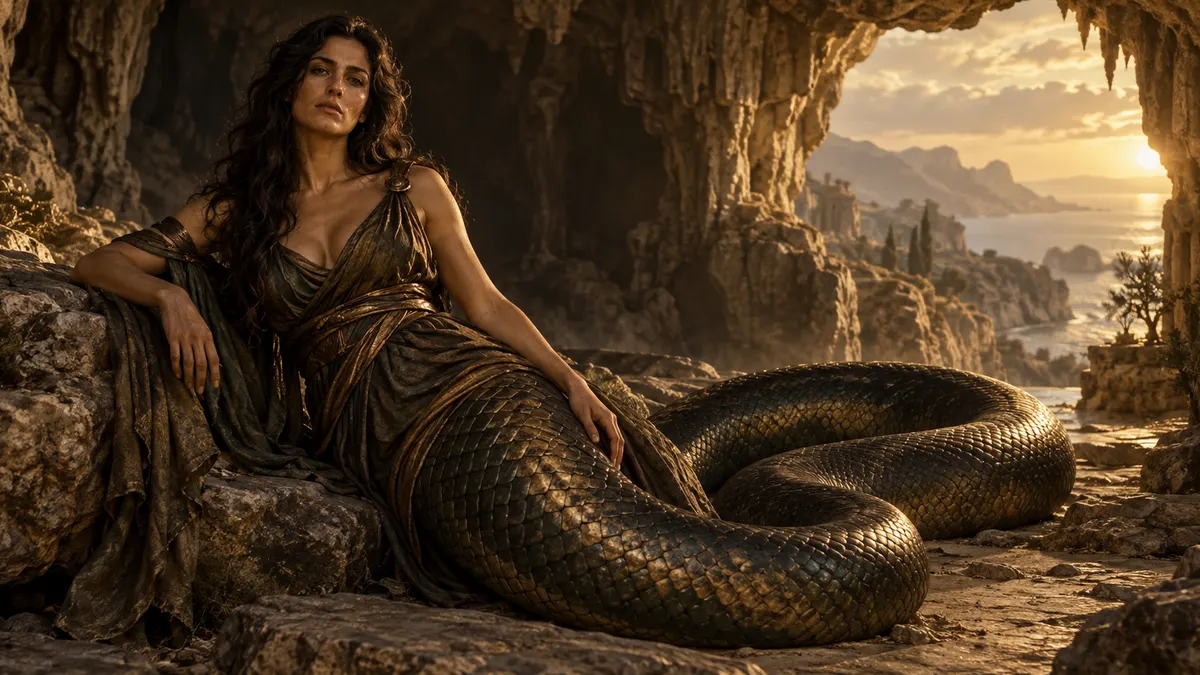
You may know me as the Mother of Monsters. It is a tidy title, easy to print beneath an illustration of a woman ending in coils. It saves everyone the trouble of asking whether I had a name, a home, or any opinion about the heroes who built their reputations over my family. I am Echidna. The poets remembered my face, my tail, my children, and different fates. They were less interested in letting me speak.
That is how monster stories usually work. Someone points toward the cave, lowers his voice, and describes what lives inside. The creature becomes scenery until a hero arrives. Then the killing receives a full account, while the life before it is reduced to teeth and parentage. Medusa would recognize the arrangement. A woman can be complicated for years, but once a famous man needs an episode, complexity becomes inconvenient.
The woman beneath the rock
Hesiod gives the oldest surviving extended portrait of me. He places me in a cave beneath a hollow rock, in Arima, far from gods and mortals. My upper half is a beautiful nymph: fair-cheeked, bright-eyed. Below, I am a huge speckled serpent. I am also deathless and ageless. Apparently eternity was available, though decent natural light was not.
My parentage in this passage is less simple than family trees on modern websites suggest. Hesiod's wording and the grammar around it are difficult. Interpretations connect me with Phorcys and Ceto, the old powers of the sea, while another reading involves Callirrhoe. The text does not hand us one clean, undisputed answer. I will not pretend otherwise merely because uncertainty makes a poor caption. Ancient genealogy often looks solid until you lean on a pronoun. The same appetite for tidy categories flattened the very different Titans into one tribe of monsters.
Typhon and the children everyone remembers badly
My partner was Typhon, the storming enemy of Zeus, a creature vast enough to make divine order feel temporary. I will spare you a sentimental courtship invented two thousand years after the fact. The old account gives us a union and children, not moonlit conversations. Together we had Orthrus, Cerberus, the Hydra of Lerna, and the Chimera. Each became famous chiefly for the person who confronted or controlled them.
Orthrus was the two-headed hound guarding the cattle of Geryon. Two heads sound excessive only to people who have never watched humans attempt theft. Cerberus had more heads and guarded the realm of the dead. He belonged at the boundary where return was forbidden, under the authority of Hades, whose kingdom was not the same thing as evil. Yet even Cerberus is often treated as a piece of heroic equipment: fetch dog, display dog, return dog.
Then there are the Sphinx and the Nemean Lion. Hesiod says Orthrus fathered them with a female indicated by an ambiguous "she." The grammar does not settle her identity securely. Depending on how the passage is read, their mother may be understood differently. I will not pull them into my direct brood just to make my title grander, nor deny their place in the wider family tangle. This is one of those cases where honesty must be allowed to look untidy.
Herakles and the family inventory
Herakles appears across my family history with remarkable regularity. His labours were a sentence imposed after horror and madness, not a cheerful tour of dangerous wildlife. His side of that story deserves its full weight. So does mine. A punishment laid upon one man became a sequence of disasters for beings who had no seat at the judgment.
He killed the Nemean Lion and wore its skin. If you want certainty about the lion's exact mother, return to that troublesome Hesiodic "she" and bring patience. He killed the Hydra, though the labour did not proceed as the clean single combat shown on souvenir pottery. When one head was cut, more grew; Iolaus helped burn the necks, and the immortal head was buried beneath a heavy rock. Even the victory required assistance and containment.
Herakles also killed Orthrus while taking Geryon's cattle. He did not capture my son. He did not lead him away for later release. Orthrus died at his post, and the cattle became another successful entry in the career of the man sent to acquire them. Guarding property is praised as loyalty until the thief has a divine father and an excellent publicist.
Cerberus survived. Herakles brought him up from the Underworld as another labour, displayed him, and returned him. That distinction matters. People casually say Herakles killed every monster in his path, as though accuracy might weaken the muscles. He did not kill Cerberus. The hound went back to his work, presumably with an even lower opinion of unauthorized visitors.
I can admit that Herakles suffered. I can also count what his suffering cost my household. Sympathy does not have to choose one door and bar the other. The usual telling follows him from task to task, so Hydra, Lion, Orthrus, and Cerberus appear as obstacles with different shapes. Seen from my cave, the list changes. It becomes news arriving in pieces: dead, dead, dead; dragged into daylight, then returned.
I do not ask you to imagine that every creature called mine was gentle. The sources do not offer that, and neither will I. The Hydra was lethal. Cerberus guarded a place mortals feared. Chimera devastated the country she haunted. A mother can know what her children are capable of without enjoying the ease with which their deaths become proof of someone else's greatness. Families manage such contradictions every day, usually with fewer clubs.
A different birth and a different death
A later mythographic account, preserved under the name Pseudo-Apollodorus, gives me another origin. There I am the daughter of Tartarus and Gaia. In that version I seize passers-by. Argus Panoptes, the many-eyed watchman, finds me asleep and kills me. It is brief, efficient, and wholly incompatible with Hesiod's deathless, ageless cave-dweller if you insist that both reports describe one continuous biography.
Do not insist. These are separate traditions. In Hesiod I remain immortal in Arima; in Pseudo-Apollodorus I die at the hands of Argus. One account leaves me outside ordinary age and death. The other gives a reason for a famous guardian to remove a danger. Myths were never a single official file kept in perfect order. They changed between poets, cities, compilers, and centuries. The contradiction is part of the record, not a crack to be plastered over.
The account of my attacks should remain inside that later version as well. It is tempting to carry the detail backward and furnish Hesiod's cave with a trail of missing travellers. Hesiod does not say that. He describes where I live, what I look like, and what strange status I possess. Pseudo-Apollodorus supplies the violence and Argus supplies the end. Combining them produces a smoother story and worse history.
The snake-woman who is not named Echidna
There is another woman people often hand my name. Herodotus tells a Pontic Greek and Scythian origin story set in Hylaea. Herakles arrives with the cattle of Geryon, loses his horses, and encounters a woman whose upper body is female and whose lower body is serpentine. She has taken the horses and makes their return conditional upon his sleeping with her. They have three sons: Agathyrsus, Gelonus, and Scythes.
Herodotus does not call this woman Echidna. The resemblance is obvious, especially to readers already carrying Hesiod's portrait, but resemblance is not a name tag. She belongs to a different tale, in a different landscape, explaining the ancestry of peoples associated with the region. Scythes succeeds in the test Herakles leaves for the sons and becomes the ancestor tied to the Scythian line.
So I will not claim those sons or that encounter as a missing chapter of my life. Later readers may identify the Hylaean snake-woman with me, and artists may borrow my familiar name because "unnamed local serpent woman" lacks market sparkle. Herodotus himself keeps her unnamed. That boundary deserves respect. Shared shape does not erase separate traditions.
What the title leaves out
"Mother of Monsters" has followed me because it is memorable and, in a narrow sense, earned. My children terrified people. Some guarded forbidden places or powerful possessions; some brought destruction. Yet the title encourages you to meet them at the instant a weapon is raised. It makes motherhood sound like the manufacture of targets.
I remember a family before it became a labour list. The poets did not preserve domestic scenes, and I will not forge them for warmth. What remains is enough: names joined by birth, a cave under rock, a partner who challenged Zeus, and a hero whose sentence crossed our bloodline again and again. The record is sparse, but sparse is not empty.
If you call me a monster, at least notice who taught you the word and who benefited from it. Notice the uncertain mother behind the Nemean Lion and Sphinx, the living Cerberus returned below, the two incompatible endings given to me, and the unnamed woman of Hylaea standing in her own tale. I have spent long enough as the convenient body at the beginning of someone else's victory. You may keep the title. Just read the small print.
Sources and traditions
- Hesiod, Theogony 295–332 — Echidna's form and dwelling, her deathless nature, Typhon and their offspring; also the ambiguous wording concerning the Sphinx and Nemean Lion.
- Pseudo-Apollodorus, Library 2.1.2 — the different parentage from Tartarus and Gaia, and her death at the hands of Argus Panoptes while she slept.
- Pseudo-Apollodorus, Library 2.5.1–2, 2.5.10, 2.5.12 — the Nemean Lion, Hydra, Orthrus, and Herakles' removal of Cerberus from the Underworld.
- Herodotus, Histories 4.8–10 — the separate tradition of the unnamed snake-woman of Hylaea, Herakles, and their three sons.
Editorial note: Echidna's first-person voice is literary framing. Conflicting genealogies and accounts of her death remain separate. Herodotus' snake-woman is not presented as a named Echidna because the ancient passage does not give her that name.