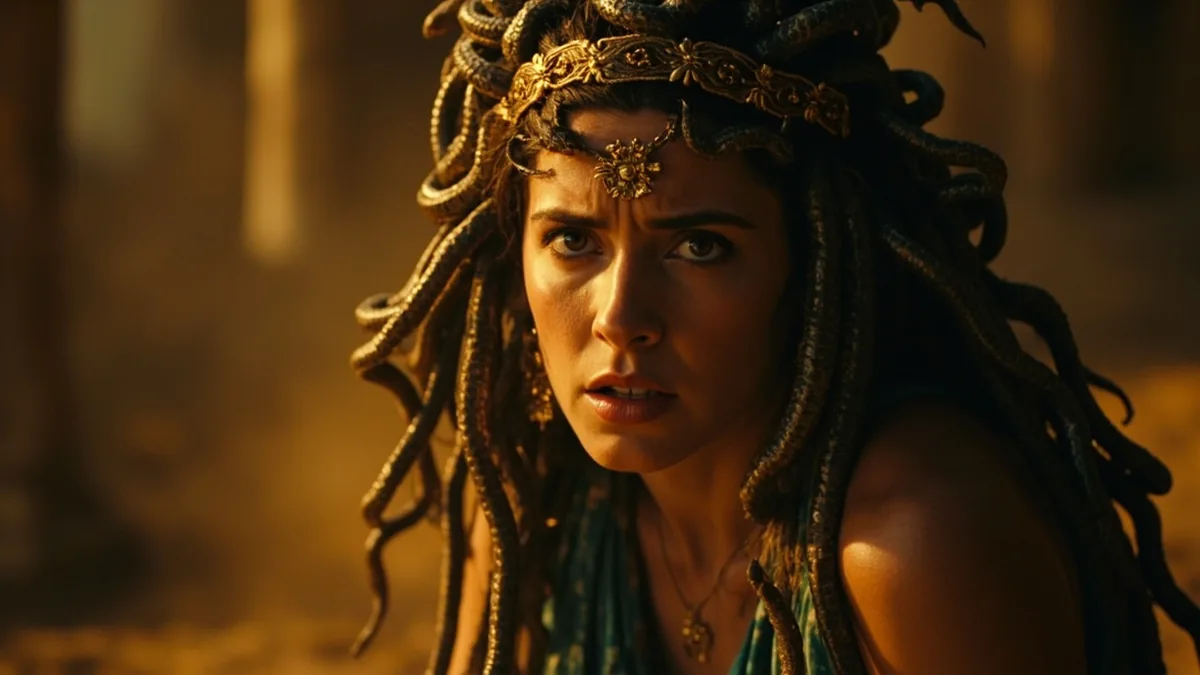
You know me from my ending. A severed head, hair of snakes, a gaze that turns flesh to stone. Nobody asks what came before Perseus' sword. So now I speak for myself.
I will not give you a single tidy tale, because there never was one. The ancient poets made me again and again, each for his own purpose. I was a monster to Hesiod, a victim to Ovid, a symbol to everyone who came after.
Hesiod's Gorgon
In the older Greek tradition I was not a beautiful girl. I was one of three Gorgons, a daughter of Phorcys and Ceto, two ancient sea deities. My sisters, Stheno and Euryale, were immortal. I alone was mortal — and in the end that decided everything.
Hesiod places us beyond Ocean, at the furthest edge of the world, near Night and the Hesperides. There, in a meadow of flowers, I lay with Poseidon. In this version there is no rape, no punishment. I am a creature of the cosmogonic world from the start, not a woman turned into a monster.
The version everyone remembers
The story you know — the beautiful priestess, Poseidon inside Athena's temple, the hair that became snakes — is not Greek. It is Roman. Ovid wrote it centuries later, in the Metamorphoses.
In that account I was a mortal woman famous for my hair. Poseidon violated me inside Athena's sanctuary. And Athena, instead of punishing the god, punished me: she turned my beauty into horror. It is a story about how violence is turned back against the victim — and perhaps that is why it still speaks to so many people today.
I will not tell you which version is "the true one." Hesiod and Ovid write about different worlds, with different questions. But the difference matters: it changes who is to blame.
The gaze that became a weapon
Whatever I was before, my gaze turned people to stone. Anyone who looked into my eyes became rock. I do not know whether that was a curse or a protection. I do know that people feared it so much they made it their own.
My face — the gorgoneion — was fixed onto shields, temples, the doors of houses, even the aegis of Athena herself. An apotropaic sign: a terrifying image meant to drive away evil. They killed me and then hung my face up like a charm. Think about that.
My death, my children
Perseus did not defeat me in battle. He came while I slept, his hand guided by Athena and a bronze shield so that he would not look at me directly. He beheaded me in my sleep. There was no duel. There was an execution.
And yet, from my neck, out of death itself, sprang my children: Pegasus, the winged horse, and Chrysaor. My children by Poseidon. Greek mythology does not try to make that image comfortable — life and death, monster and marvel, occupy the same point.
My head went on being a weapon even after my death. Perseus used it against his enemies and finally handed it to Athena. Even dead, I worked for those who had feared me.
Why I still look at you
In the centuries that followed, I became many things. A monster for those who wanted an enemy. A victim for those who saw the injustice. A symbol of power for the women who recognised themselves in my story.
These modern readings are yours, not Hesiod's. I will not pretend some ancient text shows me taking revenge or speaking of justice. It does not. My voice here is literary framing.
But the question remains, the same as always: when you kill someone you never met and hang her face up for protection, who is truly the monster? That is why I still look at you — even when you avoid my gaze.
Sources and traditions
- Hesiod, Theogony 270–294 — the Gorgons, Medusa's mortality, Poseidon, Pegasus, and Chrysaor.
- Ovid, Metamorphoses 4.770–803 — the Roman account of the beautiful Medusa, the violation, and Athena's punishment.
- Pseudo-Apollodorus, Library 2.4.1–3 — the beheading by Perseus and the later use of the head.
- Pindar, Pythian 12 — the lament of the Gorgons and the birth of the music of the flute.
- Pausanias, Description of Greece 2.21.5–6 — an ancient rationalising account of Medusa.
Editorial note: Medusa's first-person voice is literary framing. The differences between the Greek tradition (Hesiod) and the Roman one (Ovid) are stated explicitly, and modern symbolic readings are not presented as ancient.