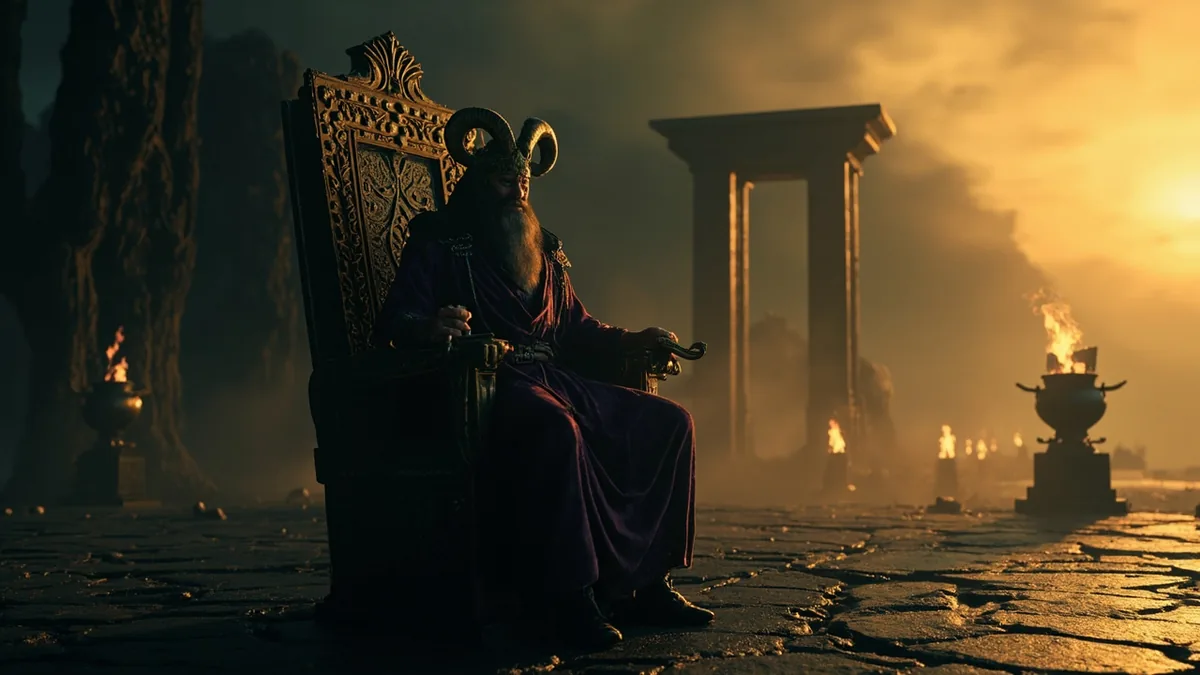
People feared my name so much that they stopped saying it. They called me Plouton, "the rich one," because every seed and every metal rises out of my earth. They called me "the hospitable one," to flatter me. Anything but Hades.
It does not bother me. I learned to live far from the light and the noise of Olympus. But since you now speak so freely about the gods, let me give my own version — from below, looking up.
The lot I did not choose
I never asked for the underworld. When we three brothers defeated the Titans, we divided power by drawing lots. In the Iliad, Poseidon himself says it plainly: Zeus received the sky, he the sea, and I the dark kingdom. Earth and Olympus were left common to all.
The lot decided, not my preference. Zeus was not "superior" because he won the sky; he was simply lucky in the draw and later turned that luck into a story about his supremacy. I took the portion nobody wanted — and I kept it in order.
My kingdom is not Hell
Let us clear up something the centuries confused. My underworld is not the Christian place of punishment. It is where all the dead arrive, good and bad alike. I am not an executioner. I am a keeper.
There is Tartarus for the few who defied the gods, and the Elysian Fields for the heroes. Between them, most souls live a faint, quiet existence. I torment no one for pleasure. I simply hold the door shut, so that whatever enters does not leave.
Persephone
I know what they say: that I seized her. In the Homeric Hymn to Demeter, the girl gathers flowers, the earth opens, and I take her onto my chariot. I will not dress it up. But it was not my plan alone — it was an agreement with Zeus, her father, who gave her to me as a wife without asking her mother.
Demeter froze the earth in her grief until Zeus relented. I had already given Persephone a pomegranate seed to eat; whoever tastes the food of the underworld belongs to it in part. So Persephone spends one portion of the year with me and the rest above. This is how the ancients explained the seasons: when she is gone, the earth mourns.
I do not claim I was a gentle suitor. I say only that in my telling Persephone became a queen, not a captive — and few gods honoured their wives as I did mine.
Cerberus and the few who crossed
At my gate stands Cerberus, the many-headed hound. He lets the dead in; he lets no one out. My rules are simple, and for that reason merciless.
Very few of the living ever crossed. Orpheus moved me with his song, and I gave him back Eurydice — on a condition he did not keep. Herakles wrestled Cerberus as a labour. Odysseus spoke with the dead at my threshold. None of them stayed. The underworld is not a place for visits.
Why you feared me
I am not evil. I am the inevitable. Ares chooses whom to strike, Zeus whom to favour. I choose no one — everyone comes, kings and beggars, each in turn. Perhaps that is why people hated me: I am the one god who cannot be bribed.
My voice here is literary framing; no ancient text makes me apologise. But the truth of the sources remains: I was not a tyrant of pain. I was the order at the end of every story. And when your turn comes, you will not find me cruel — only fair.
Sources and traditions
- Homer, Iliad 15.187–193 — the drawing of lots among the three brothers: sky, sea, underworld.
- Hesiod, Theogony 453–506, 767–774 — the birth of Cronus' children and the house of Hades.
- Homeric Hymn to Demeter — the abduction of Persephone, the pomegranate seed, and the seasons.
- Pseudo-Apollodorus, Library 1.2.1; 2.5.12 — the division of power and the labour of Cerberus.
- Pausanias, Description of Greece — cult and euphemisms (Plouton) for the god of the underworld.
Editorial note: Hades' first-person voice is literary framing. The ancient underworld is explicitly distinguished from the later idea of "Hell," and conflicting traditions are not flattened into one.