We are not one voice — but history turned us into one word
You hear “the Titans” and imagine an army of enormous monsters climbing Olympus. Excellent cinema. Poor ancient history.
In Hesiod’s Theogony, we are twelve children of Gaia and Uranus: Oceanus, Coeus, Crius, Hyperion, Iapetus, Cronus, Theia, Rhea, Themis, Mnemosyne, Phoebe and Tethys. Six male and six female powers, with different descendants, functions and destinies. We are not all described as gigantic humanoid monsters. Nor are we the Giants. In the same poem, the Giants are born from the blood of the mutilated Uranus falling upon Gaia. Typhon is not a Titan either; he has another birth and fights another war against Zeus.
The collective voice you are reading is a modern literary device. No ancient source records us issuing a joint statement — and, knowing this family, we would not have agreed on the title.
Before the war, there was an entire world
Cronus took Gaia’s sickle and overthrew Uranus. That is his act, not a collective biography for all twelve of us. After Uranus fell, our generation became part of the cosmic order that preceded Zeus’s final supremacy.
Hyperion and Theia produced Helios, Selene and Eos. Coeus and Phoebe produced Leto and Asteria; through Leto, Titan ancestry continued into Apollo and Artemis. Oceanus and Tethys were linked to rivers and Oceanids. Iapetus became father of Atlas, Menoetius, Prometheus and Epimetheus.
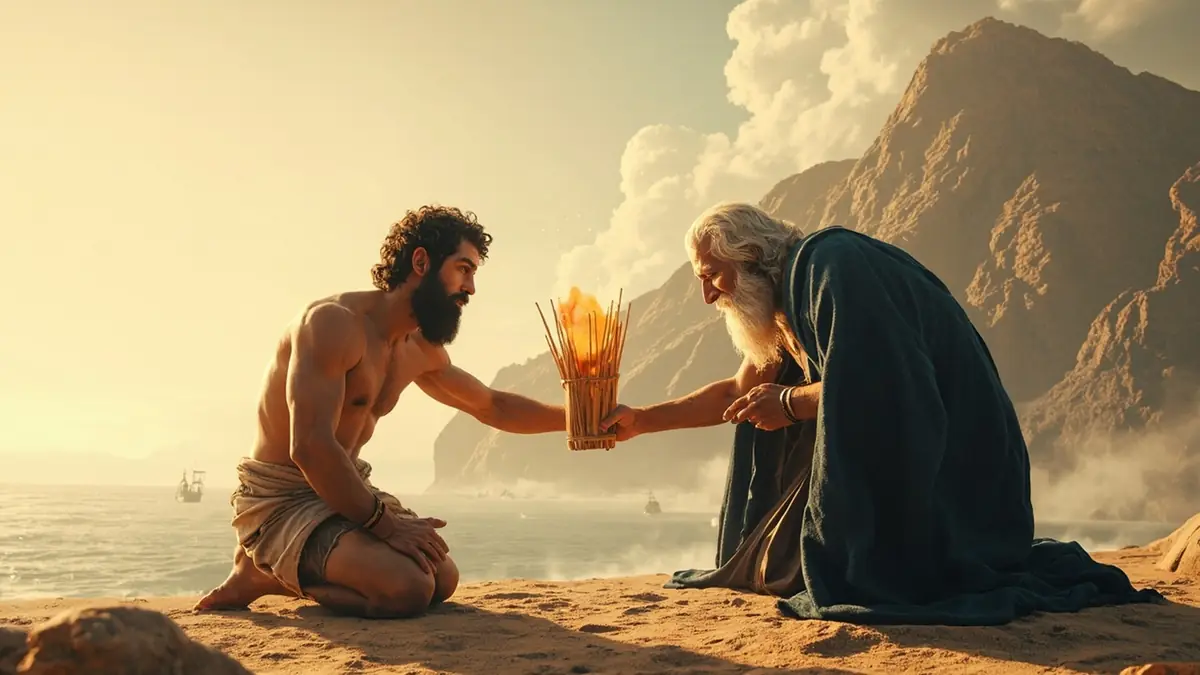
One endlessly repeated error needs correcting: Prometheus and Atlas are not members of the original twelve Titans. They are sons of Iapetus, the following generation. Modern usage often stretches “Titan” across the wider family, but the genealogical distinction matters.
We were not merely a dark draft that the Olympians later corrected. We were already embedded in the light, memory, law and waters of the world they would inherit.
The Titanomachy was not everyone against everyone
Hesiod says the conflict between gods and Titans lasted ten years. The Olympians fought from Olympus and their opponents from Mount Othrys. When Zeus released the Hundred-Handers and restored them with nectar and ambrosia, the balance shifted. They launched overwhelming volleys of stone, and the defeated Titans ended behind the gates of Tartarus.
Yet “the Titans fought Zeus” hides the fractures. Hesiod does not show every one of the original twelve fighting as a single military unit. Styx, a daughter of Oceanus, comes first with her children to support Zeus and receives lasting honors. Prometheus does not follow Atlas’s path. Themis and Mnemosyne enter the new order as partners of Zeus and mothers of powers essential to its operation.
Oceanus, moreover, does not appear in Hesiod charging into battle against Zeus. The absence of such a scene does not prove complete neutrality in every possible tradition. It proves that we are not entitled to invent a universal alliance simply because a collective label makes storytelling easier.
The victors did not erase our generation
Power changed hands after the war, but the cosmic substance of our family did not vanish. By Zeus, Themis bore the Horae and, in Hesiod’s account, the Moirai. Mnemosyne bore the nine Muses. Leto bore Apollo and Artemis. Helios continued to cross the sky. Eos opened the day. The rivers descended from Oceanus and Tethys continued to shape the inhabited world.
Even the punishments were not identical. In the Theogony, Atlas holds the sky at the edges of the earth. Prometheus is bound and tormented over his conflict with Zeus concerning sacrifice and fire. Cronus and the defeated opposition are associated with Tartarus. These are not parts of one uniform sentence for one uniform crime.
The new regime did not replace us like outdated furniture. It absorbed us, imprisoned us, married our daughters, used our powers and inherited our conflicts.
Cronus, the Golden Age and nostalgia’s trap
In Works and Days, Hesiod places the golden race of mortals in the age when Cronus ruled. Those humans lived without the toil and misery marking later life. The passage is not a detailed political manifesto for Titan government, and it does not acquit Cronus of swallowing his children.
Later reception, especially the Roman development of Saturn, gave the lost Golden Age even greater power. That history matters, but it does not permit every Greek and Roman tradition to be blended into one perfect pre-Olympian utopia.
We can belong both to the memory of a golden generation and to a family that reproduces violence from father to son. Myth can hold that contradiction. Simplified morality tales usually cannot.
We were not the villains before the real story began
The Olympians won, and much surviving poetry describes the cosmos through the stability of their rule. Victory does not make us a single species of villains, any more than it makes them morally infallible. The Titanomachy explains cosmic succession: older powers are confined, others are integrated, and a new government of gods establishes supremacy.
Do not confuse us with every enormous enemy Zeus ever faced. Do not place Prometheus among the original twelve. Do not imprison Themis, Mnemosyne and Oceanus inside a battle the sources do not narrate that way. And do not mistake victory for proof of virtue.
We are the layer beneath Olympus: not merely the defeated, but the ancestry, memory and cosmic forces the new age could never remove.
The gods changed thrones. They did not change their bloodline.
Sources and traditions
- Hesiod, Theogony 116–210 — Gaia, Uranus, the twelve Titans, the Giants and the overthrow of Uranus.
- Hesiod, Theogony 337–411 — descendants of Oceanus, Hyperion, Coeus and other Titan lineages.
- Hesiod, Theogony 507–616 — the children of Iapetus, Atlas, Prometheus and the conflict over fire.
- Hesiod, Theogony 617–735 — the ten-year Titanomachy, the Hundred-Handers and Tartarus.
- Hesiod, Theogony 886–929 — Themis, Mnemosyne and the integration of Titan lineages into Zeus’s order.
- Hesiod, Works and Days 109–126 — the golden race of mortals during the reign of Cronus.
- Homer, Iliad 14.200–210 — a different Homeric image of Oceanus and Tethys as generative figures among the gods.