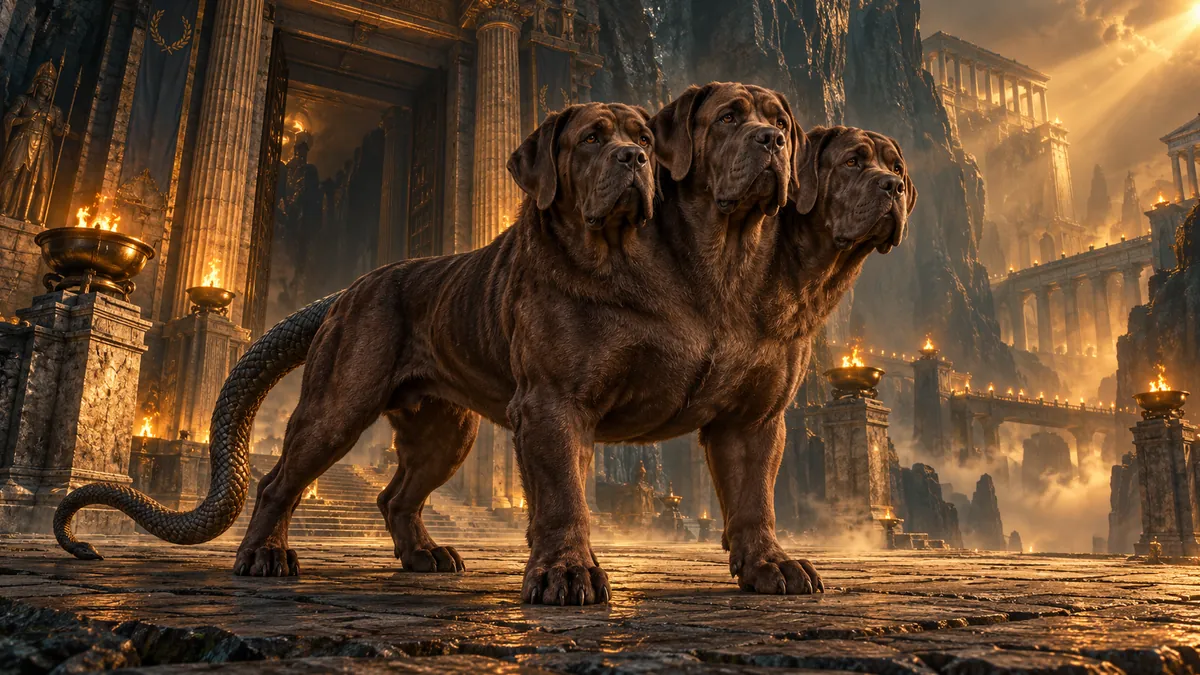
Everyone thinks I stood at the gates of Hades to keep people out. Wrong. You could come in. I would even welcome you, wagging my tail and my ears. The problem was never the way in. It was the way out.
I am Cerberus, the hound of Hades. Sit down — not too close. I will tell you what it is like to be the most loyal guard in the world and be remembered only as a monster.
My family
Hesiod, in the Theogony, says I was born to Typhon, the most terrible enemy Zeus ever faced, and to Echidna, the mother of monsters. My siblings were Orthus, the two-headed dog of Geryon, and the Lernaean Hydra. The Sphinx of Thebes, if you believe Hesiod, is my niece, a daughter of Orthus.
Did you notice something? Orthus was killed by Herakles. The Hydra was killed by Herakles. In our family, Herakles was something of a regular visitor. I was the only one who survived meeting him.
How many heads do I have?
It depends who you ask. Hesiod, the first to write about me, calls me "flesh-eating", "bronze-voiced" and… fifty-headed. Fifty heads. Pindar, the ancient commentators tell us, raised the number to a hundred, and the Roman poet Horace called me "the hundred-headed beast".
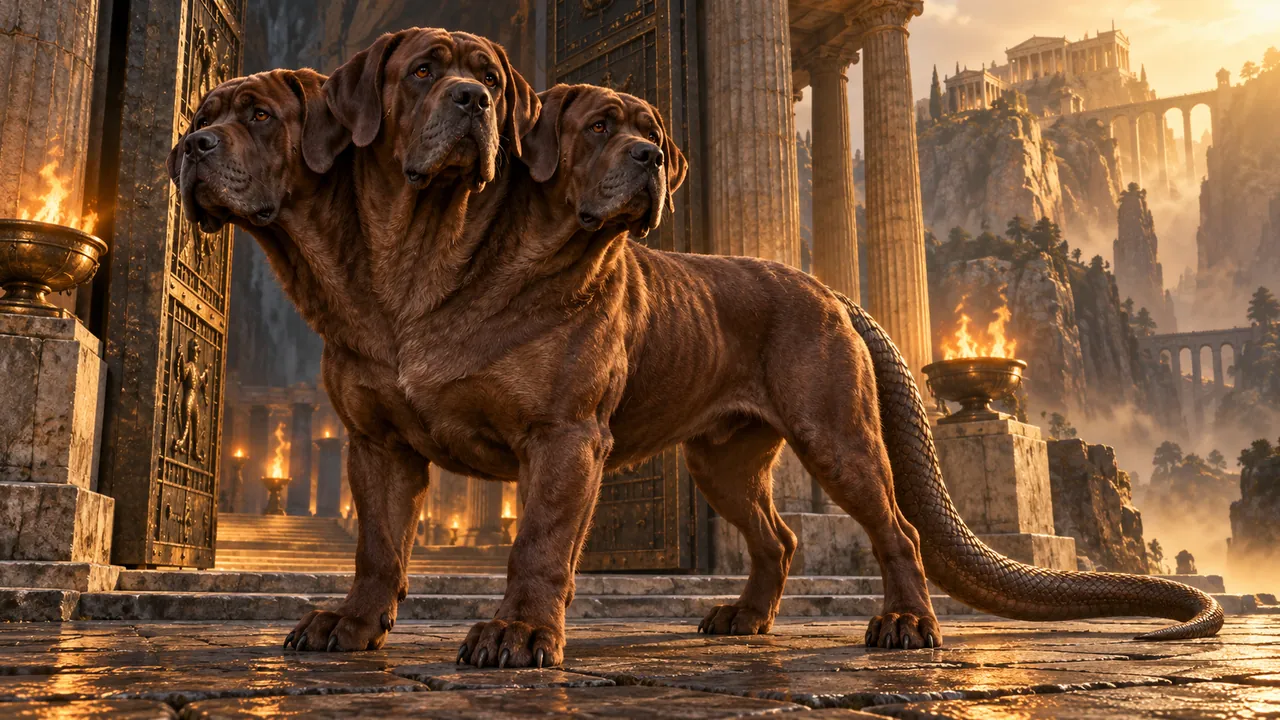
Then the sensible ones came along and cut me down to three. Pseudo-Apollodorus describes me like this: three dog heads, a serpent for a tail, and on my back the heads of all kinds of snakes. And the vase painters? On many Attic vases I have only two heads. I suppose the third one did not fit.
Remember this: the more someone feared death, the more heads they gave me. I did not change. Your fear did.
My job at the gates
Hesiod describes my job precisely: those who enter the house of Hades I greet in a friendly way. But anyone who tries to get out again, I catch. I was not a guard keeping the living out. I was the reason the dead stayed in. And the reason the living did not walk in to take them back.
 AI
AIPeople understood this and found ways to stay on my good side. In Aristophanes' Lysistrata there is a joke about the melitoutta, the honey cake. The ancient commentators explain that such a cake was placed with the dead so they could give it to me. Virgil writes that the Sibyl put me to sleep with a lump of dough soaked in honey and sleeping herbs so that Aeneas could pass. And Apuleius sends Psyche down with two barley cakes soaked in honeyed wine: one for the way in, one for the way back.
Yes, I know. The terrible guardian of the Underworld, and his weakness was sweets. We all have one.
Orpheus' lyre
Only once did someone get past without bringing sweets. It was when Orpheus came down to ask for Eurydice back. Virgil writes that, when he sang, I stood with my three mouths hanging open. I did not bark. I did not move. I simply listened.
I kept my silence and let him pass. I let him out again too. The fact that he turned to look behind him and lost her at the threshold was not my business. I did my job. He did not manage to do his.
The day they dragged me into the light
And then came Herakles, for his twelfth and final labour. Eurystheus ordered him to bring me up to the world above. It was the labour they thought impossible: no one came back from down there.
According to Pseudo-Apollodorus, Herakles prepared as if he were visiting a sanctuary. First he was initiated into the Eleusinian Mysteries, the mysteries of Demeter and Persephone. Then he went down through a cave at Taenarum, at the southern tip of the Peloponnese. Hades gave him permission to take me on one condition: that he master me without his weapons.
And so it went. Wearing his breastplate and the lion skin, he seized me by the throat and did not let go, however much my serpent tail bit him. He brought me up into the light at Troezen and took me to Eurystheus. On a 6th-century BC vase now in the Louvre, the painter shows Eurystheus hiding inside a storage jar out of sheer fear. That was the king giving the orders.
Ovid adds a detail I would rather forget. The light blinded me, I grew furious, and the foam from my mouth fell to the ground. From it grew aconite, the strongest poison the ancients knew. Even my anger became a weapon — for others.
And then? Then Herakles took me back. You always forget that part. The labour was not to kill me. It was to show me. When it was over, I returned to my post, where my job was.
My second career
The ancients were done with me. You were not. In the 14th century Dante, in the Inferno, set me to guard the third circle, where the gluttons are punished. I barked, clawed and howled so loudly that the souls wished they were deaf. And how did Virgil, Dante's guide, get past me? He bent down, filled his fists with earth and threw it into my three mouths. The same old trick: feed the dog and walk on.
In your own time you find me in films, video games and children's books. In the first "Harry Potter" there is a huge three-headed dog guarding a trapdoor that falls asleep as soon as it hears music. You do not need to be a scholar to see where that idea came from. Orpheus did it first, and with a lyre.
Notice something: in all these stories, no one beats me with a sword. They beat me with honey, with a song, with a piece of bread or with a pair of bare hands. Even the people who feared me knew I was not evil. I was simply immovable.
Was I a monster?
The traveller Pausanias visited the cave at Taenarum many centuries later. He writes that he found no road leading to the Underworld. He also passes on the explanation of Hecataeus of Miletus: a terrible snake lived there, and because anyone it bit died at once, it was called "the hound of Hades". So perhaps I was just a snake in a cave. Perhaps I was something much bigger.
I know one thing. I never hunted anyone in the world of the living. I did not burn cities, I did not devour flocks, I did not demand sacrifices. I stood at a door and guarded the border between two worlds. At my gate, kings and beggars were equal. What the heroes called a monster, I called loyalty.
If you ever find yourself in front of me, I will welcome you. Bring something sweet. And do not try to leave without asking.
Sources and traditions
- Hesiod, Theogony 306–312, 769–774 — his parents, the fifty heads, the welcome for those who enter and the punishment for those who try to leave.
- Pseudo-Apollodorus, Library 2.5.12 — the three heads, the serpent tail, the twelfth labour: initiation at Eleusis, descent at Taenarum, the fight without weapons, the ascent at Troezen and the return.
- Horace, Odes 2.13 — the "hundred-headed beast".
- Aristophanes, Lysistrata 601 (with the ancient scholia) — the honey cake of the dead.
- Virgil, Georgics 4.481–484 · Aeneid 6.417–425 — Orpheus and the Sibyl.
- Apuleius, Metamorphoses 6.19–20 — Psyche and the two cakes.
- Ovid, Metamorphoses 7.406–419 — the foam of Cerberus and aconite.
- Pausanias, Description of Greece 3.25.5–6, 2.31.2 — the cave at Taenarum, Hecataeus' explanation and Troezen.
- Dante, Inferno 6.13–33 — Cerberus in the circle of the gluttons.
- Caeretan hydria with Herakles, Cerberus and Eurystheus in the jar, c. 525 BC, Louvre Museum.
Editorial note: Cerberus' first-person voice is a literary frame. Where the sources disagree (on the number of heads and on where Herakles brought him up), the differences are stated openly.