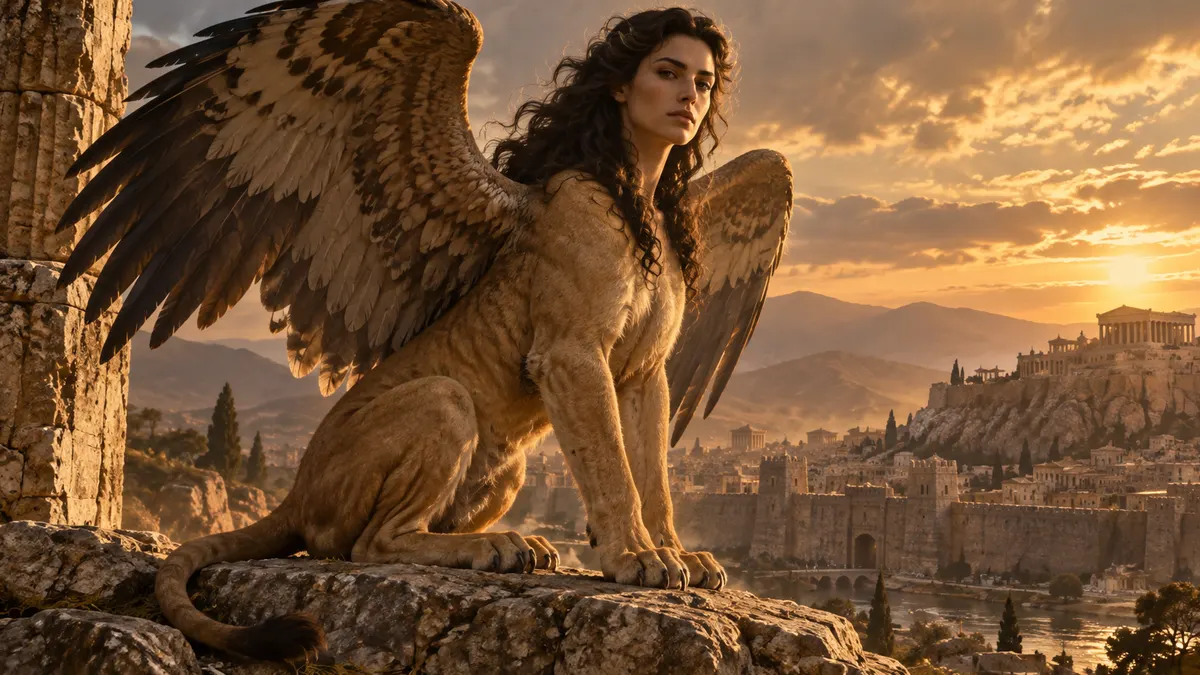
You have seen me on every Egyptian souvenir, lying in the sand with a pharaoh's face. That is not me. I have wings, I am a woman, and I never guarded a tomb in my life. I asked questions. And in a city that did not know how to answer, that was worse than any claw.
I am the Sphinx of Thebes. Hesiod calls me Phix. The Thebans called me far worse. Sit down. I will tell you how my job ended — and why the man who beat me lost more than I did.
The family I come from
My family did not have a good reputation. My grandmother — or my mother, depending on which poet you ask — was Echidna, half woman and half serpent, the one the Greeks called the mother of monsters. In the Theogony, Hesiod says that "she" bore me to Orthus, the two-headed hound of Geryon. Scholars still argue whether that "she" means the Chimaera or Echidna herself. Pseudo-Apollodorus keeps it simple: daughter of Echidna and Typhon.
Either way, the Nemean lion belongs to the same generation. Yes, the one that became the first labour of Herakles. In my family we did not keep birthday calendars. We kept count of which hero built a career on us.
A woman's face, a lion's body
Apollodorus describes me with a dry precision I never liked: the face of a woman, the chest, feet and tail of a lion, the wings of a bird. Vase painters were more generous. They gave me neat hair, a calm gaze and wings that curl upward like sickles.
At Delphi, around 570–560 BC, the people of Naxos raised an Ionic column more than ten metres tall and set me on top of it as an offering to Apollo. I am still there, in the Archaeological Museum of Delphi. You look up at me, which is exactly how I like it.
And to settle the Egypt question: the sphinxes of the Nile are usually male, wingless guardians of temples and kings. Greek travellers called them sphinxes too — Herodotus even calls them "androsphinxes", man-sphinxes. But the name is mine. I am the original Greek version. With wings. And with opinions.
Why I came to Thebes
I did not come on holiday. According to Apollodorus, Hera sent me. Later sources link my mission to an old crime of King Laius, but the ancient writers do not agree on every detail. I settled on Mount Phikion outside the city — they say the mountain took its name from me — and from there I watched the road.
I did not invent the riddle. I learned it from the Muses. Hold on to that detail, because it is the most important one in the story: the most dangerous weapon in Thebes was not my claws. It was a song with a question inside it. Sophocles calls me the "harsh singer" and the "Sphinx of riddling songs". He is not wrong.
The riddle
The Thebans would gather again and again, trying to find the answer. Every time they failed, I took one of them. Let us not go into details; let us just say my school had very strict grading. Among those lost, Apollodorus writes, was Haemon, the son of Creon.
The question was this: what is it that has one voice and becomes four-footed, two-footed and three-footed? The version you learned at school — "four legs in the morning, two at noon and three in the evening" — is a later, more poetic retelling. Apollodorus records it plainly, and a full version in hexameter verse survives in Athenaeus.
Notice how fair a question it was. I was not asking for a secret. The answer walked in front of their eyes every day. It simply never occurred to anyone to look at themselves.
The man who found the answer
Creon, who was ruling at the time, turned the problem into a public contest: whoever solved the riddle would win the throne and the hand of the late king's widow, Jocasta. Euripides has Jocasta herself remember it in the prologue of the Phoenician Women.
Then a stranger arrived from Corinth — or so he believed — with scarred feet and a name that gave them away: Oedipus, "swollen foot". He heard the question and answered without hesitation: "Man. As a baby he crawls on all fours. As an adult he walks on two. As an old man he leans on a stick."
Correct. According to Apollodorus, I threw myself from the acropolis of Thebes. The myths call it my own choice. I call it professional consistency: a riddle that has been solved is not asked twice.
The right question, the wrong man
Here is the part the heroes leave out. Oedipus won a throne and a wife. He did not know that the old stranger he had killed at a crossroads was his father, Laius. Nor that Jocasta was his mother. In Oedipus the King, Sophocles has him boast that he beat me with his own mind, without seers and without bird signs. A few scenes later, that same mind leads him to the truth that breaks him.
Think about it. The answer to my riddle was "man". Oedipus knew it for every human being — except himself. He knew how a baby crawls, but not who had left him as a baby on Mount Cithaeron. He knew that in the end a man needs a stick; he did not know that in his own old age he would walk blind, with his daughter as his guide.
I lost my life in a moment. He lost his slowly, piece by piece, inside the palace his right answer had given him. So tell me: which of us won?
Why I am still asking
The Greeks did not forget me. They painted me on vases, set me as a guardian on grave monuments, carved me on helmets and thrones. Centuries later, Ingres painted Oedipus explaining the riddle to me, as if I were the problem. Freud took Oedipus's name for an entire theory. Me, they kept for a single word: "enigma".
That is enough for me. Because my question was never about feet. It was about whether you know who you are. And no matter how many heroes walk the road to Thebes, nobody answers that one once and for all. And if you ever think you have, remember Medusa and me: the stories of "monsters" were always written by the ones who defeated us.
Sources and traditions
- Hesiod, Theogony 326–332 — Phix, "the ruin of the Cadmeans", and the Nemean lion, born of Orthus.
- Pseudo-Apollodorus, Library 3.5.8 — her parents, her form, Hera sending her, the riddle learned from the Muses, Haemon, Creon's proclamation, Oedipus's answer and her end.
- Sophocles, Oedipus the King 35–39, 130, 391–398 — the "harsh singer", the "Sphinx of riddling songs" and Oedipus's boast.
- Euripides, Phoenician Women (Jocasta's prologue) — the Sphinx at Thebes and Creon's proclamation.
- Athenaeus, Deipnosophists 10.456b — the verse form of the riddle.
- Herodotus, Histories 2.175 — the Egyptian "androsphinxes".
- The Naxian Sphinx, Archaeological Museum of Delphi (c. 570–560 BC).
Editorial note: the Sphinx's first-person voice is a literary frame. Where the sources disagree (on her parents, on why she came to Thebes and on the wording of the riddle), the differences are stated openly.