You have seen me in tattoos, in logos, in films where someone rises out of the flames while the music swells. A fine picture. Except that the first people who wrote about me never mentioned any fire. And the most famous of them all admitted he had never seen me.
I am the Phoenix. Sit down. I will tell you what the ancients really said about me — and what you added later, because a good story was never quite enough for you.
The historian who only saw me in a painting
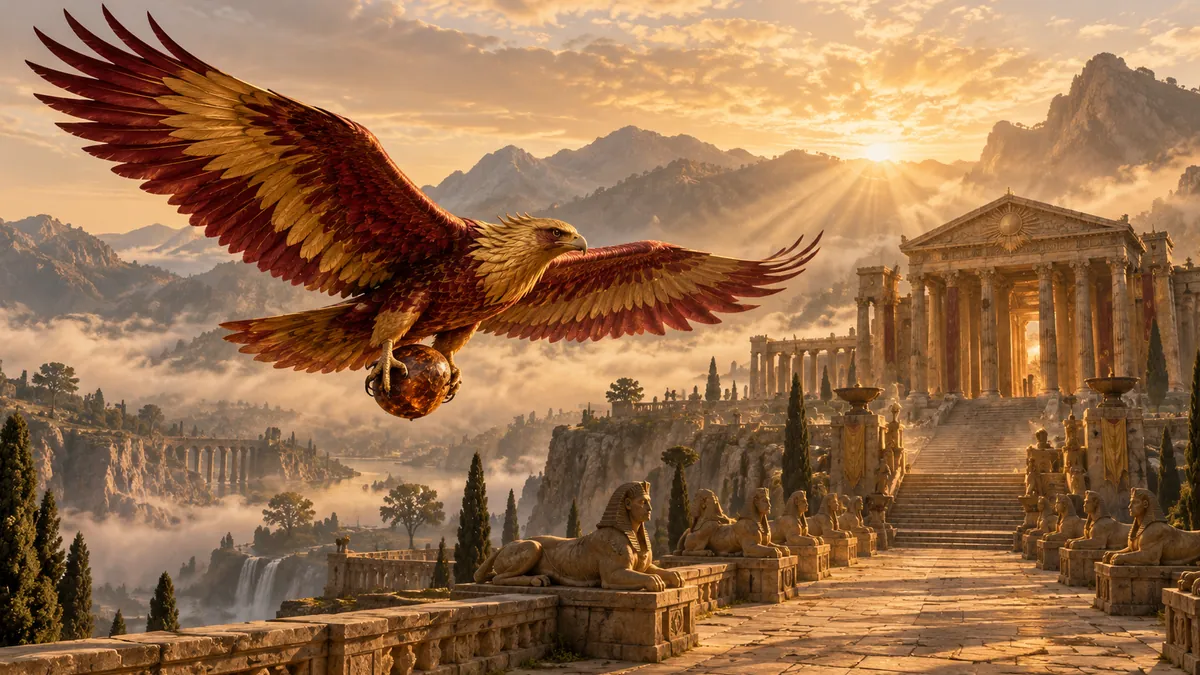
Herodotus travelled to Egypt in the 5th century BC and asked about everything. At Heliopolis, the city of the Sun, the priests told him about a sacred bird they called the phoenix. He writes honestly that he never saw me himself, only in paintings. From the paintings he understood that I look very much like an eagle in outline and size, and that my plumage is partly gold and partly red.
The priests told him I appear rarely: once every five hundred years, when my father dies. I like that Herodotus wrote down the whole story and then noted straight away that he did not believe it. He was my first sceptic. He was not the last.
The egg of myrrh
Listen to what I do, according to those priests. When my father dies, I set out from Arabia to bring him to the temple of the Sun. I do not carry him any old way. First I shape an egg of myrrh, as heavy as I can lift, and test whether I can fly with it. Then I hollow it out, place my father inside and seal the opening with fresh myrrh. With him inside, the egg weighs exactly what it weighed before. And so I fly all the way to Egypt.
 AI
AINotice something: in the oldest version of my story there is no fire and no ash. There is a son carrying his father. It is not a story about death. It is a story about duty. The first thing the new Phoenix does is honour the one who came before.
How long do I live?
The Greeks had their own answer, and it was a riddle. In a fragment attributed to Hesiod and preserved by Plutarch, there is a chain of lifetimes: the crow lives nine generations of men, the stag four crows, the raven three stags, and I live nine ravens. Do the maths: that is 972 human generations. And at the end of the chain, the Nymphs live ten times as long as I do. There is always someone older around to spoil your mood.
Others disagreed on the numbers. Tacitus writes that most people say five hundred years, but some say 1,461. The numbers changed. The rarity stayed.
The nest at the top of the palm
The Roman poet Ovid, in the Metamorphoses, gave me my most beautiful description. He says I eat neither seeds nor grass, but tears of frankincense and the juice of fragrant plants. When I have lived five hundred years, I build a nest in the branches of an oak or at the top of a palm, out of cassia, nard, cinnamon and yellow myrrh. There I lie down and end my life among the perfumes.
From my body a small bird is born that will live the same span of years. When it is strong enough, it lifts the nest — its own cradle and its father's tomb together — and carries it to the city of Hyperion, before the doors of the temple of the Sun.
And a note on my name. In ancient Greek the word phoinix means the date palm, the deep purple-red colour, and a man from Phoenicia. No one knows for certain which meaning came first. Either way, I nest in a palm, I am the colour of the palm's name, and I am called Phoenix. You cannot accuse me of inconsistency.
The fire came later
And the flames? They are not in Herodotus. They are not in Ovid. They enter my story in Roman times. The poet Martial, in the 1st century AD, writes about the nest being "renewed" by fire. In the 4th century, Lactantius devoted a whole poem to me and described my body burning and a new creature emerging from what was left. That is where the phrase you know was born: "rising from its own ashes".
The early Christians loved me at once. Around AD 96, Clement of Rome used my story in a letter as an example of resurrection. From then on you find me in mosaics, in manuscripts and in churches. A bird Herodotus did not believe in ended up as a symbol of hope for centuries.
The day they "brought" me to Rome
The Romans could not bear for me to be only a story. Tacitus records that in AD 34 a phoenix appeared in Egypt, and that the learned men of his day argued at length about whether I was real. Pliny the Elder goes a step further. He writes that in AD 47, under the emperor Claudius, a phoenix was brought to Rome and shown in public in the Forum. And he adds drily: no one doubted it was a fake.
Pliny also passes on a description: a golden sheen around the neck, a purple body, a blue tail with rose-coloured feathers. Very flattering. A pity he never saw me either.
Why Greece kept me
Many scholars today believe my story began with an Egyptian sacred bird of Heliopolis, the Bennu, which was linked to the sun and to renewal. But the Bennu was usually painted as a heron, not an eagle. The Greeks took a foreign idea and gave it a Greek name, a Greek shape and a Greek riddle. That is what they always did better than anyone.
And Greece never forgot me. When the Revolution of 1821 began, a phoenix rising from the flames was painted on the flag of Alexandros Ypsilantis' Sacred Band. And in 1828 Ioannis Kapodistrias gave my name to the first currency of the new Greek state: the phoenix, with the bird rising out of the fire. A state that had just been reborn from its own ashes chose me to say so.
What they did not tell you
Everyone remembers the part with the flames. No one remembers the part with the egg. And yet that was the most important part. Before I flew, I tested whether I could bear the weight. Then I carried those who came before me to the end of the road.
If you want to be like me, do not rush to burn. First learn what you can lift. And remember that even the rarest creature in the world lived only to keep a story alive. Just as the Sphinx lived for a question, I live for a promise: that something can end without being lost.
Sources and traditions
- Herodotus, Histories 2.73 — the phoenix of Heliopolis, seen by Herodotus only in paintings: eagle-like, gold and red plumage, every 500 years, the egg of myrrh.
- Hesiod, fr. 304 (Merkelbach–West), in Plutarch, On the Obsolescence of Oracles 415c — the chain of lifetimes: crow, stag, raven, phoenix, Nymphs.
- Ovid, Metamorphoses 15.391–407 — the nest of spices, the new phoenix and the nest carried to the city of Hyperion.
- Tacitus, Annals 6.28 — the sighting of AD 34 and the disagreement over 500 or 1,461 years.
- Pliny the Elder, Natural History 10.2 — Manilius' description and the "phoenix" displayed in Rome in AD 47.
- Martial, Epigrams 5.7 · Lactantius, On the Phoenix Bird — fire and rebirth from the ashes.
- 1 Clement 25 — the phoenix as a symbol of resurrection.
- The phoenix, first currency of the modern Greek state (1828–1832), under Ioannis Kapodistrias.
Editorial note: the Phoenix's first-person voice is a literary frame. Where the sources disagree (on its lifespan, on whether it burns and on its Egyptian origins), the differences are stated openly.