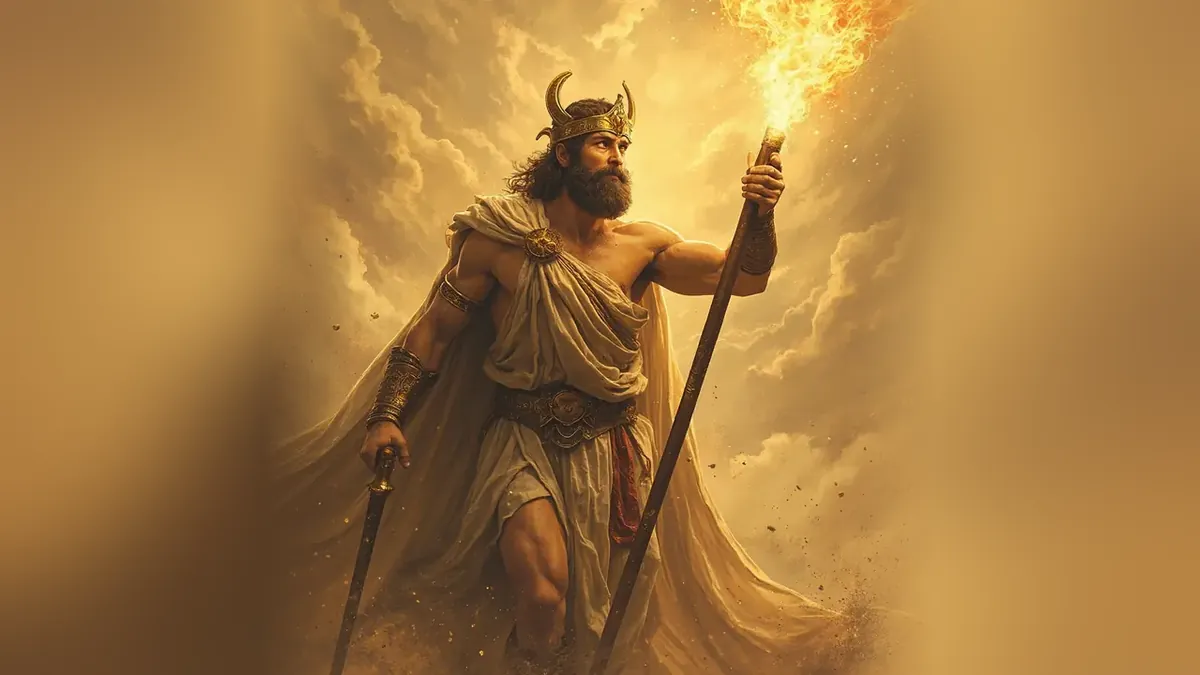
Whenever someone calls me “the sun god,” my son raises an eyebrow. Fairly. I am Hyperion. He is Helios. Kinship is not identity.
The voice is literary. The genealogies and episodes follow Hesiod, Homer and the Homeric Hymns without flattening them into one account.
Father of the light
Hesiod lists me among the twelve elder Titans. With Theia I fathered three children: Helios, Selene and Eos. Sun, moon and dawn are not exactly departmental responsibilities on a modern chart. They are divine figures with stories of their own.
The Homeric Hymn to Helios names his mother as Euryphaessa and his father as Hyperion. Euryphaessa is often associated with Theia, but the hymn itself uses another name. Ancient genealogies did not come from one editorial committee.
I do not drive across the sky
The daily journey belongs to Helios. The hymn shows him driving his chariot, radiant and tireless. In the Odyssey, he owns herds of cattle and sheep on Thrinacia. Odysseus’s companions slaughter them despite the warning, and Helios demands justice from Zeus. He even threatens to descend and shine among the dead if the crime goes unpunished.
He is not an impersonal disc. He sees, hears, grows angry and protects what belongs to him.
The god who sees
In the Homeric Hymn to Demeter, Demeter asks Helios who took Persephone. He saw the abduction and names Hades along with Zeus’s consent. In the Odyssey, he is the one who informs Hephaestus about Ares and Aphrodite. His light does more than warm the world. It exposes what happens beneath it.
What about Apollo?
In Hesiod and the Homeric texts used here, Helios and Apollo are separate figures. Helios is the child of Hyperion; Apollo is the child of Zeus and Leto. This does not by itself settle the whole history of their relationship. Modern scholarship treats early connections between Apollo and the physical sun as a matter of debate, so it is unsafe to describe the process as a simple, late “Roman identification.”
There is no single ancient story in which Apollo “steals” Helios’s chariot. In the texts narrated here, Helios is the daily charioteer and Apollo remains a separate god. Their later connections must be described by period and source, not as one simple replacement.
Hyperion does not simply mean Helios
My name can appear as a patronymic or poetic marker for Helios, which helped the confusion. Father and son share the language of height and radiance. We do not share one identity.
I belong to the generation before Olympus. My son continued crossing the sky after Zeus won. Dynasties changed. Sunrise kept its schedule.
The siblings of Helios
Selene and Eos are not supporting lamps around Helios. Eos has her own loves and tragedies, while Selene develops a separate tradition around Endymion. Hesiod places all three in one family to connect the cycle of the sky: dawn, daylight and night.
That does not mean every detail of their later stories already existed inside four lines of the Theogony. The genealogy provides a foundation. Later poets build different houses on it.
Seven herds and seven flocks
Circe warns Odysseus that seven herds of cattle and seven flocks of sheep belonging to Helios graze on Thrinacia, fifty animals in each. They are neither born nor die. The hungry crew violate the prohibition and slaughter them while Odysseus sleeps. The crime is not simply “eating the god’s steak.” They destroy a sacred, unchanging herd that carries the property and honour of Helios.
When Helios complains to Zeus, he does not ask permission to become important. He has enough cosmic weight to threaten a change in where his light shines. Zeus answers by destroying the offenders’ ship.
Hyperion in the war of the Titans
Later retellings and modern images often place me in the front line of the Titanomachy. Hesiod’s battle narrative gives me no personal duel, speech or weapon. I belong to the generation that loses power, but an individual military biography for Hyperion does not survive there.
Silence is tempting. Every gap invites a new storyteller to fill it. We can imagine a scene, provided we call it imagination rather than a missing chapter of Hesiod.
Phaethon came later
The famous story of Phaethon, the son who drives the solar chariot and loses control, is known especially through Ovid. It is a Roman poetic treatment of older material, not part of Hesiod’s brief genealogy or Homer’s story of the cattle. In those later accounts, Phaethon’s father is Helios, not Hyperion.
Confusing father, son and solar title can make the family tree shine so brightly that nobody reads it. Lower the glare and the lines become visible.
One sky, several traditions
The Greeks did not inherit one locked handbook of the gods. Hesiod, Homer, the hymns and later poets preserved different details. Careful reading does not force every name into one person or every version into a single biography. In Hesiod and the Homeric episodes examined here, Helios remains Hyperion’s son and the traveller across the sky. His wider relationship with Apollo belongs to a separate historical debate and cannot be reduced to “one god replaced the other.”
Sources and traditions
- Hesiod, Theogony 133–138, 371–374 — Hyperion among the Titans and his children with Theia.
- Homeric Hymn to Helios 1–19 — the genealogy and radiant journey of Helios.
- Homeric Hymn to Demeter 62–87 — Helios reveals the abduction of Persephone.
- Homer, Odyssey 8.266–271 — Helios informs Hephaestus; 12.127–141, 260–419 — the herds and anger of Helios.
- Ovid, Metamorphoses 1.747–2.400 — the extended Roman narrative of Phaethon.
- Tomislav Bilić, “Early Identifications of Apollo with the Physical Sun in Ancient Greece,” Mnemosyne 74.5 (2021), 709–736 — the scholarly debate over early links between Apollo and the physical sun.