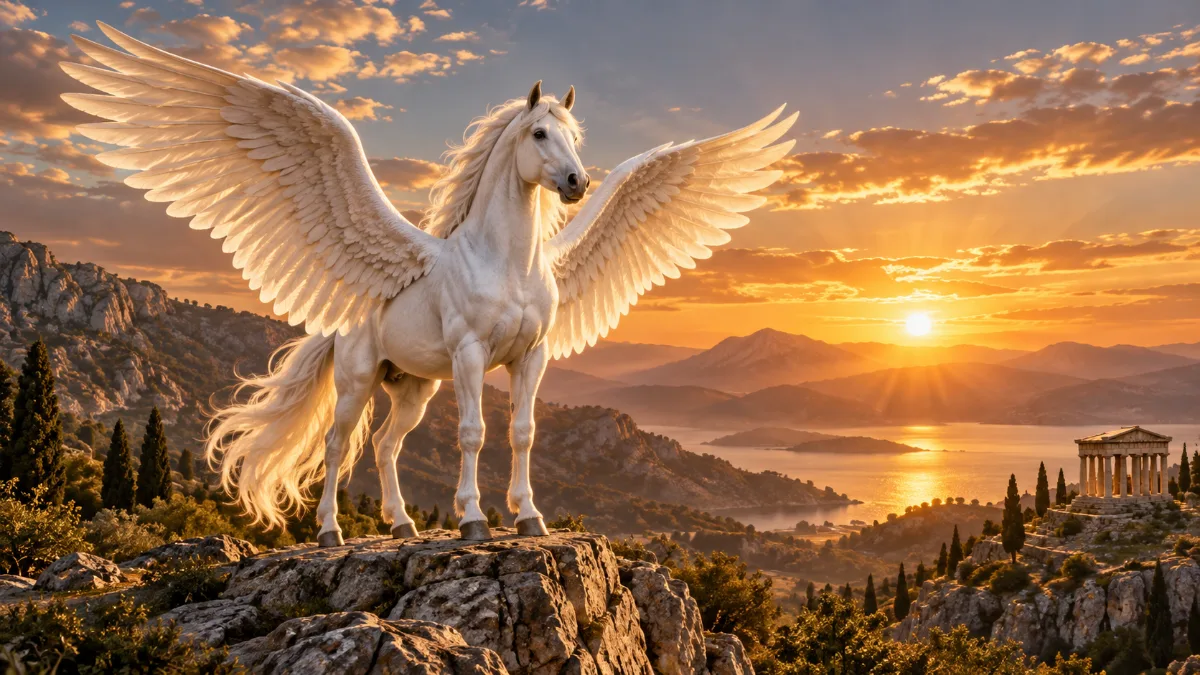
When you see wings, you think freedom. When a hero sees wings, he thinks transport. I am Pegasus, and I would like to point out that carrying somebody else was never my entire story. Before I became a warrior's companion, I was Medusa's son. After the battles, my life continued.
Springs, Muses, thunderbolts, stars: quite a journey for someone usually introduced as “Bellerophon's winged horse.” Come a little closer. There is room beneath these wings for a story, provided nobody arrives expecting a ride.
My mother's name
My mother is Medusa. In Hesiod's Theogony, she is the mortal Gorgon, and Poseidon is my father. When Perseus cut off her head, Chrysaor and I sprang forth together. Ovid explicitly says we were born from her blood. We need no closer description to understand the strange beginning: our lives opened where hers ended.
Hesiod explains my brother's name through the golden sword he carried. Mine he connects with the springs of Ocean, near my birthplace. That is the poet's explanation of my name. It does not mean every later story about me and a spring was already part of his account.
One other point: in Pseudo-Apollodorus, Perseus has winged sandals. You need not put me underneath every airborne hero. His mission includes my birth; my famous rider is someone else. Our family connections are complicated enough without swapping passengers.
A hoof on Helicon
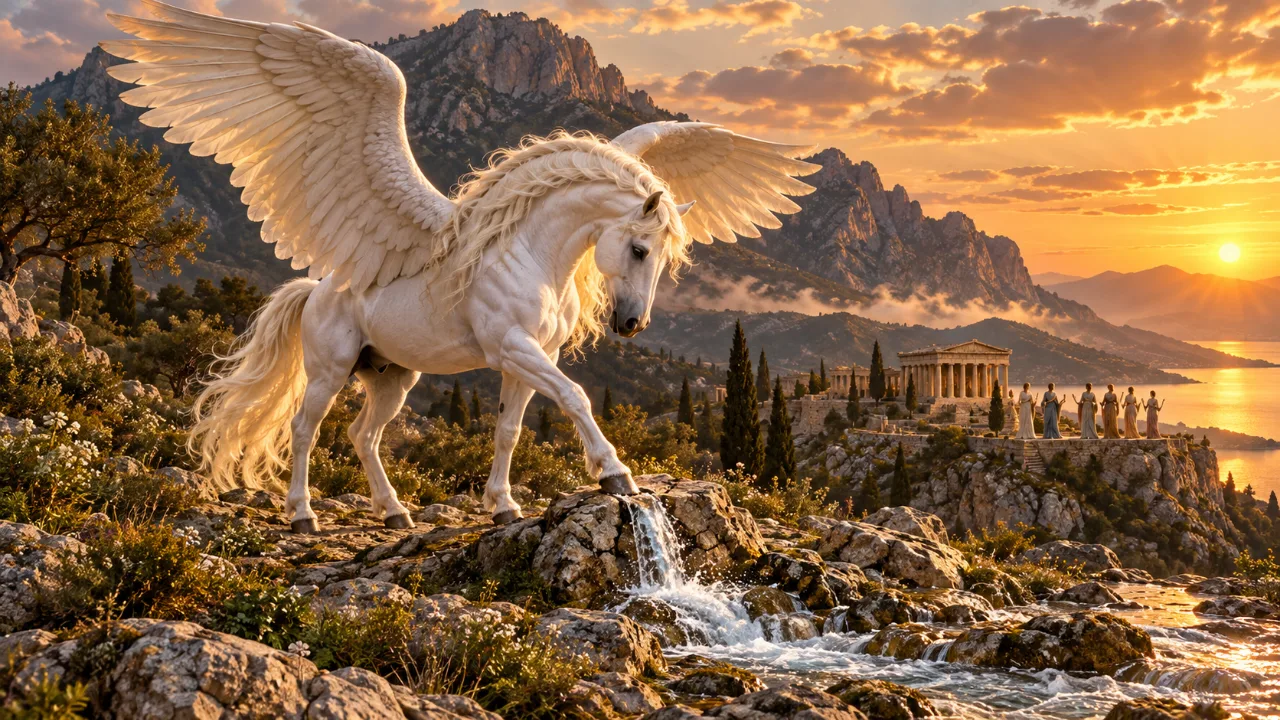
Leave the weapons aside and listen to water. On Helicon, the mountain of the Muses, my hoof struck rock and Hippocrene, the Horse's Spring, burst forth. Pausanias records the tradition and locates the spring uphill from the grove. One movement of my foot acquired a longer literary life than many royal proclamations.
In Ovid's Metamorphoses, Athena visits the Muses because she wants to see the new spring. Urania confirms that I made it and shows her the water. Here is a specific ancient connection between Pegasus and the Muses. If my wings suggest inspiration to you, enjoy the thought; that interpretation need not pretend to be another ancient event.
 AI
The golden bridle
In Pindar's thirteenth Olympian Ode, Bellerophon struggles to tame me beside Peirene at Corinth. Peirene is not Hippocrene. Even a winged horse may stop at more than one watering place without somebody redrawing the map.
Following the seer Polyidus' advice, the hero sleeps at Athena's altar. She appears in a dream with a bridle bearing golden fittings. When he wakes, the gift is beside him. He follows the instructions concerning sacrifice to Poseidon and an altar for Athena, then finally slips the bridle around my jaws.
The traditions differ. In the Hesiodic Catalogue of Women, Poseidon gives me to Bellerophon, who is also his son in that account. This is a separate work, not the birth passage in Theogony 276–286. Pausanias, meanwhile, says Athena herself tamed and bridled me before handing me over. Poseidon's gift, Athena's assistance, Athena doing the taming: related accounts, but not one identical scene.
The Chimera and the next assignments
Bellerophon needed more than a stylish way to travel. Proetus sent him to Lycia carrying a message that asked for his death. Iobates assigned him to confront the Chimera, expecting the creature to finish him. The heroic opportunity was a death sentence with flattering packaging.
The Chimera combined lion, goat and serpent, and breathed fire. In the Library, my rider rises into the air on my back and shoots her from above. I supply the height; he supplies the aim. Let us acknowledge the partnership. Without the wings, his firing position would have been considerably less convenient.
Next came the Solymi and the Amazons, followed by an ambush laid by chosen Lycian warriors. Iobates took some time to accept that his “do not come back” assignments kept failing. Eventually he recognised the hero's prowess and gave him his daughter. Pindar explicitly associates me with the fighting against the Solymi and Amazons as well as the Chimera.
A pause for honesty: Iliad 6.155–205 tells of Bellerophon's trials and eventual isolation, but never mentions me. I cannot insert my wings into Homer because they improve the picture. One poet's silence does not invalidate another's account. It does mean we should resist borrowing details from one and quietly putting them into the other's mouth.
The sky is not an invitation
Winning an impossible battle does not make every subsequent desire wise. In his seventh Isthmian Ode, Pindar says Bellerophon wanted to reach the heavenly dwellings and the company of Zeus. I threw him. That is where our ascent together ended.
I will not invent our final conversation, or present a gadfly sent by Zeus as a detail in that passage. It is not there. Nor does Homer explain Bellerophon's lonely wandering as the consequence of falling from my back. The accounts can speak to one another without being silently stitched into a single narrative.
Within this imagined voice, my own thought is simple: being able to climb does not make your destination yours. The bridle could direct my head. It could not restrain the desires of the man holding it. There is room to admire his courage without treating his final ambition as another victory waiting to happen.
The stables of Zeus
My story continues on Olympus. Pindar places me in Zeus' ancient stables. Hesiod already has me living in the god's house and carrying his thunder and lightning. In the passage about my birth, he moves straight to my heavenly home, without inserting the rider's fall between the two.
That matters. My service to Zeus is not presented there as a reward for throwing Bellerophon. It is my place among the gods. I carry the thunderbolts; I do not manufacture them. You will agree, though, that transporting them calls for rather more care than delivering a sack of barley.
There is something satisfying about still having a role after the hero's adventure ends. A reader may close the story when the rider disappears, but the horse has somewhere to go. Hesiod and Pindar both leave me with a heavenly home, even though they approach it through different poems.
A horse among the stars
In the Phaenomena, Aratus describes the heavenly Horse with only half a body and connects it with the animal that opened Hippocrene. The spring remains on earth while the Horse circles in Zeus' sky. Here is the ancient poetic connection to the constellation you know as Pegasus, rather than a detailed scene of transformation into stars.
Remember me that way: a hoof beside running water, wings opening towards the sky. Medusa's child, a hero's companion, a servant of Zeus. The roles change; my mother does not disappear from my story. And if you look up tonight, put the bridle down for a moment.
Sources and traditions
- Hesiod, Theogony 276–286 — parentage, birth, name and service to Zeus.
- Hesiodic Catalogue of Women, Bellerophon fragment — Poseidon gives Pegasus to the hero; fragment numbering varies by edition.
- Pindar, Olympian Ode 13 — Athena, the bridle, Poseidon, battles and Zeus’ stables.
- Pindar, Isthmian Ode 7.44–48 — attempted ascent to heaven and fall; no gadfly is mentioned.
- Homer, Iliad 6.155–205 — Bellerophon and his trials, without mentioning Pegasus.
- Pseudo-Apollodorus, Library 2.3.1–2, 2.4.2 — missions, Chimera, birth and Perseus’ winged sandals.
- Pausanias, Description of Greece 2.4.1 — Athena tames and delivers Pegasus.
- Pausanias, Description of Greece 9.31.3 — Hippocrene on Helicon.
- Ovid, Metamorphoses 4.785–786 — birth from Medusa’s blood.
- Ovid, Metamorphoses 5.256–264 — Athena, the Muses and the spring.
- Aratus, Phaenomena 205–224 — the heavenly Horse and Hippocrene.
Editorial note: Pegasus’ first-person voice, thoughts and humour are a literary frame. Different accounts of his taming, the rider’s fall and his heavenly home are distinguished; the order of these sections is not a single ancient chronology.