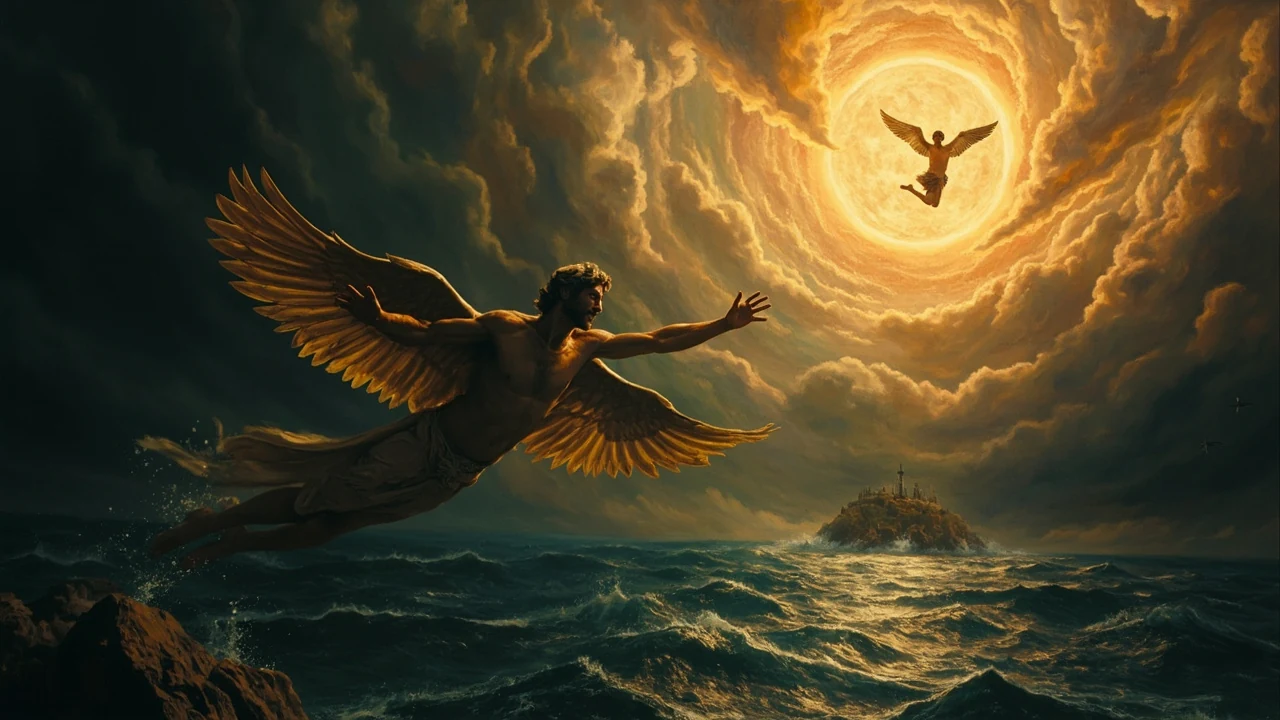
I built a road through the sky to save my son. The only thing I could not construct was a way to bring him back.
My name is Daedalus. People remember it when they speak of genius, the Labyrinth, and wings made from feathers and wax. I remember it whenever I hear waves. Fame has this defect: it preserves the marvel and leaves its maker alone with the cost.
One honest warning before we begin. There is no single ancient version of our story. Pseudo-Apollodorus, Diodorus, Ovid, Hyginus, and Pausanias agree that Icarus never reached the opposite shore alive, but they disagree even about whether we flew. I will tell you the famous story of the wings—and then the version in which “flight” was simply a very fast ship.
1. Before Icarus, another child fell
I was born in Athens and learned to make wood appear alive, stone seem to move, and metal obey. Centuries later, Pausanias still saw wooden cult images that people attributed to me. Craftsmen made me their ancestor. They might have chosen a better moral example.
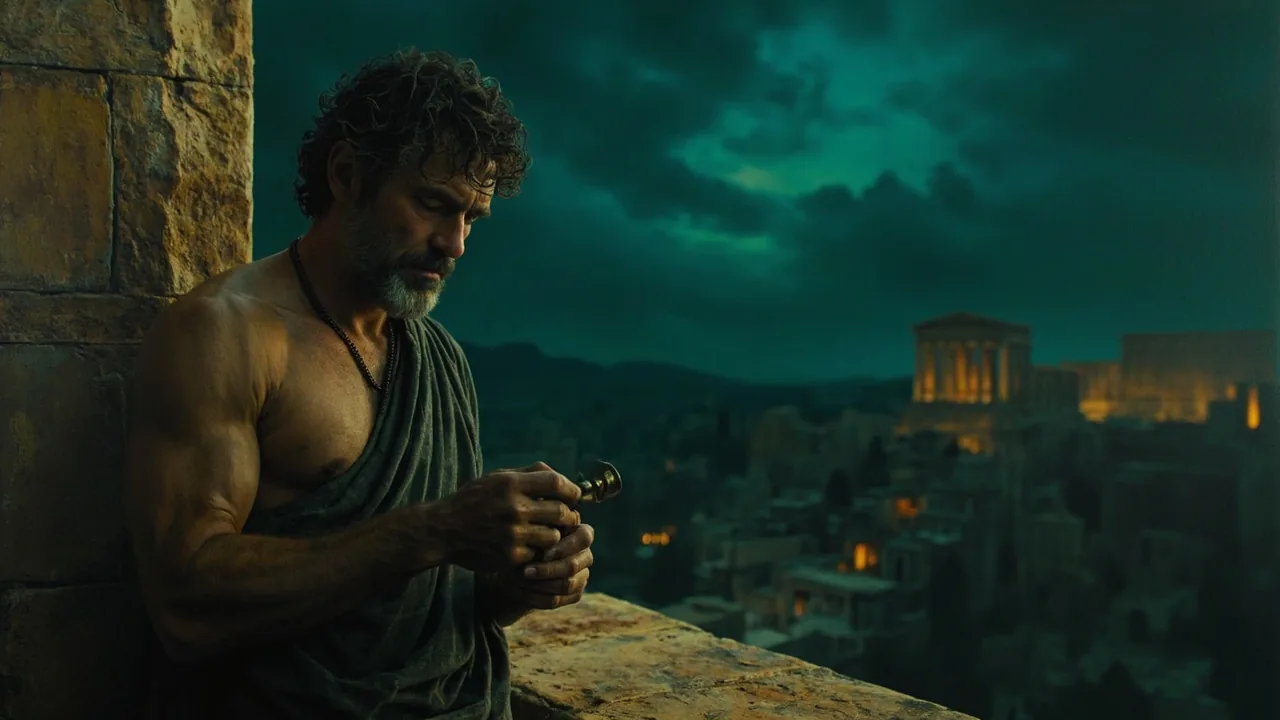
My nephew and pupil appears under several names—Talos, Perdix, or Calos. He was young and frighteningly gifted. In Ovid’s later telling, he copied the spine of a fish and invented the saw; he joined two metal arms and created the compass. I, the celebrated inventor, saw his talent and felt fear instead of pride.
The traditions say that I threw him from the Athenian Acropolis. In Pseudo-Apollodorus I was convicted before the Areopagus and fled into exile. In Ovid, Athena saved the boy by turning him into a partridge, a bird that flies low because it remembers the fall. I am not asking for forgiveness. I am telling you that the first great fall in my life was not my son’s—and that jealousy had already proved genius without character is merely a more efficient danger.
 AI
AI2. Crete and the king who wanted solutions without consequences
I reached Crete and the court of Minos. He had a fleet, a kingdom, and the absolute conviction that every problem could be solved by finding a sufficiently clever craftsman and never asking whether that craftsman wished to participate.
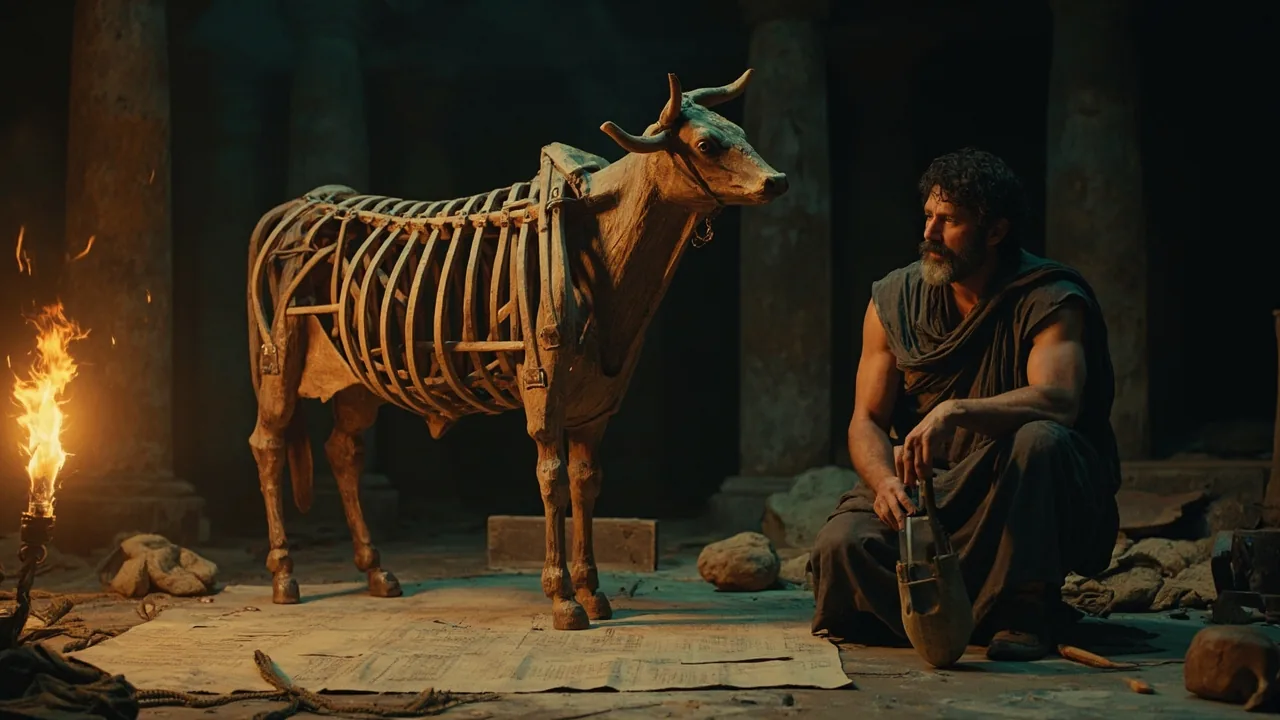
The sources place me beside some of the palace’s darkest secrets. When Pasiphaë desired Poseidon’s bull, I built a hollow wooden cow covered with hide. From her union came the Minotaur. If there was ever a moment for a professional to say, “This commission exceeds the ethical limits of my workshop,” that was it.
Diodorus and Hyginus clearly assign the device to me. The myth does not say that I created the monster, but it makes me an accomplice in the mechanism that brought it into the world. The distinction is technically accurate and morally much less comforting.
 AI
AI3. I built the Labyrinth—and the Labyrinth built my prison
Minos asked for a structure no one could escape. I made the Labyrinth: passages folding back into themselves, turns that erased the memory of the previous turn, spaces in which even the designer had to think twice.
The Minotaur was confined inside. Young men and women from Athens followed as a tribute of blood. Ancient accounts vary over the schedule and details of that tribute, but the central fact remains: my masterpiece became a machine for death.
People like to say that a tool is neutral. They usually say it when they do not want to look at what the tool does after the invoice has been paid. I knew every corridor. For too long, I pretended not to hear the screams.
4. Ariadne, the thread, and the first crack in Minos’s design
When Theseus came to Crete to kill the Minotaur, Ariadne chose to help him. In Pseudo-Apollodorus’ Epitome, she asked me for the method of escape and, at my suggestion, gave Theseus the thread. The thread did not defeat the Labyrinth; it gave the Labyrinth a memory.
Theseus tied one end at the entrance, entered, killed the Minotaur, and followed the line back out. Minos did not admire the elegance of the solution. Kings love intelligence until the moment it works against them.
The sources differ about the precise reason for my punishment. Pseudo-Apollodorus connects my imprisonment with the escape of Theseus and Ariadne. Hyginus connects it with the discovery of the wooden-cow affair. Either way, the man who designed the prison found himself inside it with his son.
5. Icarus was not a symbol. He was my son
Icarus was not born to become a warning sign. Pseudo-Apollodorus names his mother as Naucrate, a slave of Minos; beyond that, the ancient sources tell us remarkably little about his life. They do not give us a secure age. Art makes him a child in one century and a young man in another.
I remember someone raised among tools. He knew the sound of a properly stretched thread and the smell of warm wax. He had watched his father solve problems for kings and probably believed that his father could solve this one too.
That is a parent’s most dangerous power: for a while, a child believes you cannot be wrong. Instead of admitting that I was afraid, I showed him a pair of wings.
6. Since Minos held land and sea, I took the sky
In Ovid’s famous account, I said that Minos might block land and sea, but he did not rule the heavens. It is a magnificent line. It is also exactly the kind of line an inventor delivers just before believing that his intelligence has defeated nature.
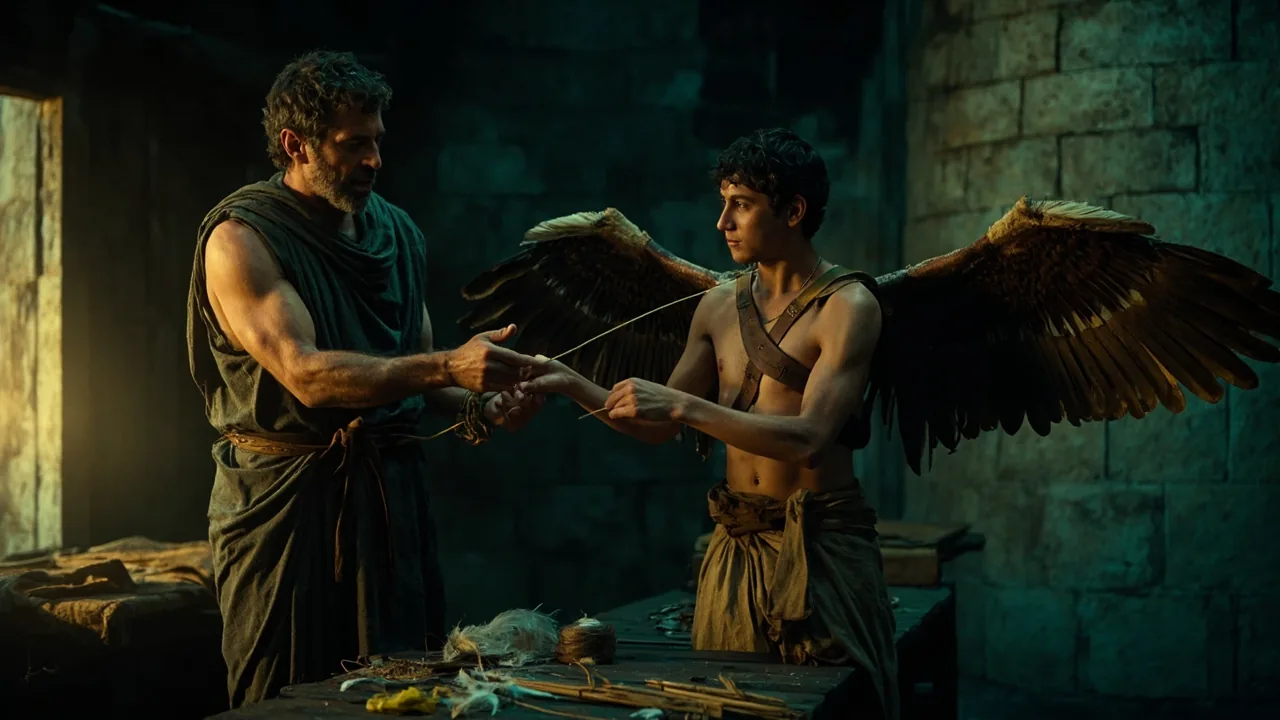
I studied birds. I arranged feathers from shortest to longest to form a curve. Ovid describes thread through the middle and beeswax at the base; Pseudo-Apollodorus speaks of pinions and glue. The ancients left us no engineering manual—which, frankly, has prevented several additional tragedies.
Ovid places Icarus beside me, laughing as he catches drifting feathers and softens the wax with his thumb, unaware that he is handling his own danger. This is not a portrait of an arrogant youth. It is a child turning his father’s workshop into play because the workshop feels safe.
7. The real warning was not “do not fly near the sun”
I told him to keep the middle course. Not too high, because heat would soften the wax or glue. Not too low, because moisture and seawater would weigh down or detach the feathers. That double warning appears in both Pseudo-Apollodorus and Ovid.
The modern phrase “do not fly too close to the sun” preserves only half the instruction. The myth does not simply say, “Do not dare.” It says that excess and fear both carry danger, and that freedom requires judgment between them.
But the “middle course” is easy when drawn across a workbench. Above open water, with wind against your face and no walls around you for the first time, it becomes something else entirely.
8. My hands trembled before we took off
Ovid says that as I fitted the wings to his shoulders, my hands shook and my cheeks were wet. I kissed him while knowing—without admitting it—that it might be the last time. Then I flew ahead like a bird leading its fledgling from the nest, constantly turning to look back.
Below us, the poet says, fishermen, shepherds, and ploughmen mistook us for gods. That is the trouble with watching a marvel from a distance: you cannot see the trembling inside the machine.
For a while, it worked. Crete receded. Islands opened ahead of us. My son was flying. Had the story stopped there, you would remember me as the man who gave humanity wings. Stories, however, stop where loss decides.
 AI
AI9. Icarus climbed
In Ovid, Icarus began to delight in his daring flight, abandoned his guide, and was drawn upward by desire for the heavens. Pseudo-Apollodorus says more bluntly that he ignored the instructions and rose ever higher. Diodorus attributes it to youthful inexperience.
None of these phrases requires us to turn him into a proud boy who believed himself a god. The famous “hubris of Icarus” is an interpretation, not a speech Ovid places in his mouth. It may have been excitement, inexperience, the intoxication of first freedom—or all three.
I saw him rise and shouted. Wind is a poor messenger. Or perhaps he heard me and thought there was still time. The young believe every warning belongs to the next moment. Fathers believe they will have time to repeat it.
10. The wax softened
Heat softened the wax. Feathers began to separate. In Ovid, Icarus beats bare arms against the air—his oars of heaven gone—and calls his father’s name as he falls into the dark water.
He did not fall because the sun god struck down an insolent mortal. No deity hurls a bolt in this story. He fell because wax and feathers could not endure where a young man carried them. That makes the story worse, not better: there is no monster to blame.
People ask why I did not dive and save him. Imagine wings held by wax above waves, no way to stop in midair, no rope, and no second attempt. I had invented flight. I had not invented rescue.
11. A father who was no longer a father
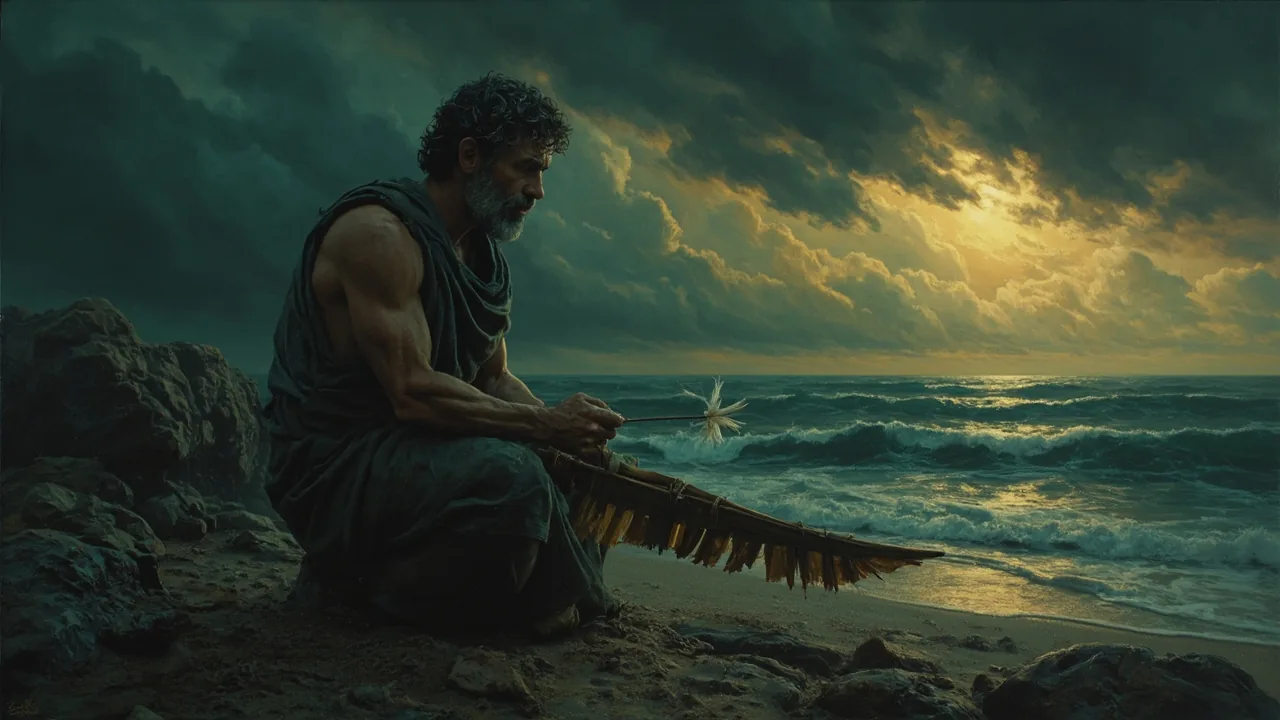
Ovid uses the cruelest phrase: “the unhappy father, now no longer a father.” I called “Icarus” again and again until I saw feathers floating on the waves. Then I cursed my arts.
In Ovid’s version, I found the body and buried him; the island became Icaria and the sea the Icarian Sea. In Pausanias, as we will see, Herakles finds and buries the drowned Icarus. The traditions change the hands that closed his eyes. None changes the fact that the father continued alone.
As I buried my child, Ovid says, a partridge called nearby—the bird into which my old pupil had been transformed. One fall returned to witness another. I do not know whether the gods call that justice. A father calls it understanding that arrived too late.
 AI
AI12. The ancient version with no wings at all
Now for the turn that rarely survives children’s retellings: Diodorus preserves two versions. In the first, Pasiphaë provided a vessel. Icarus fell into the water while disembarking recklessly on an island and drowned. Immediately afterward, Diodorus gives the miraculous wax-wing story as a different tradition.
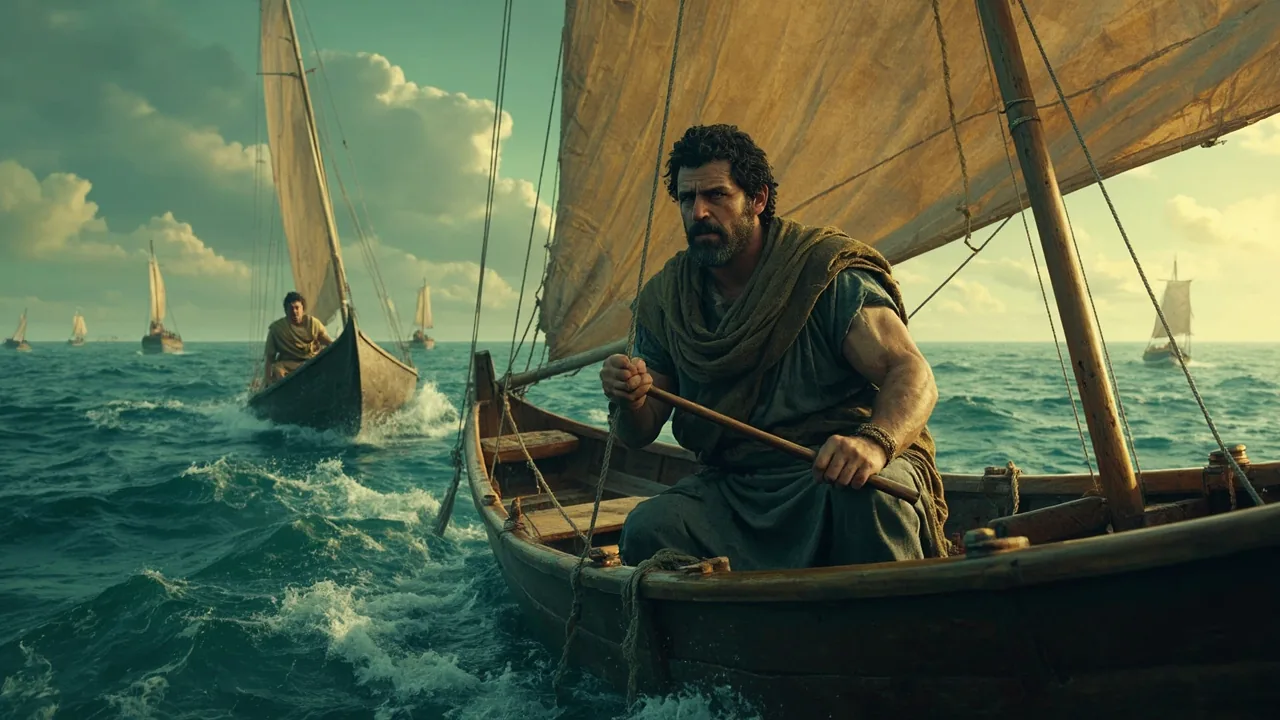
Pausanias offers an even clearer nautical account: we built small craft and used sails—supposedly unknown at the time—to outrun Minos’s oared fleet. Icarus’s ship overturned because he was an inexperienced helmsman. Herakles found the body and buried it.
Perhaps the “wings” were sails that made ships fly over water. Perhaps the sailing story is a later rationalization of a marvel. The sources do not allow us to choose one as historical truth. They do allow us to watch ancient people reinterpret their own myths.
 AI
AI13. Sicily, the shell, and the final Labyrinth
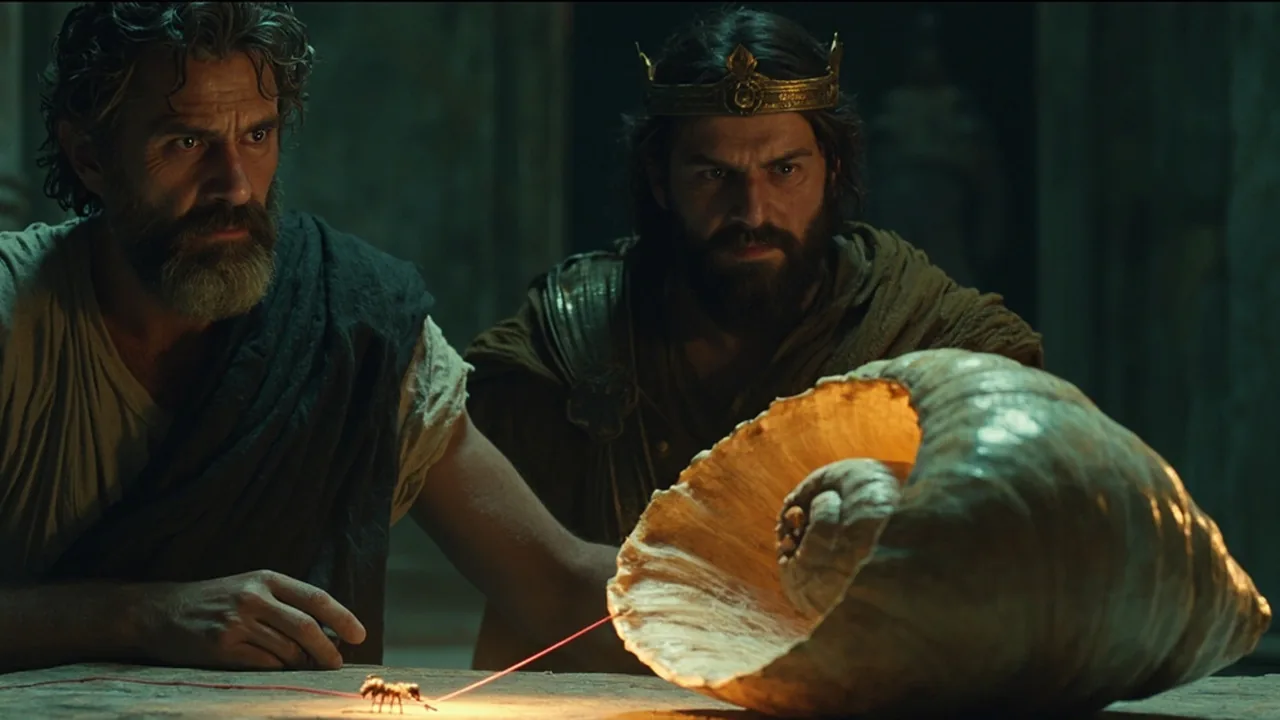
I reached Sicily and the court of King Cocalus. Minos pursued me with a spiral shell, promising a reward to anyone who could pass a thread through it. He knew that only I would see the solution.
I tied the thread to an ant, bored a small opening, and let the creature find its way through the spiral. I solved the puzzle and revealed my hiding place at the same time. Some people cannot resist proving their cleverness even when the correct answer is silence.
In Pseudo-Apollodorus, Cocalus promises to surrender me, but his daughters kill Minos in his bath—one version uses scalding water. I survived. That is the word we use when life continues without being repaired.
 AI
AI14. This is not a myth against ambition
Icarus became a symbol of excessive ambition: the youth who wanted more, approached the sun, and was punished. The reading is powerful, but it is very convenient for people who remain safely on the ground while advising everyone else not to take off.
The ancient story is more complicated. The warning concerned flying too high and too low. Ovid shows Icarus playful and exhilarated, not delivering a speech of arrogant defiance. And before judging the boy, we should look at the father who took him above open sea on the strength of his own invention.
The myth can be about measure. It can be about technology without limits, parental responsibility, the intoxication of freedom, or the price of escape. Great myths are not road signs with one instruction. They are mirrors that change according to who is grieving before them.
15. I built wings to save my son—and lost him
In a later Roman image, Virgil brings me to Cumae, where I dedicate my wings to Apollo and carve the Cretan story on a temple’s doors. Twice I try to carve the fall of Icarus. Twice the father’s hands fall.
That is the ending I understand best. A craftsman may imitate a bird, tame a spiral shell, outwit a king, and design a path through an impossible building. He cannot always give form to the moment that broke him.
I built a road through the sky. I simply failed to imagine that once a young man felt himself flying, he would never wish to come down. If you remember me, do not remember only the wings. Remember the hands that trembled before fastening them—and the father who learned too late that no masterpiece is worth more than the person you ask to trust it.
Source note
Ancient traditions do not agree on a single version. The detailed construction and flight scene comes chiefly from Ovid, while Diodorus and Pausanias also preserve nautical versions without literal wings. The first-person voice is a literary device.
Principal ancient sources
- Pseudo-Apollodorus, Bibliotheca 3.1.4 and 3.15.8; Epitome 1.8–15 — the wooden cow, Daedalus’ pupil, Ariadne’s thread, confinement in the Labyrinth, the double warning, Icarus’ fall, Cocalus, and the spiral shell.
- Diodorus Siculus, Library of History 4.77–79 — parallel escape traditions by boat and by wings, the death of Icarus, and Daedalus’ works in Sicily.
- Ovid, Metamorphoses 8.183–259 — the detailed manufacture of the wings, the middle course, the father’s fear, the flight and fall, and the link to Talos/Perdix. This is an Augustan Latin poetic account, not a Homeric text.
- Hyginus, Fabulae 39–40 — Daedalus’ exile, Pasiphaë, the Labyrinth, imprisonment, the wings, and flight to Cocalus.
- Pausanias, Description of Greece 1.21.4 and 9.11.4–5 — the tradition of the murdered nephew and an alternative escape by sailing craft, the capsizing of Icarus’ ship, and his burial by Herakles.
- Virgil, Aeneid 6.14–33 — later Roman reception: dedication of the wings and Daedalus’ inability to depict his son’s fall.