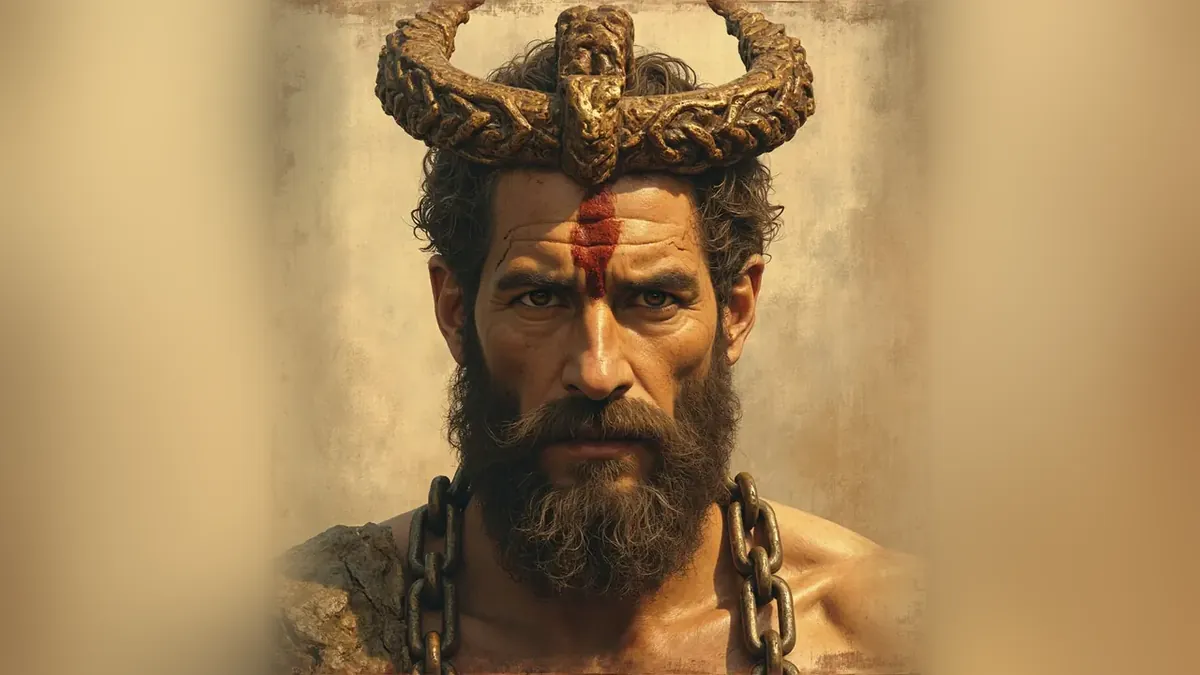
They call me the benefactor of humankind. Zeus prefers “thief.” Both descriptions contain enough truth to annoy everyone.
The thoughts and irony are literary voice. The events below keep Hesiod’s account separate from what later poets added.
I was not one of the original twelve
Let us begin with the mistake repeated almost everywhere: I am not one of the twelve elder Titans. My father is Iapetus and, in Hesiod, my mother is the Oceanid Clymene. I belong to the next generation, alongside my brothers Atlas, Menoetius and Epimetheus. Atlas held up the sky, Epimetheus accepted Pandora, and I decided that testing the patience of the new ruler of the cosmos was a sensible career.
The trick at Mecone
At Mecone, when gods and mortals were settling the portions of sacrifice, I divided an ox into two piles. In one I hid the good meat and entrails inside the animal’s stomach. In the other I placed bones beneath a shining layer of fat. Hesiod says Zeus recognized the deception, chose the misleading pile and then grew angry. The episode explains why mortals burn bones and fat for the gods while keeping the meat.
This was not an innocent joke. It was a rigged negotiation. Zeus answered by withholding fire from humankind.
Fire inside the fennel stalk
I stole it back inside a hollow fennel stalk, which could carry a live ember. Fire meant more than warmth. It meant cooked food, metalwork, workshops and nights that did not end at sunset. Hesiod does not write me a hymn for it. He presents the theft as the next move in my conflict with Zeus.
In the Theogony, Zeus answers the theft with two punishments: a first woman is fashioned for humankind as the “price of fire,” while I am bound and an eagle devours my liver. In Works and Days, Hesiod develops Pandora’s story further: Epimetheus accepts the gift, and human troubles spread from the jar.
The eagle was not the end
Herakles eventually killed the eagle and released me. Hesiod carefully says this did not happen against Zeus’s will. Zeus allowed it so that the fame of his son would grow even greater. Even my liberation required royal approval.
The Prometheus of the stage
In Prometheus Bound, traditionally attributed to Aeschylus although its authorship remains debated, my character changes. There I list the skills I gave mortals: numbers, writing, medicine, seafaring and divination. It is a powerful dramatic version, not a simple retelling of Hesiod. Flatten the two together and we lose what makes the myth interesting. Each age wanted a different Prometheus.
I was not a modern saint. I was an immortal who deceived Zeus and took the side of mortals. The result was fire, along with a price no ancient poet allowed anyone to forget.
The brother who understood afterwards
In Works and Days, I had warned Epimetheus not to accept any gift from Zeus. He accepted Pandora and understood the danger only when it stood before him. Hesiod builds the contrast between the brothers into the story: I plan before acting, while he learns afterwards. That does not make every one of my plans wise. The trick at Mecone won a temporary advantage and drew a response that fell upon all humankind.
Pandora’s story is uncomfortable for a modern reader. Hesiod presents a woman fashioned by the gods as a trap and links her arrival to human suffering. That is what the ancient poem says; it is not a neutral truth about women. We can read the passage critically without rewriting it into something more convenient.
The dispute over sacrifice
Mecone is not simply the tale of a clever Titan fooling a slow god. Hesiod says Zeus recognized the deception. His choice leads to the division of the sacrificial animal between gods and mortals. The myth explains a real ritual habit through conflict and cunning. It is not a worship manual but a poetic explanation for why humans burn the inedible bones and fat for immortals.
In this version, my intelligence does not cancel Zeus’s authority. It challenges that authority and finally confirms it. Zeus punishes me, sends Pandora and remains ruler. The theatre would later make me more heroic and Zeus more tyrannical. Hesiod is more interested in showing that even the sharpest deception cannot escape the ruling god forever.
Why the fire remained
Zeus could punish the thief, but the fire did not return to a heavenly storehouse. Mortals kept it. That is the myth’s strange balance: my act violates the order, the punishment restores authority, yet humanity keeps the gain. Perhaps that is why no later age managed to confine me entirely to the role of trickster or saviour.
The same Titan, two different questions
Hesiod asks how Zeus’s rule became stable and why human life is full of labour. The dramatic Prometheus asks what power owes to knowledge and what a ruler may do to someone who resists. Blend those questions and both works lose their shape. There is no single “true personality” of mine hiding behind every text. Different poets used the same figure to stage different conflicts. That is not a defect in mythology; it is one of the reasons the myth survived.
Sources and traditions
- Hesiod, Theogony 507–616 — the family of Iapetus, Mecone, fire and punishment.
- Hesiod, Works and Days 42–105 — the theft of fire, Pandora and human suffering.
- Prometheus Bound 436–506 — the arts and knowledge the dramatic Prometheus claims to have given humanity; the play’s authorship is debated.