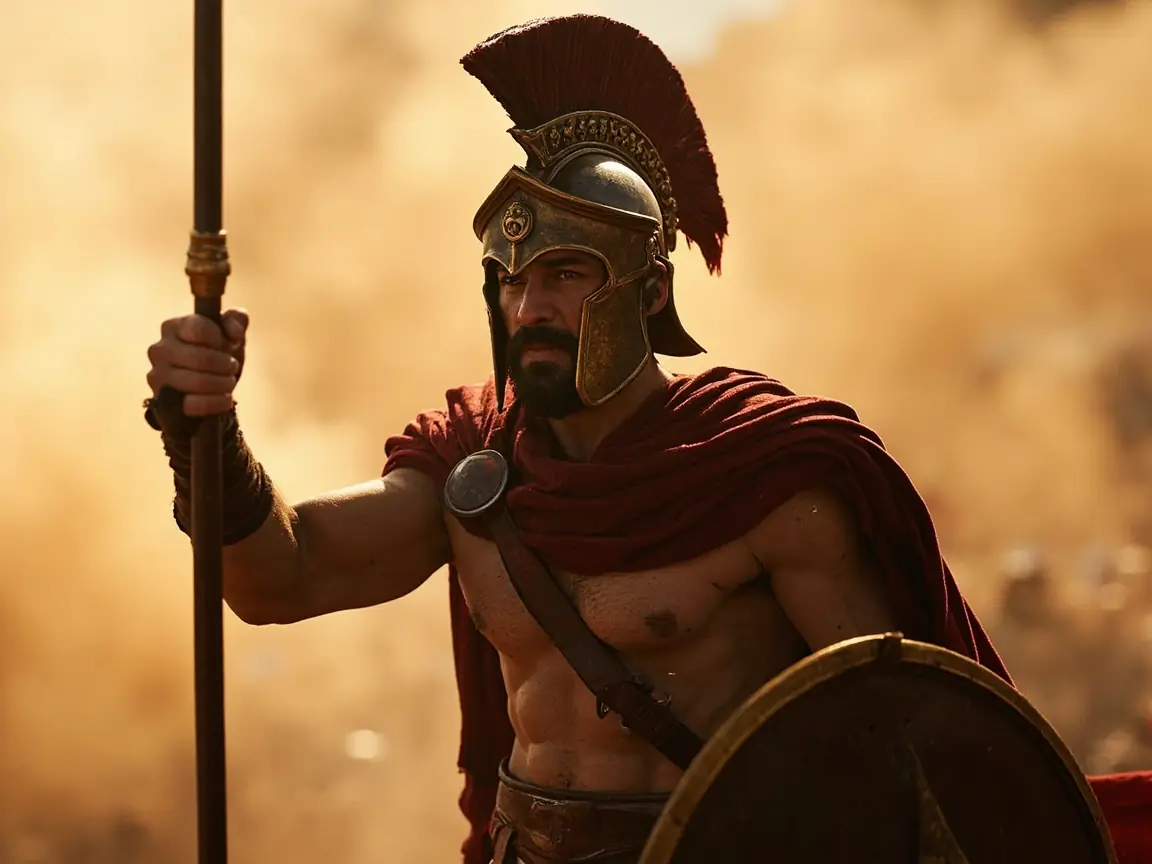
I will start with the worst line ever written about me, so you don't think I'm hiding it. In the fifth book of the Iliad, my own father, Zeus, looks at me and says I am the most hateful of all the gods on Olympus, because strife and wars and battles are dear to me. That wasn't an enemy talking. That was my father. Hold onto it, and let's talk.
Son of Zeus and Hera — and still a stranger
I did not come out of a head, or a thigh, or sea-foam. In Hesiod and in the Iliad I am the son of Zeus and Hera, the two rulers of Olympus. Legitimate. Clean. And yet, in that same house, they look at me as if I arrived from somewhere else.
The reason is simple: I don't pretend. War is neither wise nor beautiful. It is mud, screaming and fear. The others want the glory of victory without the filth of it; I am the face of the filth. That makes me an easy target. It is more comfortable to blame a single god for the madness of battle than for each person to admit their own.
Ares versus Athena: two faces of war
Someone will say at once: "But there is Athena too, goddess of war, and she is wise." True. And here hides the most misread truth about me.
Athena is war as you think of it from a safe table: a plan, discipline, the right moment, the victory won in the mind before a sword is drawn. I am war when the plan breaks. The moment no map helps anymore and only the body, the shield and the fear remain. We are not "the good one and the villain." We are two truths of the same field. And no strategy stays clean once men begin to fall.
The day a mortal wounded me
I'll tell you the part my enemies love to remember, too. In the fifth book, Diomedes strikes me with his spear. A mortal. But read the whole passage: he did not suddenly grow stronger than a god. Athena, invisible, guided his spear and drove it into me. I bellowed like ten thousand warriors at once, left the field, and climbed to Olympus to complain.
Yes, I complained. And instead of comfort, Zeus threw me that line about how much he hates me. Later, in the twenty-first book, Athena knocks me down again — this time with a great stone, an old field boundary marker, against my neck. These are not my most flattering moments. But they are Homeric, not some later joke. The god of war is wounded inside the war. There is no more honest image of what battle is.
My children — and Harmony
Here is what almost no one mentions. Hesiod writes that from me and Aphrodite three children were born:
- Phobos, who runs ahead of the clash.
- Deimos, the terror that stays once it begins.
- And Harmonia. Yes, Harmony herself.
Sit with that for a moment. From the god of war and the goddess of love came not only terror; balance came too. I don't say it so you'll like me. I say it because it is written, and because it shows something you forget: even the most incompatible forces give birth to something that keeps the world standing.
The rock that took my name
I'll tell you something that fits my reputation not at all. I had a daughter, Alcippe. Halirrhothius, a son of Poseidon, assaulted her. And I did what any father who is not a coward would do: I killed him.
Poseidon did not demand blood for blood. He demanded a trial. And so I stood, a god accused of murder, before the other gods, on a rock in Athens. They heard me. They judged me. And they acquitted me.
That rock has been called the Areopagus ever since — the rock of Ares. And it became the place where Athens tried cases of murder for centuries. Consider the irony. The god they call bloodthirsty stood at the origin of the first court of blood. The god of raw violence became the reason a city learned to judge a killing instead of simply avenging it. You won't find that on the posters that show me only with a bloodied spear.
What I will not prettify
I will not tell you every battle was necessary. I will not baptize every killing a sacrifice. I will not play the good one. I am the madness and disorder of the clash, and I know it. But I am not the cause of every war, nor the excuse for any. Humans light wars with their pride; I simply show up once they have already drawn their swords.
If you want to honor me, do not raise a sword. Look first at who will stay in the dirt when the speeches are over. Those are the ones I remember — not the shining names, but the nameless who never got a gravestone. I am Ares, and I make no apology for who I am. I only ask that you see the whole of me.
Sources and traditions
- Homer, Iliad 5.889–898 — Zeus calls Ares the most hateful of the gods, because strife and battle are dear to him.
- Homer, Iliad 5.825–863 — Athena guides Diomedes' spear and wounds Ares; his cry and his ascent to Olympus.
- Homer, Iliad 21.391–414 — Athena strikes Ares down with a field boundary stone during the battle of the gods.
- Hesiod, Theogony 921–923 — Ares as the son of Zeus and Hera.
- Hesiod, Theogony 933–937 — Phobos, Deimos and Harmonia, children of Ares and Aphrodite.
- Pseudo-Apollodorus, Library 3.14.2; Pausanias 1.28.5 — the killing of Halirrhothius, the trial of Ares, and the naming of the Areopagus.
Editorial note: Ares' first-person voice is a literary frame. The Homeric and Hesiodic episodes are cited to named sources.