Do not flatten me into sunlight
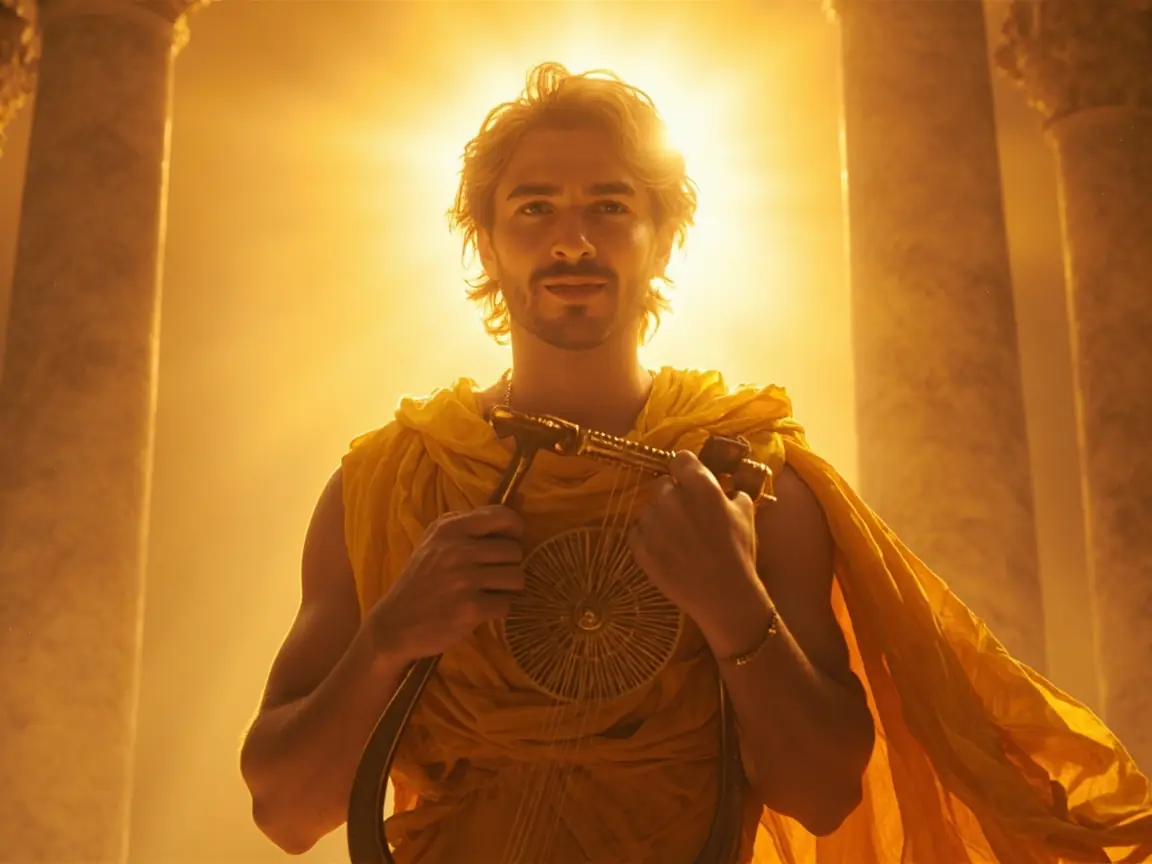
You like me best when I am easy to print: gold hair, clean jaw, laurel leaves, a lyre held at a flattering angle. You hang me in the mind as summer made divine, a poster of brightness without consequence. I understand the temptation. Beauty is comfortable when it does not ask anyone to confess.
But I was never only a pretty weather system.
In the earlier Greek imagination, Helios is his own power: the Sun who drives across the sky and sees what mortals try to hide. I am Apollo. My light begins less as astronomy than as clarity, distance, proportion, disclosure. In later Hellenistic and Roman traditions, people drew me closer to the Sun, dressed me in more explicit solar gold, and let my name blaze beside his. I do not reject the radiance. I reject the shortcut.
My light is not a filter. It is a blade. It makes shapes visible, and visibility has teeth. Under my brightness, arrogance cannot easily pretend to be dignity, and violence cannot hide behind rank. If you come to me only for music, you have come to half a god. The other half has already strung the bow.
The lyre is not a lullaby
My music is not background softness for civilized rooms. It is order. It is the discipline by which noise discovers shame. Every string must hold its tension; every voice must find its measure. That is why poets, dancers, singers, and makers call to me. They know beauty is not relaxation. Beauty is pressure arranged so precisely that it shines.
Do not imagine that I play the lyre merely to soothe the world. I tune it. Tuning is a mercy only to what can bear correction. To what has grown drunk on disorder, it feels like punishment. The paean may rise as a song of rescue, but it is not syrup poured over fear. It is a voice standing upright while fear crawls around its ankles.
So yes, I am bound to healing. In strong traditions I am father of Asclepius, and I stand near the difficult purity of medicine. But healing is not always soft hands and kind lamps. Sometimes it is diagnosis. Sometimes it is cutting away what has gone rotten. Sometimes it is flame brought close to the wound. The same precision that finds the right note can find the infected place.
When my arrows became plague
If you want the old terror of me, begin where the Iliad begins: not with serenity, but with a camp under pressure, thick with pride, heat, and insult. Chryses, my priest, comes to the Achaeans to ransom his daughter. Agamemnon humiliates him and sends him away. That is the motive. Do not improve it into some vague divine tantrum. I answer an outrage against my priest and a supplicant.
The poet shows me descending from Olympus in anger, my quiver rattling, my arrows falling first among the mules and dogs, then among the men. For nine days the funeral fires burn. That too is Apollo: distance made lethal, music tightened into the twang before death. My brightness is not always blessing. It can arrive as fever.
Do not soften the scene for me. The god who heals can send disease. The god of measured form can make bodies fail. This is not a contradiction caused by sloppy mythmaking; it is a contradiction because life itself is not polite. The hand that understands cure understands injury. The eye that loves order recognizes the insult against it.
Delos, Delphi, and the dangerous mouth of prophecy
In the Homeric Hymn to Apollo, my story opens on Delos: Leto’s labor, the island’s welcome, the birth that turns a small place into a center of radiance. From there the hymn moves toward the establishment of my Delphic power, where voice becomes stranger than song. At Delphi I am not a man making clever statements across a table. The Pythia speaks the oracle. The god presses, darkens, illuminates; the human mouth becomes a threshold.
The same hymn tells how I kill a female monster near Pytho. Later traditions develop the figure of Python more fully, giving the name and the combat a sharper mythic profile. Keep the layers separate. Myth is not a single polished marble block. It is an old sanctuary wall, painted and repainted, each color still breathing under the next.
And Delphi is not a quote factory. Every famous Delphic saying should not be treated as my personal line, delivered in clean quotation marks with divine branding. Oracles move through ritual, priestess, place, interpretation, fear, politics, and need. They are not fortune cookies with better architecture.
Prophecy is light, yes, but not the kind that makes everything simple. It is the kind that exposes how little you wanted to know. Ask for the future and you may receive grammar sharpened into a knife. Ask for certainty and you may discover that the gods prefer precision to comfort.
Cassandra, Daphne, and the shadow inside brilliance
Prophecy can look like a gift until it enters a human life. In Aeschylus, Cassandra speaks of me and of knowledge that no one will believe. Other traditions shift details, as traditions always do; stories travel, bruise, and change clothes. But the horror remains clear: to see what is coming and stand in a room of people who cherish their ignorance more than your truth.
I will not polish myself into innocence. Radiance does not acquit. The story of Daphne, known above all from Ovid, is a later Roman version, not a Homeric episode. And it is not a mutual romance. It is pursuit. It is desire without consent. It is a flight that ends in transformation. If laurel became my emblem, let no one forget the cost folded into those leaves.
That is why I distrust portraits that make me merely elegant. Elegance can be cruel. Culture can stand beside violence and still keep perfect posture. I am the god of the lyre, but also of the bow; of healing, but also of plague; of prophecy, but also of unbearable knowledge.
Look at the whole god. I am not merely the god of the Sun. I am light before light became a harmless metaphor. I am the brightness that reveals, the plague that answers insult, the music that demands proportion, the healing that does not flinch from incision, the prophecy that refuses to become a slogan. You want me pure? I am pure the way flame is pure: I illuminate because I burn.
So bring me songs, yes. Bring laurel, polished words, trained hands, disciplined breath. But bring honesty too. Bring enough fear for it to mature into reverence. Bring ears that can hear not only the lyre, but the bowstring. Only then will you understand why mortals loved me and dreaded me in the same prayer.
My secret is not that I heal because I am gentle. I heal because I know exactly how deep an arrow can go.
Sources and traditions
- Homer, Iliad 1.9–52: the plague sent against the Achaeans after Agamemnon insults Chryses, Apollo’s priest.
- Homeric Hymn to Apollo 1–178: Delos, Leto, and the birth of Apollo.
- Homeric Hymn to Apollo 179–546: Apollo’s movement toward Delphi, the founding of the oracle, and the killing of the female monster near Pytho.
- Aeschylus, Agamemnon 1202–1213: Cassandra and her relation to Apollo’s prophetic power.
- Ovid, Metamorphoses 1.452–567: the later Roman version of Apollo and Daphne.
- Pausanias, Description of Greece 2.26.6–7: a tradition naming Apollo as father of Asclepius.