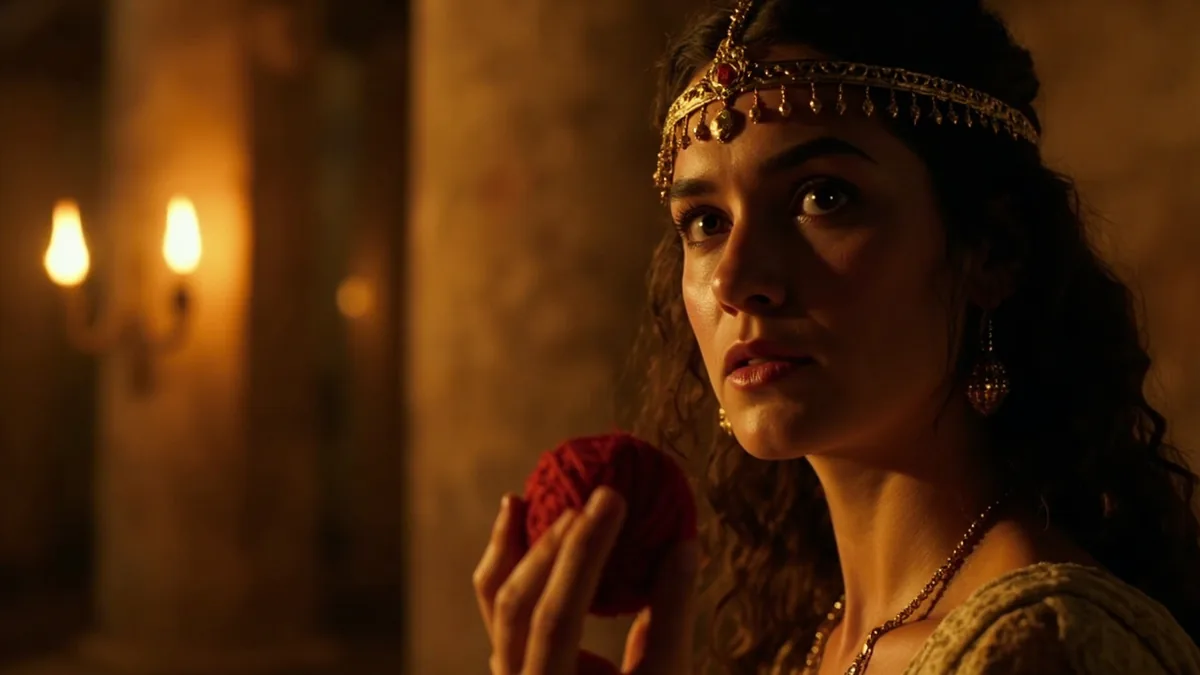
You know me from a thread and an abandonment. I gave Theseus the thread, he killed the "monster," and then he left me asleep on a beach. That is what you remember. Nobody asks inside which palace I grew up, who my brother — the one they named the Minotaur — really was, or why an entire island had to become the villain of a story written by the Athenians. So now I speak for myself.
I will give you the myth first — mine, without the pretty wrapping. And then, because my name got stuck onto a real civilization that no poet ever lived through, I will step aside and let history speak in its own, serious voice. Do not confuse the two. It is the most honest thing I can give you.
My bloodline: a bull, the Sun, and a god
Before me there was Europa. Zeus desired her, turned himself into a gentle bull, tricked her into climbing onto his back, and carried her across the sea to Crete. There she bore Minos — my father. My family, in other words, begins with an abduction that you call "the love of Zeus."
My mother, Pasiphae, was a daughter of the Sun. Yes, of Helios himself. Titanic light and Olympian power run in my veins at once. And yet, in the story you know, I am merely "the girl who helped the hero."
Everything went wrong over a bull. Poseidon sent my father a magnificent bull, up out of the sea, to be sacrificed in his honour. Minos kept it — it was too beautiful for the knife. A god does not forget such an insult. Poseidon's revenge did not fall on my father; it fell on my mother. He planted in her an irresistible, unnatural desire for that bull.
Think about it coldly: a woman is punished for her husband's arrogance. My mother did nothing wrong. The craftsman Daedalus built her a wooden cow so she could approach the bull, and from that union my brother was born.
The brother they called a monster
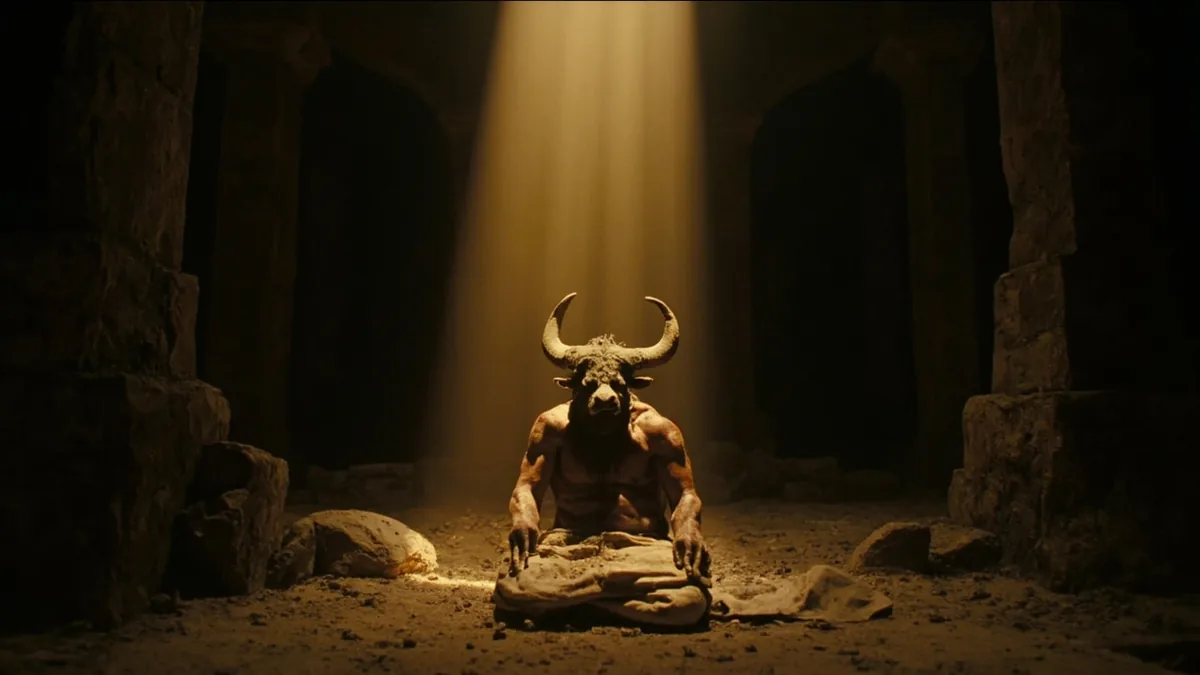
His real name was Asterion — "the starry one." You call him the Minotaur, "the bull of Minos," as if he were property and not a child. He did not choose how he would be born. He committed no crime by coming into the world half man and half bull. He was the result of a divine punishment — and you punished him for it.
My father was ashamed. He did not kill Asterion; he hid him. He ordered Daedalus to build the Labyrinth: a structure with so many corridors that whoever entered never found the way out again. A building made to bury a family's shame alive. In there my brother grew up, in the dark, alone.
 AI
AIAnd then came the blood. My other brother, Androgeos, was killed in Attica. My father made war on Athens and won. The tribute he imposed was monstrous: whenever the agreement fell due, Athens sent seven youths and seven maidens to Crete, food for Asterion inside the Labyrinth. I will not tell you this was just. It was not. Only remember that the horror began with the death of one of our own — and that the Athenians, when they wrote the story, remembered only their own share of the pain.
The thread: what I actually did
On the third shipment, among the young came Theseus, the son of the king of Athens. He came saying he would kill the monster. I saw him and I fell in love — I will not hide that. I was young, a princess of an island living under a curse, and he looked like a way out.
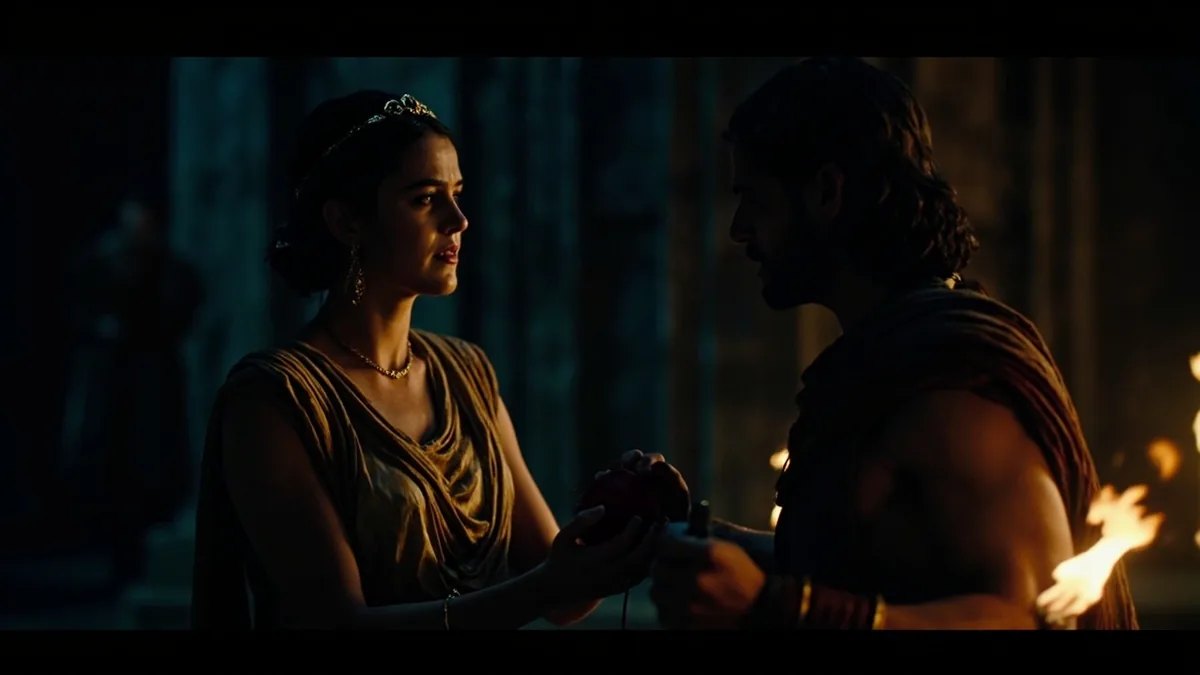
I went to Daedalus. The same man who built the Labyrinth gave me its solution: a ball of thread. Tie it at the entrance, unwind it as you go, and you will find your way back. That ball — the thread — I gave to Theseus. And, in some traditions, a sword too.
Let us say it plainly, once, out loud: the great Athenian feat, the hero who defeated the Minotaur, managed it because a girl from Crete gave him the mind and the thread. Without me, Theseus would have been lost in those corridors like all the others. He killed my brother and came out alive by following my thread. And yes — I betrayed my home for him. I know it every single day.
 AI
AINaxos: the betrayal they baptised "a god's plan"
We left Crete together. We stopped at the island you call Naxos — the old ones called it Dia. There I fell asleep. And when I woke, Theseus' sails were already a speck on the horizon. He left me. The girl who saved his life, abandoned asleep on a foreign shore.
Here the poets disagree, and I will not pretend they agree. Catullus and Ovid show me betrayed, screaming at the waves behind a ship that will not turn back. Other traditions say Theseus was no scoundrel — that a god, Dionysus, wanted me for himself and forced Theseus to leave me. Convenient, isn't it? Whenever a man abandons a woman, there is always a god to blame.
And there is a third, darker version, the oldest one. In Homer's Odyssey I get no happy ending. There, Artemis kills me on the island of Dia "on the testimony of Dionysus," before I even reach anywhere. One line, and I am finished. I will not choose for you which version is "the true one." I will only tell you that in each of them, someone else decides my ending.
The ending they rarely tell: I became a god's wife
In the version I prefer — and yes, I have the right to prefer — I did not stay the victim. Dionysus found me on Naxos, not to steal me, but to make me his companion. He crowned me. My crown, they say, rose into the sky and became a constellation — the Corona Borealis. Look up on some clear night: that half-circle of stars is mine.
From the daughter of a king they turned into a monster, I became the wife of a god and a name in the starry sky. I do not say it to make you feel better. I say it because in the story you know I stop existing the moment the ship sails away — and that is the lie I want to correct.
So remember who held the pen. The story of Crete — of the "tyrant" king, my "monster" brother, the "traitor" princess — was written by the winners on the far side of the sea, centuries later, when all that was left of our civilization was ruins and fear. The loser rarely keeps the ink.
Note: Ariadne's first-person voice is literary framing. Everything you have read up to this point is myth — narrative, not historical evidence. The differing ancient traditions about Ariadne's ending are stated explicitly and are not flattened into one.
⟢ Here Ariadne's voice ends. What follows is not myth and not an "uncensored" confession. It is history and archaeology, written in a serious, educational tone. The myth above is not a historical source for the Minoan civilization: it was written by Greek poets centuries after that civilization had collapsed. Wherever modern research disagrees or does not know, we will say so clearly.
The historical Minoan civilization — what we can verify
The very name "Minoan" is a modern invention
Let us start with something that surprises most people: the people of this civilization never called themselves "Minoans." The term "Minoan" was coined by the British archaeologist Arthur Evans when he began excavating Knossos in 1900. He borrowed it from the mythical King Minos. The real name by which the Bronze Age inhabitants of Crete identified themselves is unknown to us, because we still cannot read their language. What we call "Minoan," then, we named ourselves — through the myth.
When it flourished
We are talking about the Bronze Age in Crete, roughly from 3100 to 1100 BC. The great palaces — Knossos, Phaistos, Malia, Zakros — appear around 1900 BC. The peak, the so-called "Neopalatial" period, is placed at roughly 1700–1450 BC. These dates are a scholarly reconstruction from archaeological layers and laboratory dating, not dates anyone recorded at the time; that is why they are always given as "approximately."
The scripts: Hieroglyphic, Linear A and Linear B
Here lies one of the most important and often misunderstood points. Three writing systems were used in Crete in succession:
- Cretan Hieroglyphic — the earliest script, barely understood.
- Linear A — the main script of the Minoan palaces. It records the genuine Minoan language and remains undeciphered to this day. We do not know what language the Minoans spoke.
- Linear B — deciphered in 1952 by Michael Ventris (with John Chadwick). The great surprise: Linear B recorded an early form of Greek. It is not the language of the original Minoans; it is the language of the Mycenaeans, Greeks from the mainland who later controlled Knossos.
In plain terms: the language we can read from Crete (Linear B) belongs to the later, Greek-speaking phase; the language of the real Minoans (Linear A) remains silent.
Palaces, frescoes and bull-leaping
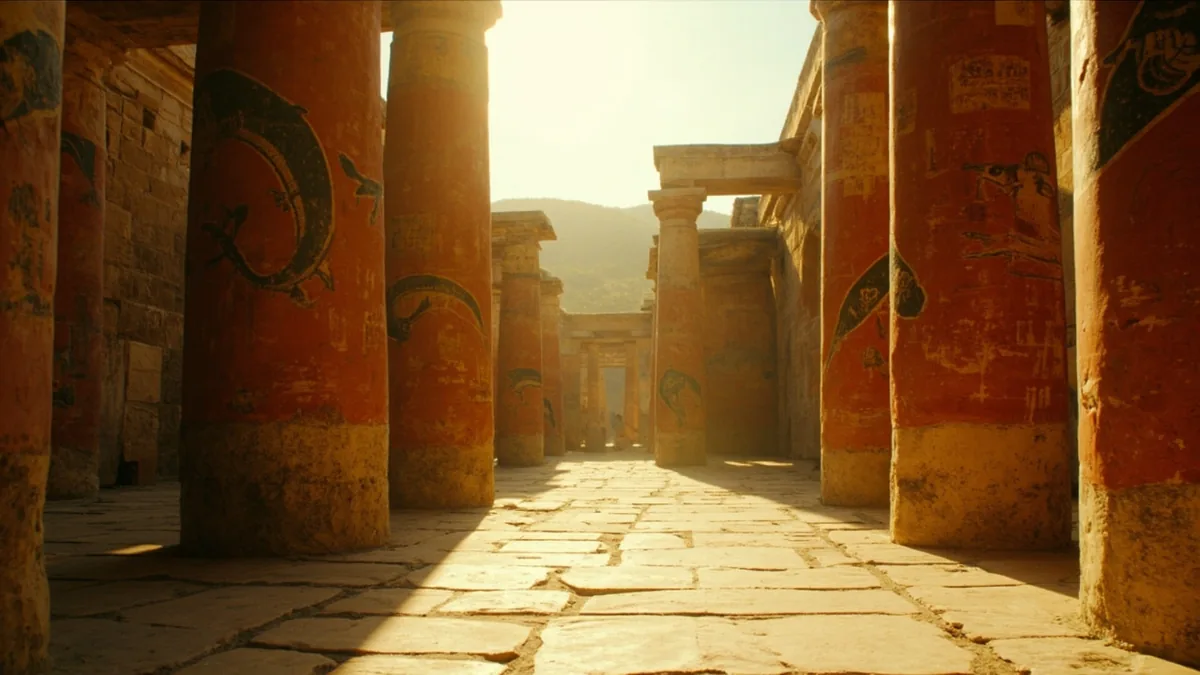
The Minoan civilization left us astonishing art: frescoes of dolphins, lilies, blue-green seas and scenes with bulls. The palace of Knossos is an enormous, maze-like complex with hundreds of rooms, storerooms, light-wells and staircases. Many scholars — Evans first among them — suspected that this very labyrinthine complexity, together with the double-axe symbol (labrys) repeated on the walls, later fed the Greek myth of the "Labyrinth." It is a plausible link, but not a proven fact.
 AI
AIThe frescoes also show acrobats leaping over bulls — the famous "bull-leaping." That the bull was a central sacred and symbolic animal for the Minoans is certain; whether bull-leaping was a real sport, a ritual, or an artistic convention remains under discussion. Here, perhaps, lies the historical kernel behind the mythical "bull" of Crete.
The "thalassocracy": an ancient idea, a modern debate
You will have heard that Minos had the first great fleet and ruled the Aegean. That idea comes from an ancient source: Thucydides writes that Minos acquired a navy and cleared the sea of pirates. Evans and later scholars connected this literary tradition with the finds and spoke of a "Minoan thalassocracy." Modern research is more cautious: that Minoan Crete had strong maritime trade relations across the Eastern Mediterranean is well documented; that there was an organised naval "empire" with a fleet and army is a working hypothesis, not a proof.
The destruction: Thera and what followed
At some point in the Late Bronze Age, the volcano of Thera (Santorini) erupted with terrifying violence, burying the settlement of Akrotiri under ash. The exact date is one of archaeology's most intense open questions: archaeological evidence traditionally pointed to around 1500 BC, while radiocarbon dating pushes the event earlier, into the 17th century BC. The disagreement has not been definitively resolved.
Beware a popular oversimplification: Thera did not "destroy the Minoans" in a single night. The Minoan decline was gradual and had many causes. Around 1450 BC most of the palaces are destroyed, and Knossos passes under Mycenaean control — which is exactly why we find Linear B there, that is, Greek. The Minoan world did not vanish instantly; it was absorbed and replaced.
Where myth and history touch
Let us close honestly. The myth of Ariadne, Minos and the Minotaur is not a historical document. The Greeks who shaped it lived many centuries after the collapse of the Minoan civilization and had no archaeological knowledge of it. The "Minos" of myth is more likely a composite figure or a title of power than one specific historical king.
And yet, some historical realities seem to have fed the legend: a powerful palace-centre at Knossos, a building so complex it resembled a labyrinth, the dominance of the bull in art and worship, and the distant memory of a Cretan sea power. The myth is not a photograph of history — it is its echo, distorted by time and by those who told it.
Sources — the myth (ancient texts)
- Pseudo-Apollodorus, Library 3.1 & 3.15, Epitome 1.7–11 — Europa and Zeus, Poseidon's bull, Pasiphae, the birth of the Minotaur (Asterion), the Labyrinth, the tribute of Athens, the thread and the escape.
- Plutarch, Theseus 15–20 — the tribute of youths, Theseus in Crete, Ariadne, the many versions concerning Naxos (among them the involvement of Dionysus).
- Homer, Odyssey 11.321–325 — the archaic, grim version: Ariadne killed by Artemis on Dia "on the testimony of Dionysus."
- Catullus, Poem 64 & Ovid, Heroides 10, Metamorphoses 8 — the Roman image of the betrayed, abandoned Ariadne.
- Bacchylides, Dithyramb 17 & Diodorus Siculus — parallel traditions on Theseus, Crete and Ariadne.
Sources — the history (archaeology & modern research)
- Sir Arthur Evans, The Palace of Minos at Knossos (1921–1935) — the excavations of Knossos from 1900 and the coining of the term "Minoan."
- Michael Ventris & John Chadwick — the decipherment of Linear B (1952) as early Greek (Mycenaean); Linear A remains undeciphered.
- Thucydides, Histories 1.4 — the ancient reference to Minos's navy, the basis of the later idea of a "thalassocracy" (today debated, not an established fact).
- Dating of the Thera eruption — an open scholarly question: archaeological evidence (~1500 BC) versus radiocarbon dating (17th century BC). Minoan chronology in general is a scholarly reconstruction with uncertainties.
Editorial note: this article is deliberately split into two parts. The first is myth, narrated in the first person as a literary device. The second is historical and archaeological information, in which the uncertain or disputed points (the Thera date, the "thalassocracy," the nature of bull-leaping) are stated explicitly and not presented as certainties. Myth and history are not mixed.