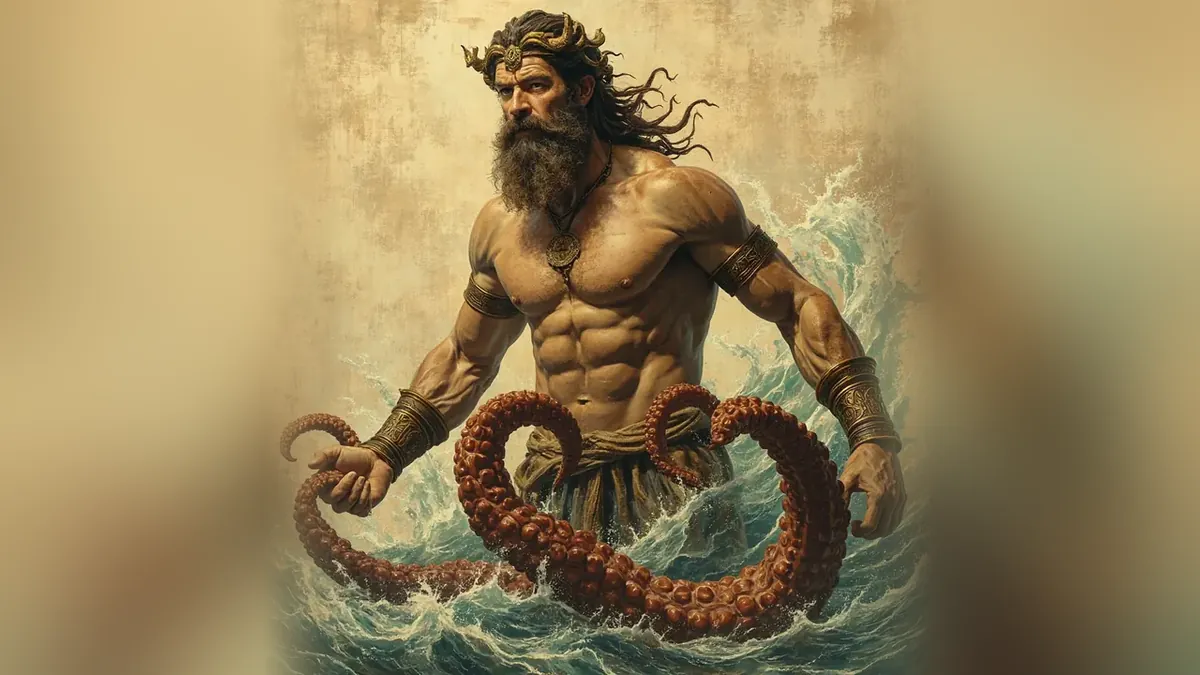
Modern readers hear “ocean” and picture a vast body of salt water. The ancient Greeks imagined me differently: a river at the edges of the earth, flowing around the inhabited world.
The voice is literary. Hesiod’s and Homer’s different cosmic images remain separate.
I am not Pontus
In the Theogony, Gaia produces Pontus, the sea, by herself. I am born later from Gaia and Uranus and belong to the twelve elder Titans. This is not a dictionary quibble. Pontus is the sea itself; Oceanus is the cosmic current marking the world’s boundary.
Three thousand rivers and three thousand daughters
With my sister and consort Tethys, I fathered the river gods and the Oceanids. Hesiod names some and then speaks of three thousand rivers and as many Oceanids. The number gives a poetic sense of abundance, not a complete surviving census.
One of our daughters is Styx. When Zeus called the gods to choose sides, she came first with her children, following her father’s counsel, as Hesiod specifies. Zeus honoured her by making her water the gods’ great oath. The stance of Oceanus’s family shows why “the Titans against Zeus” is much too convenient.
Did I fight in the Titanomachy?
Hesiod speaks collectively of Titans fighting from Mount Othrys, but he does not name me in a personal battle scene. In the same Theogony, Styx goes first to Zeus on my counsel. This does not explicitly exclude me from every conflict; it means we should not invent an individual combat role or an official pact of neutrality.
Divine families were not military units in matching armour. My daughter supported Zeus. Other Titan descendants were punished. Genealogy did not automatically determine political allegiance.
Homer remembers an older father
In the Iliad, Hera says she is going to Oceanus, “source of the gods,” and to mother Tethys, explaining that the two raised her. A little later, Sleep refers to the streams of Oceanus and to Oceanus as their source. These Homeric images are not the same genealogy as the Theogony, where Oceanus and Tethys are children of Gaia and Uranus. They offer another poetic picture of origin and cosmic flow.
On the shield of Achilles, Hephaestus places the mighty stream of Oceanus around the outer rim. That is where I belong best: not on a throne, but at the edge of the image, enclosing everything mortals know.
Water before maps
I was not the Atlantic or Pacific. Those are later geographical names. I was an ancient answer to the question “what lies beyond the edge?” The Greeks drew a river there and gave it my name.
The road to the Underworld crosses my waters
In Book 11 of the Odyssey, Odysseus travels to the limits of Oceanus and the land of the Cimmerians to summon the dead. Homer supplies no modern coordinates. My stream acts as a boundary between the familiar world and places where ordinary rules begin to loosen.
That does not make me god of the Underworld. It shows how a cosmic boundary works in epic geography. Beyond me lie distant peoples, darkness, and regions of sunrise and sunset that do not fit easily on a map. The poets were not drawing a satellite image. They were building a world in which a ship could travel to the edge of the possible.
My children were not scenery
The rivers Hesiod names, including Nile, Alpheus, Strymon, Maeander and Achelous, belong to real geography and cult. The Oceanids enter the genealogies of gods and heroes, foster the young, marry other cosmic powers and bear figures who shape the new order. Metis, for example, is an Oceanid and becomes central to the story of Athena’s birth.
When a poem says “three thousand,” it asks the audience to feel that every stream has a place in one enormous family. Water is not background. It is a network of kinship.
Why was I not sent to Tartarus?
Collective memory says Zeus defeated “the Titans” and threw all of them into Tartarus. The poem itself is more careful. It speaks of defeated opponents, yet continues to use my family within the divine order. Styx receives honour. Metis becomes Zeus’s wife before he swallows her. Many Oceanids remain active.
No ancient scene shows Zeus awarding me an official certificate of neutrality. We have my absence from the battle narrative and the continuing presence of my descendants. The honest wording is less dramatic, but more accurate.
From god to geographical word
Over time, the word for a cosmic river became the term for the enormous bodies of salt water on maps. Language kept the name and changed the picture. Every time someone says “ocean,” a fragment of the older cosmology survives, even when no one imagines a Titan flowing around the earth.
Read the boundary, not a modern map
Try to locate my current by latitude and longitude and the myth looks like failed science. Read it as an image of the boundary and it becomes clearer. I mark the point where the known world admits that it is not the whole world. That is why I can touch the land of the dead, distant peoples and the rim of Achilles’ shield without becoming one identifiable sea. The old cosmology is doing narrative work, not pretending to be modern oceanography. Its shape may shift between poets, but its function as the outer limit remains recognizable.
Sources and traditions
- Hesiod, Theogony 131–138, 337–370 — the self-generation of Pontus, Oceanus among the elder Titans, and the children of Oceanus and Tethys.
- Hesiod, Theogony 383–403 — Styx and her children supporting Zeus.
- Homer, Iliad 14.200–210, 14.245–246 — Oceanus as “source of the gods,” Tethys as Hera’s foster-mother, and the streams of Oceanus.
- Homer, Iliad 18.607–608 — Oceanus around the shield of Achilles.
- Homer, Odyssey 11.13–22 — the journey to the limits of Oceanus and the land of the Cimmerians.
- Hesiod, Theogony 886–900 — the Oceanid Metis, Zeus and the prophecy surrounding Athena.