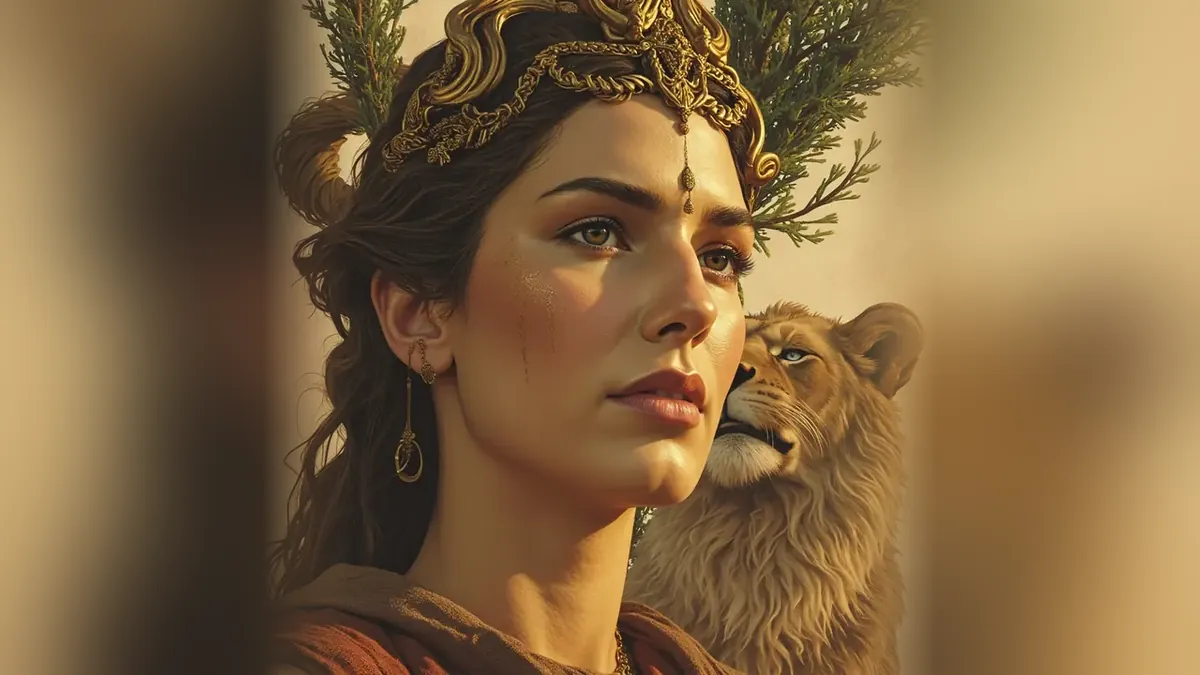
Most people remember the stone. Fewer remember the woman who wrapped it, handed it to her husband and waited to see whether he would notice that he was not holding a baby.
The inner voice is literary. The genealogy, the swallowing of the children and the rescue of Zeus follow the named ancient traditions.
Daughter of Gaia, wife of Cronus
I am one of the twelve elder Titans, a child of Gaia and Uranus. With Cronus I bore Hestia, Demeter, Hera, Hades, Poseidon and Zeus. That is Hesiod’s order. It was less a family tree than a list of disappearances.
Cronus had learned from Gaia and Uranus that one of his children would overthrow him. He swallowed every newborn. The poem does not describe them as dead. He kept them inside him, a living threat in a living prison.
The final birth
When Zeus was about to be born, I asked my parents for help. Hesiod sends me to Crete. Gaia receives the child at Lyctus and hides him in a cave. I give Cronus a large stone wrapped in swaddling clothes. He swallows it without a second look.
Hesiod does not place the Curetes around that cave beating their shields. That detail appears clearly in the later synthesis of Pseudo-Apollodorus, where the Curetes guard the infant and drown out his crying. The traditions are related, but they do not need to be pressed into one seamless paragraph.
An overthrow that began with a deception
Zeus grew, and Cronus brought back the children he had swallowed. Hesiod moves quickly from prophecy to their return. Pseudo-Apollodorus gives Metis a role and describes a drug that forces Cronus to disgorge them. These are different narrative layers and should be named as such.
The result is shared: my act did not save only one child. It opened the way for the return of the other five and for the fall of Cronus. The Olympian dynasty began with a mother refusing to surrender her final child.
I did not vanish after childbirth
Many retellings move me aside as soon as Zeus grows up. The Homeric Hymn to Demeter remembers another role. When Demeter withdraws from the gods and the earth becomes barren, Zeus sends me to carry his offer and lead her back. I do not solve the conflict over Persephone alone, but I act as a respected mediator between divine generations.
They call me “mother of the gods.” The title sounds peaceful. Its history is not.
The stone that remained as a sign
When Cronus brought his children back up, the first thing to emerge was the stone he had swallowed instead of Zeus. Hesiod says Zeus set it at Pytho beneath the slopes of Parnassus as a sign and wonder for mortals. The poem does not call it “Rhea’s stone” or explain a complete ritual around it. It does, however, preserve the instrument of deception inside the new divine order. Victory remembers the trick that made it possible.
What did I do in the Titanomachy?
An easy cinematic retelling would put me on the battlefield, perhaps secretly commanding the Olympians. Hesiod tells no such scene. His Titanomachy focuses on Zeus, his allies, the Hundred-Handers and the defeated opponents confined in Tartarus. We are not entitled to fill that silence with a military career because it suits the character we would like me to be.
My decisive action comes before the war. I saved Zeus, allowed the future liberator of his siblings to grow, and broke the cycle of swallowing. That is enough. A figure does not need to hold a sword to change the succession of power.
The mother between generations
In the hymn to Demeter, Zeus turns to me after the other gods have failed to persuade my daughter. He asks me to carry the promise that Persephone will return for part of the year and that Demeter will receive honours among the immortals. The scene does not make me judge of the settlement. It shows that I can reach a place where Zeus’s authority alone is insufficient.
I am mother to Zeus and mother to Demeter. I stand between the king issuing commands and the goddess who has frozen the earth in grief. That position carries power and cost. I already know what happens when a father decides his children are possessions.
Rhea and the Great Mother
In later periods, Greeks and Romans brought Rhea into close contact with cults of the Great Mother and Cybele. That historical association helps explain later images filled with lions, drums and mountain processions. It does not mean Cybele is secretly present under the same name in Hesiod’s Theogony. Ancient religion changed, borrowed and identified divine figures. Cultic kinship does not erase different origins.
I am not a footnote to Zeus
The sources give me fewer speeches than a modern biographer might want, but the action they preserve is clear. Cronus possessed power, prophecy and violence. I found the point at which his system could be deceived. I did not rule Olympus after the victory. Without me, however, there would have been no god to rule it. Calling that “only motherhood” says more about the reader’s scale of importance than about the myth.
Sources and traditions
- Hesiod, Theogony 133–138, 453–500 — the elder Titans, Rhea’s children, the stone and the rescue of Zeus.
- Pseudo-Apollodorus, Library 1.1.5–1.2.1 — the Cretan version, the Curetes and the role of Metis.
- Homeric Hymn to Demeter 441–470 — Rhea as messenger and mediator toward Demeter.
- Strabo, Geography 10.3.12–15 — later identifications and shared cultic features of Rhea, Cybele and the Great Mother.