I was born as a threat
Before I became father of gods and men, I was an infant who had to disappear. Cronus had learned from Gaia and Uranus that one of his sons would overthrow him. He swallowed the children Rhea bore: Hestia, Demeter, Hera, Hades and Poseidon. When my turn came, my mother hid me and handed him a stone wrapped like a newborn. Hesiod tells the deception; later traditions disagree about the places and details of my upbringing.
I do not remember that night. Anyone placing precise thoughts inside a newborn god’s mind is writing literature, not recovering an ancient testimony. I can still read the mark it left on my reign. I was born inside a terror of succession. My father feared I would do to him what he had done to Uranus. He was right.
With help from Rhea and, in Pseudo-Apollodorus’ synthesis, Metis, my siblings returned to the light. The war that followed was not a clean contest between good and evil. It was another violent transfer of power inside the same family.
The thunderbolt was not my birthright
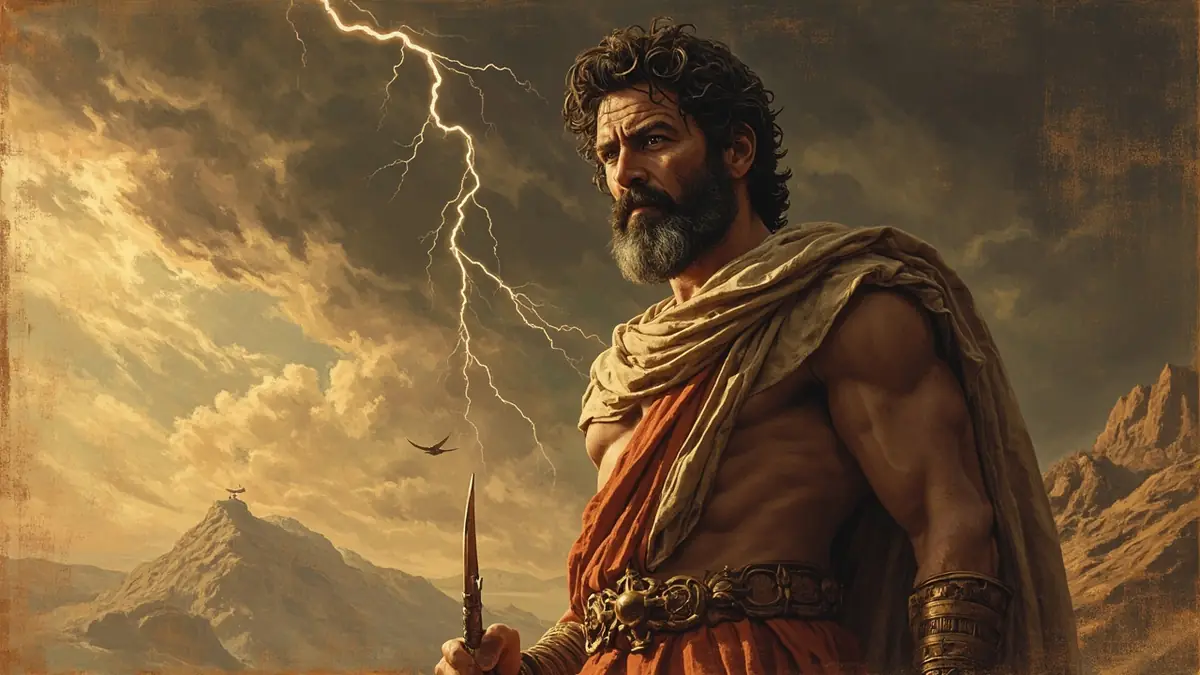
I did not invent the thunderbolt or inherit it with a ready-made crown. In Hesiod’s Theogony, the Cyclopes give me thunder, lightning and the bolt after their release from bondage. Later, after ten years of war, the Hundred-Handers become decisive allies against the Titans. Their countless arms throw volleys of rock while my fire burns through the battlefield.
My victory was not the work of a solitary hero. I owed my weapon, intelligence and military strength to others. Kings enjoy polishing alliances into personal legends. Here, I will not claim that luxury.
After our victory, the defeated Titans were confined in Tartarus, with the Hundred-Handers guarding them in Hesiod’s account. Yet Titan ancestry was not a single criminal sentence. Themis, Mnemosyne, Prometheus, Styx and her children belong to a far more complicated landscape of loyalties. The war had opposing sides, but genealogy alone did not determine guilt.
I did not receive the whole universe
The familiar image of Zeus single-handedly dividing creation flatters my throne, not the ancient evidence. In Iliad 15.187–193, Poseidon says that the three brothers drew lots. I received the broad sky, he received the sea, and Hades received the darkness below. Earth and high Olympus remained common to us all.
That made me ruler of the sky, not private owner of every patch of earth or every divine will. My supremacy rested on force, alliances, oaths, kinship and the ability to impose consequences. In the Iliad, I threaten and negotiate, but I am also resisted, deceived and forced to calculate. Hera, Poseidon and Athena are not my employees. They are powerful relatives with desires, loyalties and old claims of their own.
When I nod to Thetis and seal a promise, Olympus shakes. It sounds absolute. In practice, every promise creates another debt.
Order is not innocence
I established a kind of order after the war, but my order had teeth. I punished Prometheus in the conflict over sacrifice and fire. I swallowed Metis after learning that, following Athena, she might bear a son destined to rule gods and men. My father swallowed children. I swallowed the mother of a possible successor. The method became more elegant; the fear remained recognizable.
Poets and worshippers called upon me as guardian of oaths, strangers and suppliants. Those roles carried genuine weight in Greek religion and poetry. They were not certificates of personal innocence. A god may defend the institution of hospitality and still violate boundaries when desire takes command. Divine jurisdiction is not the same thing as moral perfection.
That contradiction is not an attack invented by modern readers. It lives in the distance between the roles attached to my name and the actions preserved in my stories.
My transformations carried a mortal price
A bull for Europa. Golden rain for Danaë. The form of Amphitryon to approach Alcmene. These stories are not interchangeable, and calling all of them “love affairs” makes power disappear from the sentence. Pseudo-Apollodorus preserves narratives involving abduction, deception and divine access that no mortal could confront on equal terms.
For centuries, my transformations have been admired as evidence of endless ingenuity and desire. Look again. Transformation can also hide identity, bypass consent or make meaningful resistance impossible. That is a modern ethical reading, not a quotation placed in the mouth of an ancient poet. It is nevertheless a reading the stories can bear — and now demand.
The children born from these unions became heroes, founders and links in royal genealogies. That helps explain why communities treasured the myths. It does not erase what happened to their mothers. My power produced political legitimacy for cities and families, while often leaving other people to pay the bill.
Even Hera’s anger, cruel as it could be, became part of that aftermath. The easier version laughs at the jealous wife. The harder version asks why divine consequences so often struck women and children while the ruler returned to his throne.
The sky never made me infallible
I will not perform the role of a modern, repentant statesman merely to become likable. The ancient sources give me no such confession. The voice you are reading is literary framing. The events remain: I overthrew a frightened father, won through allies, ruled by oaths and threats, protected institutions and violated people.
That is the problem with a thunderbolt. For one instant it illuminates everything around it except the hand holding it.
If you want only the wise father, you must discard half the stories. If you want only a monster, you must ignore the order, justice and political cohesion Greeks attached to my name. I carry both burdens: the guarantor who can become a transgressor, the liberator who fears succession, the king who knows no throne is truly eternal.
I defeated Cronus. That does not prove I escaped his shadow.
Sources and traditions
- Hesiod, Theogony 453–506 — Zeus’s birth, the stone, the release of his siblings, and the Cyclopes’ weapons.
- Hesiod, Theogony 617–735 — the ten-year war, the Hundred-Handers, and the defeat and confinement of the Titans.
- Hesiod, Theogony 535–616, 886–900 — Prometheus, fire, and the swallowing of Metis.
- Homer, Iliad 1.493–530, 15.187–193 — the promise to Thetis and the lot dividing sky, sea and underworld.
- Pseudo-Apollodorus, Library 1.1.5–1.2.1, 2.4.1, 2.4.8, 3.1.1 — Zeus’s rise and traditions concerning Danaë, Alcmene and Europa.
- Walter Burkert, Greek Religion — modern scholarship on Zeus’s sovereignty, oaths, hospitality and cult.