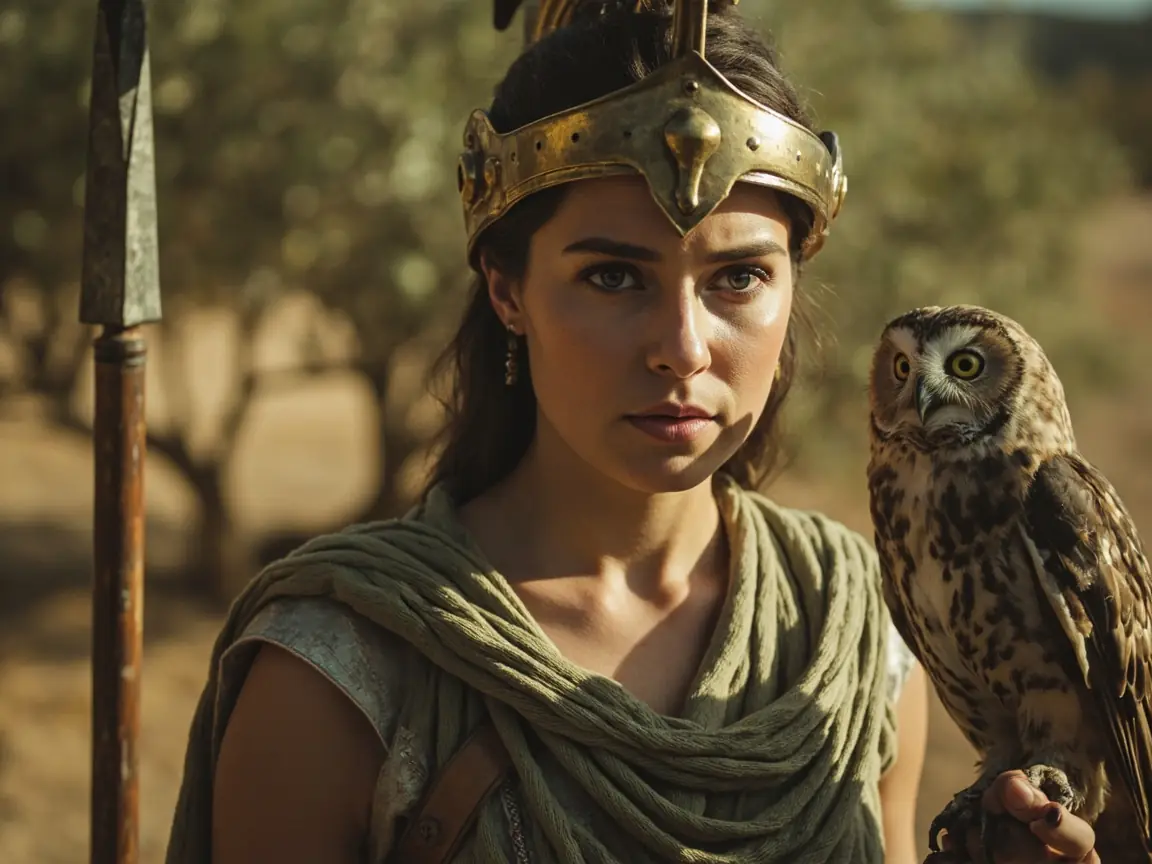
Let's clear one thing up front, because there are many versions floating around: I did not appear "out of nowhere," and I was not some marketing stunt for my father's power. I am the product of a carefully engineered move — and of a goddess you no longer see, because he carries her inside him. Her name is Metis. Without her, I would not exist, and — I'm fairly confident — neither would most of Zeus's victories. Let me walk you through it in order: calmly, with sources, and without the decorations later centuries glued on.
Before Me: Metis
In Hesiod, Metis was Zeus's first wife — not the most famous, but arguably the most dangerous to his throne. Her name doesn't just mean "wisdom." Metis is calculated intelligence: the craft of reading your opponent's move and answering before he has even decided it. That is the woman Zeus chose. And that is the woman Zeus feared.
Earth and Sky revealed the prophecy to him: Metis would bear, first, a daughter equal to her father in strength and in counsel; and then a son with an overbearing spirit, fated to rule gods and men. Zeus did not wait to see whether the prophecy would come true. He did what he does best: he moved first. While Metis was carrying her first child, he tricked her with honeyed words and swallowed her.
Notice what that actually says, because it is usually read in a hurry: Metis did not die. In Hesiod, she remained inside Zeus — and from within him she plotted his gains and his troubles, a permanent counselor. My father did not eliminate a threat. He acquired lifetime access to the best advisor in existence. Think of it as a hostile takeover where the company never closes: it simply becomes a part of you.
(One detail, with its label: the later Pseudo-Apollodorus adds that Metis changed shapes to escape Zeus — animals, forms, everything she had. That scene is not in Hesiod.)
How I Was Born: Three Tellings, One Head
The first telling is the oldest: Hesiod's. When the time came, Zeus gave birth to me from his head. He spends only a few lines on it, almost in passing — I spring up before him with my spear, and Olympus trembles. No axe, no assistants, no staged pyrotechnics. Brevity is not a deficiency; it is style.
The second is the Homeric Hymn to Athena — and here the spectacle begins. The poet sees me stepping out of the immortal head in full golden armor, shaking a long spear. Olympus shudders, the earth cries aloud, the sea is thrown into dark waves — and the Sun halts his horses in the sky until I set my armor aside. I cannot swear to you that it happened exactly so; I can tell you it is exactly how it deserved to be written.
The third telling is later and far more cinematic: Pseudo-Apollodorus writes that at the moment of labor someone split Zeus's head open with an axe — he assigns the role to Prometheus or, as others say, Hephaestus. This is the scene painters love. Just know this: it is not in Hesiod. If anyone presents it to you as "the ancient version," they are selling you a later tradition without the label.
The Mother You Cannot See
In the main Greek texts, I have no mother — not in the sense you mean. There is no "mother of Athena" holding an infant; my maternity is hidden inside my father. That is why they call me the daughter of the mind: Zeus's head and Metis's cunning, in one body.
But there was a tradition that told it differently. Herodotus writes that the Libyans believed Athena was the daughter of Poseidon and Lake Tritonis — and even that my robe and my fringed aegis were borrowed by the Greeks from the dress of Libyan women. I am not telling you to believe it. I am telling you it existed. Wisdom is knowing the difference between what you know, what you have merely heard, and what you would like to be true.
One more thing, because I hear it constantly: reading my story as a symbol of patriarchy — the man who "absorbs" the woman's wisdom and gives birth alone — is a modern interpretation. Interesting, entirely legitimate as analysis, and nowhere to be found in the ancient texts. The texts say exactly what I have narrated to you.
Athens — and the Gift That Kept Growing
When the contest for the city came, Poseidon arrived first and struck the sacred rock of the Acropolis with his trident: a sea sprang out — salt water inside stone. I moved second and planted an olive. I had called Cecrops as my witness at the moment of planting; in the judgment that followed he testified that Athena had first taken possession of the land — and the twelve gods, sitting as arbiters, awarded the city to me. Poseidon did not take it graciously — they say that in anger he flooded the Thriasian plain. I gave the city my name. Fair? I would say: documented.
And Herodotus keeps the best part of the story: when the Persians burned the Acropolis, the sacred olive burned with the temple. The next day, from the charred stump, a new shoot grew — a cubit high. My gift was not an advertisement; it was infrastructure. And infrastructure grows back.
Arachne: A Story That Arrived Late
Many attribute the story of Arachne to me as if every ancient Greek knew it. A little precision, please: the version you know — the Lydian weaver, the dyer's daughter, the contest at the loom, the insolence, the noose, the spider — is told by Ovid, a Roman poet, in his Metamorphoses, centuries after classical Athens. The spirit of the story suits me: flawless technique, yes; insolence toward the gods, never. But when you look at it, you are looking through a Roman pen. Later Greeks loved it and kept it — as we keep all good stories. With the receipt attached.
Sources and traditions
- Hesiod, Theogony 886–900 — Zeus's marriage to Metis, the prophecy of Earth and Sky, the swallowing; Metis remains inside Zeus as counselor.
- Hesiod, Theogony 924–926 — the birth of Athena from Zeus's head.
- Homeric Hymn 28, To Athena — the armed emergence from the immortal head, the trembling of Olympus, the Sun halting his horses.
- Pseudo-Apollodorus, Library 1.3.6 — Metis's shape-shifting and the opening of the head with an axe (Hephaestus or Prometheus); a later tradition.
- Pseudo-Apollodorus, Library 3.14.1 — the contest with Poseidon for Athens, Cecrops's testimony, the flooding of the Thriasian plain.
- Herodotus, Histories 8.55 — the sacred olive that re-sprouted after the Persian fire.
- Herodotus, Histories 4.180 — the Libyan tradition: Athena, daughter of Poseidon and Lake Tritonis.
- Herodotus, Histories 4.189 — the goddess's aegis and dress, borrowed from the fringed goatskin garments of Libyan women.
- Ovid, Metamorphoses 6.1–145 — the myth of Arachne.