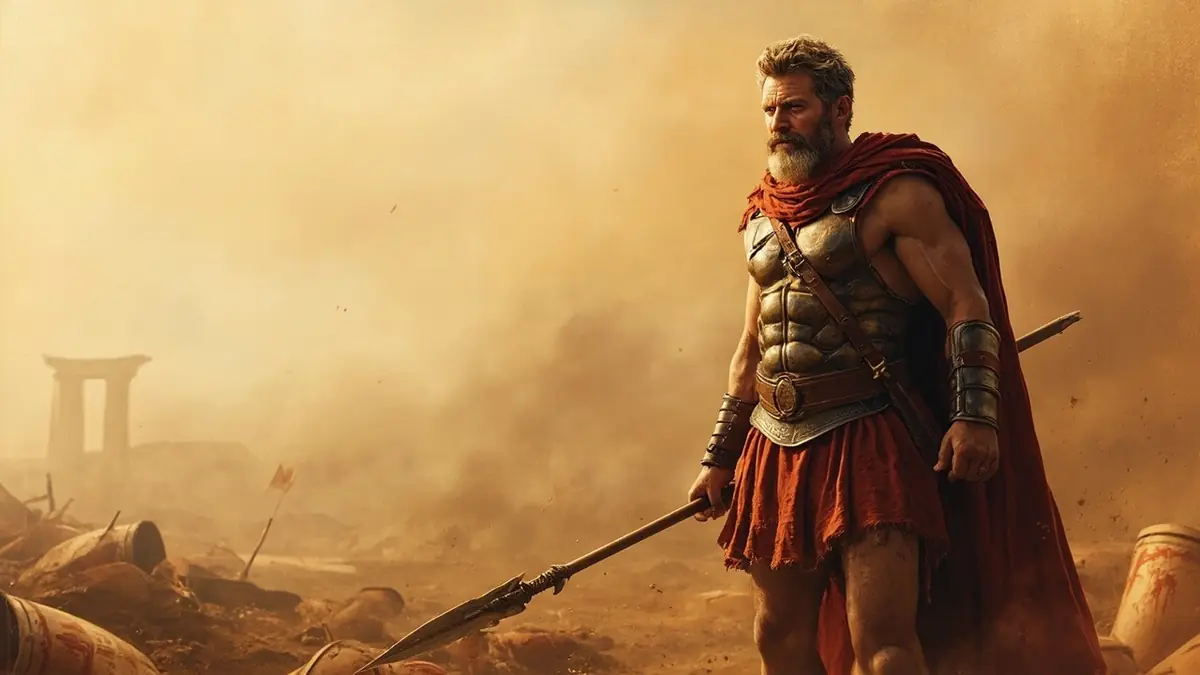
My name is Ares, and people think that is enough to explain me. War. Blood. A scream. A bronze helmet covering an empty head.
The poets did not flatter me. In Iliad 5.888–898, Zeus himself calls me the most hateful Olympian because strife and war are always dear to me. If you came here for an apology, you chose the wrong temple. What I can offer is harder: the difference between the glory of war and war itself.
I was not Troy's commanding general
I did not run a single divine headquarters during the Trojan War. The gods chose sides, shifted the balance, and broke boundaries laid down by Zeus. Hera and Athena favored the Achaeans. Apollo, Aphrodite and I often stood nearer the Trojans. “Often” matters. In the same book, Athena reminds me that Hera, Athena, and I had agreed to help the Achaeans, yet I was fighting among the Trojans. Zeus therefore calls me alloprosallos: changeable, unreliable, facing one way and then another. Divine alliances in the Iliad shift with anger, kinship, and insult.
Athena represents the kind of war that wants to believe it is rational: planning, discipline, the proper moment. I am war after the plan breaks. Our conflict is not simply “wise goddess against violent god.” We are two truths of the same field. No strategy stays clean once bodies begin to fall.
The day a mortal wounded me
In Book 5 of the Iliad, Athena helps Diomedes strike me. The mortal did not suddenly become stronger than a god. She guided his spear and drove it into my body. I roared with the sound of thousands of warriors, left the battlefield, and climbed to Olympus to complain to Zeus.
Yes, I complained. Hold your laughter for a moment.
The god of war was wounded inside war. Nothing could show battle more clearly. No one stands outside it, not even the power that imagines it is in command. Zeus did not comfort me. He rebuked my love of quarrels and battle. Then, because I remained his son, he ordered that I be healed.
That is Olympus: condemnation, kinship and medical care in a single scene.
Athena knocked me down again
Later, in Book 21, the gods fight openly. I attacked Athena. She seized a great, black, jagged stone — an old boundary marker for a field — and struck me in the neck. I fell and covered a great stretch of ground. Aphrodite tried to lead me away; Hera sent Athena after her, and Aphrodite fell as well.
It is not my most flattering scene. It is Homeric, however, not a modern joke. The poet is unafraid to make immortals look ridiculous beside mortal suffering. Perhaps he wants us to remember that the gods return to Olympus while humans remain in the soil.
Fear and Terror march with me
Hesiod names Phobos and Deimos as the children of Aphrodite and me. On a battlefield their names need no translation. Fear comes before the clash; Terror remains after it begins.
People often speak of honor, courage and kleos, the glory that survives death. Those are not inventions. Hector fought while knowing what he could lose. Achilles chose a short life with undying fame. Patroclus entered battle in another man's armor and paid the price. Yet each brilliant name in epic tradition casts a shadow over hundreds who remain unnamed.
Those are the ones I remember. The soldier who received no carved epitaph. The man who ran without being a coward because his body understood first that it wanted to live. The family that heard the word “glory” and received an absence.
The shield that said more than speeches
In Book 18, Hephaestus makes the shield of Achilles. It carries two cities: in one, weddings are celebrated and a dispute is judged in the marketplace; the other is under siege. In the battle around the second city, Athena and I appear larger than mortals and clothed in gold.
Do not look only at the gold. Notice that war occupies one place inside an entire world of fields, dancing, herds, judgment, harvest and marriage. That is what disappears when you turn me into a mascot for violence. War is not all of life. It is the force that threatens to consume all of life.
What I will not glorify
I will not tell you every battle was necessary. I will not rename every killing a sacrifice. I will not present the Trojan War as a clean contest between good and evil. Ancient traditions do not even agree that Helen was physically present in Troy. How could they agree on the justice of ten years of bloodshed?
I am Ares. I am not the cause of every war, and I am nobody's excuse. In the Iliad, I embody the fury and disorder of battle. I am not the sole cause of human war, and I am nobody’s excuse.
If you want to honor me, do not lift a sword. First look at who will remain on the ground after the speeches end.
Sources and traditions
- *Homer, Iliad 5.825–909* — Ares changing sides, his wound, and Zeus’ rebuke.
- *Homer, Iliad 6.390–502; 9.410–416; 16.130–144, 818–857* — Hector, Achilles’ choice, and Patroclus’ death.
- *Homer, Iliad 18.478–608; 21.391–433* — Achilles’ shield and the clash between Athena and Ares.
- *Hesiod, Theogony 933–937* — Phobos, Deimos, and Harmonia as children of Ares and Aphrodite.
- *Pseudo-Apollodorus, Epitome 3.5; Euripides, Helen 31–43* — the Egyptian tradition and Helen’s phantom.
Editorial note: Ares' voice and private comments are literary reconstruction. Homeric episodes and competing ancient variants are identified separately.