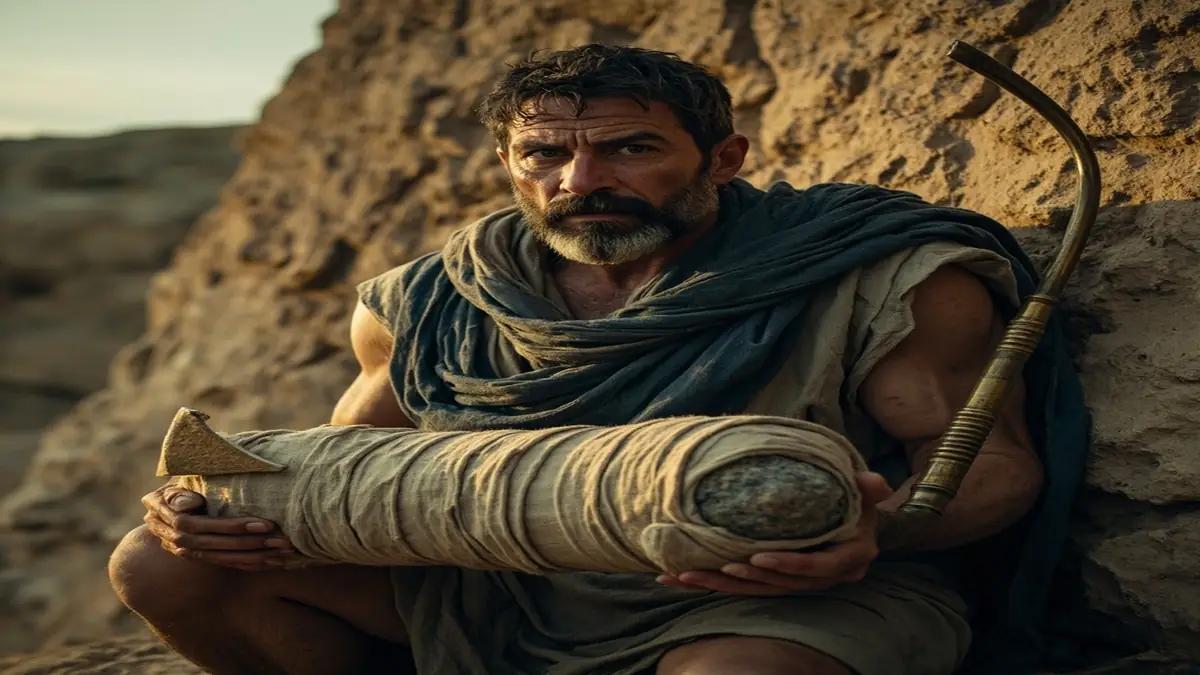
I will tell you a story that began before I was born. I did not witness the first things; I inherited them as genealogy, trauma, and prophecy. To a Titan, however, yesterday compared with those events is still a sneeze.
(Narrator's note: my private thoughts, the scenes I paint and the motives I attribute to myself are literary framing — where the ancient sources fall silent, I write as Cronus, not as a scholar.)
Before everything: Chaos
Hesiod begins with a word that resists a single translation: Chaos. Whether it means a gap, an opening, or something else is a matter of interpretation. The poem's sequence is clear: Chaos first, followed by Gaia, Tartarus, and Eros.
After Chaos, Hesiod places three first beings: Gaia, Tartarus and Eros — the force that unlocks every union (Theogony 116–122). From that Chaos came Erebus and Night. Night, united with Erebus, gave birth to Aether and Day; on her own, Night gave birth to Sleep and Death.
Gaia — the first mother
And then came Gaia. The Earth. My mother. Hesiod places her after Chaos without naming any parent. On her own, without an erotic act, she gave birth to Uranus, the Mountains, and Pontus (the Sea).
Uranus — the first overlord
Uranus embraced Gaia. And from that embrace came her first children: the Titans — twelve exactly, as Hesiod records them (Theogony 133–138, 453–506). First Oceanus, then Coeus, Crius, Hyperion, Iapetus, and I, Cronus. And my six sisters: Theia, Rhea, Themis, Mnemosyne, Phoebe, Tethys.
(Literary framing: Uranus' inner thoughts and motives are my imagining — Hesiod says what he did, not why.)
Then came the Cyclopes and the Hecatoncheires. Beings beyond any imagination.
The dark side of Uranus
Here is where the story that marked me begins.
Uranus was not a good father. He looked at his children and saw threats. Hesiod says plainly that he hated them — from the very moment they were born (Theogony 155–160). So what did he do? He locked them back inside Gaia. Every time Gaia gave birth, he pushed the newborns back into the dark, into the bowels of the earth.
The day I took the sickle
Hesiod says Gaia "forged" a sickle from grey adamant and asked me to castrate my father. Many read the castration literally — as a sexual assault. Others read it symbolically, as the "cutting" of male domination. I will not tell you which version is "right," because no one knows. But I know what happened next.
I took the sickle. I waited for Uranus at Gaia — because down to her he always came at night. When he came, I struck. From the blood of Uranus that fell upon the earth were born the Erinyes (the eternal avengers), the Giants, and the Meliae (nymphs of ash trees). Later, from his genitals cast into the sea, the sea foamed and out came Aphrodite — born not from blood but from foam.
And so Uranus, the first king, fell.
The scene I imagine
Hesiod does not narrate Uranus' death or a theatrical retreat above the clouds. If I imagine him distant and bitter, that is literary framing. In the same Hesiodic tradition, Uranus and Gaia later warn that one of my children will overthrow me. He does not simply become a voiceless backdrop.
The ascent of the Titans
With Uranus set aside, Gaia breathed. The Cyclopes and Hecatoncheires came into the light — or, to be precise, it is not certain I freed them right away. Hesiod does not say so explicitly; Apollodorus (Bibliotheca 1.1.1–1.2.1) narrates that I brought them out and then, fearing their strength, locked them up again in Tartarus. Perhaps Apollodorus is filling in; perhaps Hesiod is silent on purpose. The only certain thing: my relationship with these siblings of mine was never simple.
And we, the Titans, became rulers.
I, Cronus, took my father's place. Then Gaia and Uranus warned me that one of my children would overthrow me. So I swallowed each child as Rhea bore it; Zeus survived because she hid him and gave me a swaddled stone. I knew what a son could do to a father — and became what I feared.
Each Titan carries his own power. Oceanus is not "the sea" — he is the cosmic river that, for Hesiod, flows all around the earth. The sea with its waves is Pontus — the one Gaia bore without a father. Mnemosyne holds memory, Themis institutional order, Phoebe light — together with Coeus she will bear Leto, mother of Apollo. Tethys and Oceanus begot the three thousand rivers and the Oceanids. Theia with Hyperion bore Helius (the sun-god), Selene, and Eos, the dawn. Iapetus will become the father of Prometheus. And I am Cronus, not automatically Chronos or Time; later authors and interpreters often merged our names. With Rhea, my sister, I will beget the gods who will overthrow us.
Other traditions, other voices
Hesiod was not the only one. Pherecydes of Syros, our elder, placed at the beginning three principles: Zas (a form of Zeus), Chronos (Time), and Chthonie (the Earth) — in fragments preserved by later authors. A more philosophical cosmogony, less dark. If you asked me to be honest, I would tell you that Pherecydes' Chronos does not automatically identify with me — Greek spelling and later conflations require a note of caution. Later interpretation often merged Chronos and Cronus; Pherecydes did not identify his primordial Chronos with Hesiod’s Titan.
The Orphic cycle goes even further back — and it is not unified. In some versions, Nyx holds an egg; in others, the dawn precedes it or co-exists with different principles. Scholars speak of different fragment numberings (Kern, Bernabé, West) that do not agree — which is why I avoid false precision. In several accounts, from the egg emerges Phanes (or Protogonos), beginning a divine succession that eventually includes Night, Uranus and Gaia; the exact genealogy changes between Orphic reconstructions. The label "Phanes-Hermes" is not universal; Hermes appears alongside him in some texts, but not all. And the beginning is not always bloodless.
Cronus is not automatically Chronos
Let me tell you something. Everyone speaks of "mythology" as if it were a fairy tale. It was not. It was the way the first Greeks explained why there is something instead of nothing. My story is a warning: when a god fears his children, his children will overthrow him. And when they overthrow their father, they will become like their father. That is the vicious cycle I, Cronus, know firsthand.
Sources and traditions
- Hesiod, Theogony (lines 116–210 — the first beings, the birth of Uranus/Titans, the castration; 453–506 — the children of Cronus and Rhea).
- Apollodorus, Bibliotheca (1.1.1–1.2.1) — the prose synthesis of the tradition and the re-imprisonment of the Cyclopes/Hecatoncheires in Tartarus.
- Pherecydes of Syros (fragments preserved by Damascius and other later witnesses; numbering varies by edition) — the alternative cosmogony with Zas, Chronos, and Chthonie.
- Orphic Fragments — the numberings of the Kern, Bernabé and West editions differ significantly; for the egg cosmogony and Phanes/Protogonos I use the general picture without false precision.
- Editorial note: Pherecydes' Chronos does not automatically identify with the Titan Cronus — Greek spelling and later conflations (especially in the Roman period) require caution.