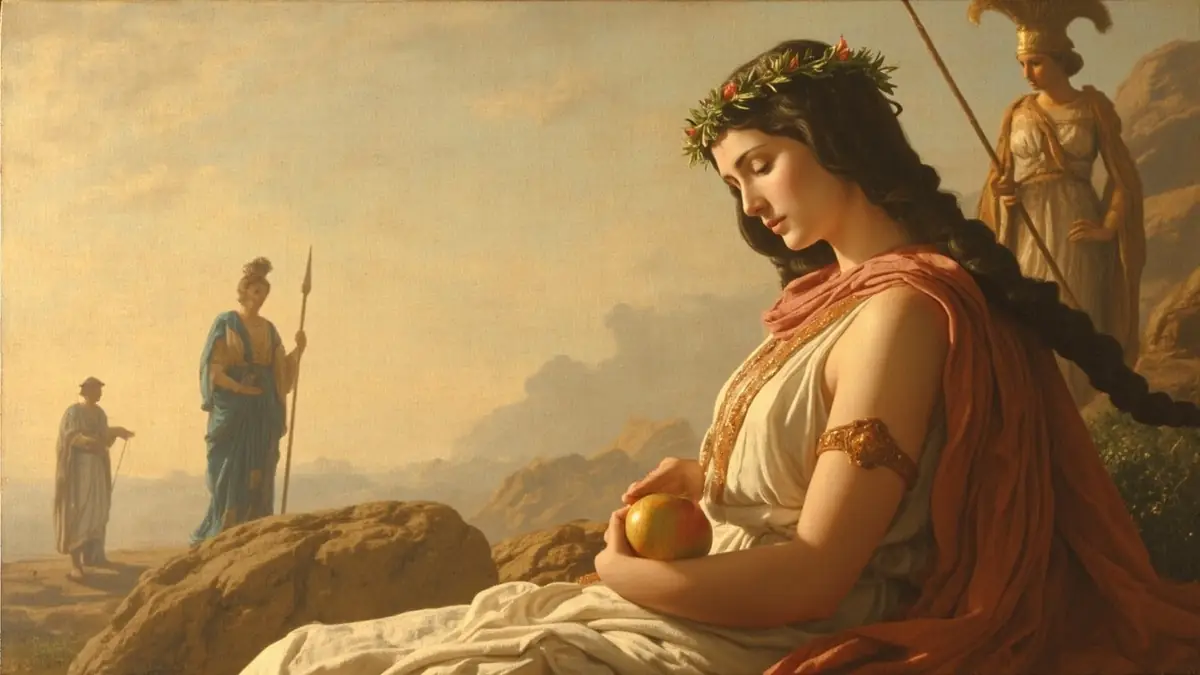
People keep asking me if I regret the apple. I laugh every time — because nobody asks the right question. I don't regret the apple. I regret that the world believes everything started with it.
Let me tell it the way I lived it. No pauses for drama. No "let us explore what truly happened." I was there, and the facts speak for themselves.
> A note before we begin: the first-person voice, private motives, and sensory scenes that follow are literary framing — my voice, not an ancient source. Where the ancient traditions disagree, I'll say so openly.
Before the apple: the wedding that almost wasn't
It all started at a wedding. Not mine — Peleus and Thetis, on Mount Pelion, where Chiron the centaur had his cave. Every Olympian had been invited except one: Eris, goddess of discord. Eris cannot bear guest lists that omit her name. She answered the insult by sending a single golden apple into the feast, an inscription carved deep into the skin: "To the fairest."
Not the wisest. Not the most just. The fairest. And only one apple — not three prizes, not a bundle in each hand.
Hera, Athena, and I didn't need to exchange glances. We all knew the inscription wasn't a question — it was a provocation. And all three of us took it personally. The lost Cypria, known through Proclus' summary, preserves the wedding and the quarrel; Apollodorus' Epitome explicitly gives the golden apple.
Paris was not chosen by accident
Zeus refused to judge among us. He ordered Hermes to lead Hera, Athena and me to Paris, Priam's son, who was living as a shepherd on Mount Ida after an omen had caused his abandonment in infancy. Apollodorus' Epitome preserves the appointment. Paris could judge three goddesses; refusing Zeus was another matter.
The judgment on the mountain
The cold valley, snow and smoke belong to my literary staging; the sources do not provide a weather report. They do give us one apple and three offers. Hera promised rule and power. Athena promised victory and martial excellence. Then came my turn.
What I told him
I didn't speak of kingdoms. I didn't speak of wisdom. He had heard both already, and had learned young that neither was enough.
In modern words, my offer was simple: I would give him the most beautiful woman in the world. Pseudo-Apollodorus states it more precisely as marriage to Helen.
That was it. No crown. No army. Just a woman.
And Paris took the single golden apple and gave it to me.
Why my offer was not innocent
The woman was Helen, wife of Menelaus, king of Sparta. Paris was not ignorant of her marriage. He later travelled to Sparta, accepted Menelaus' hospitality, and departed with Helen while his host was away.
I had won the apple and the hostility of Hera and Athena. Iliad 24.25–30 links their hatred of Troy to Paris' judgment; it does not say that I knew every future death or foresaw Troy burning. Certainty would be another invention. The honest word is risk.
What followed in Sparta
Ancient traditions do not agree about Helen's departure. Some make her willing, some emphasize Aphrodite's divine compulsion, and others describe abduction. The lost Cypria and Apollodorus belong to this disputed tradition. A radically different strand removes the real Helen from Troy entirely.
That disagreement matters. Reducing Helen to either a faithless wife or a silent prize makes the story easier, not truer. It also conceals how much responsibility each poet assigns to gods, men, and Helen herself.
What Homer actually lets me do
Hera and Athena support the Achaeans, while I repeatedly defend the promise I made to Paris. In Iliad 3, when Menelaus is dragging Paris toward defeat, the helmet strap breaks and I conceal Paris in mist, carrying him to his chamber. I then summon Helen and threaten her when she resists. It is not a tender portrait of love. It is a portrait of divine power enforcing its own bargain.
The truth about my promise
I can call my attachment to Paris love, but that is the voice of this retelling, not a fact recorded by Homer. What survives in the sources is my partiality: I offered Helen, Paris chose me, and I protected him when the consequences arrived.
The apple was a trigger, not an explanation
The myths make the judgment a cause of divine hostility, but a ten-year war cannot be understood through one beauty contest alone. Oaths, dynastic power, wounded hospitality, desire and divine rivalry all enter the tradition. “The apple caused everything” is a memorable headline, not a complete explanation.
The traditions refuse to agree
- Theseus had already abducted Helen when she was young; no ancient source has him taking her “with her sister.”
- Stesichorus' Palinode denied that Helen went to Troy. Euripides' Helen uses a phantom at Troy while the real Helen remains in Egypt. Herodotus also places Helen in Egypt, but without a phantom: in his account the Egyptians detain the real Helen after Paris arrives there.
That is not a flaw in Greek mythology. It is the reason the story remained alive: each poet asked who was responsible, and each answer exposed a different fear.
Sources and traditions
- Cypria (fragments, through Proclus' summary) — for the wedding, the divine quarrel and the judgment; the surviving summary does not itself preserve every later detail of the apple.
- Apollodorus, Epitome 3.2–3.3 — for the appointment of Paris as judge and his voyage to Sparta.
- Homer, Iliad book 3 — for Helen at the walls and Aphrodite rescuing Paris; Iliad 24.25–30 — for the consequences the judgment set in motion.
- Euripides, Helen — for the real Helen in Egypt and the phantom sent to Troy.
- Stesichorus, Palinode — for denying Helen's presence at Troy; Herodotus, Histories Book 2 — for a distinct Egyptian account involving the real Helen, not a phantom.
> Editorial note: the first-person voice and the private motives I ascribe to Paris, Helen, and myself are literary framing. Where ancient sources compete — willing elopement, divine compulsion, abduction, or the phantom Helen — I have flagged the disagreement rather than picking a winner.