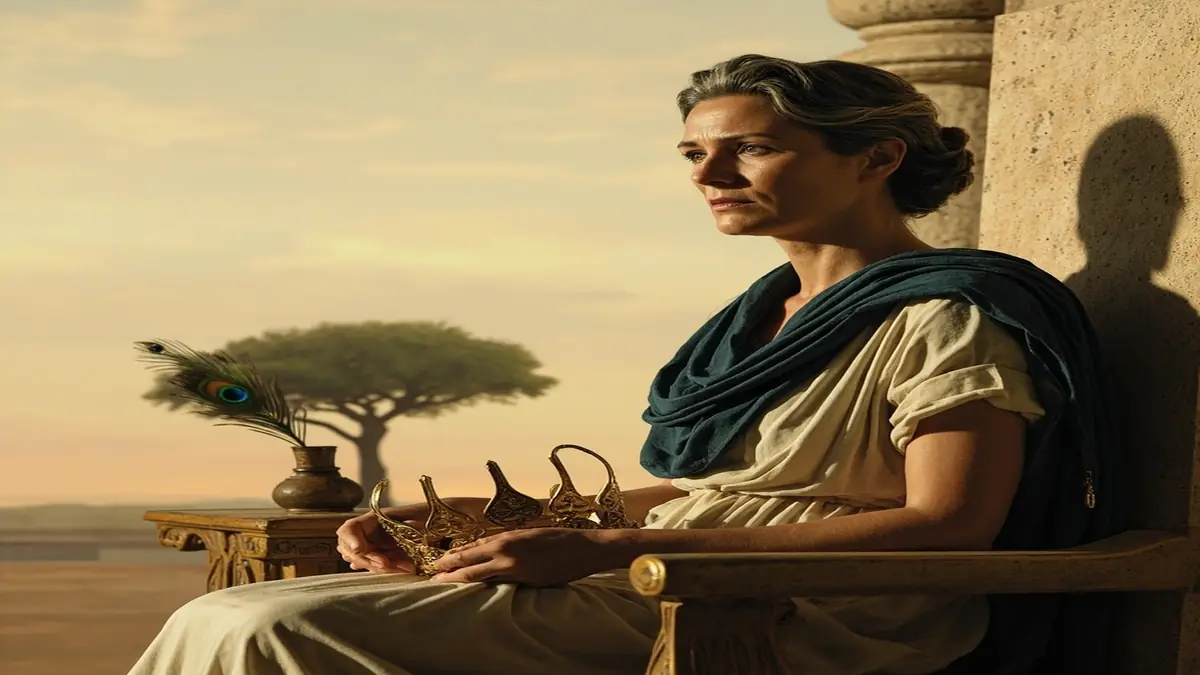
I was never merely the jealous wife
Mortals have enjoyed making me small. They call me jealous, spiteful, forever stalking the women who crossed Zeus’s path. It is a tidy portrait, useful to poets who wanted thunder to look majestic and consequence to look hysterical. How convenient.
I was not a footnote to my husband’s appetite. I was queen of Olympus, goddess of marriage, lawful union, legitimacy, and the public bond that turns desire into household, dynasty, and order. No ancient source describes our marriage as a formal political compact after the Titanomachy. That is my modern reading: when the ruler of the sky joins the goddess of lawful marriage, the thunderbolt gains ritual, institution, and public order beside it.
Zeus had the thunderbolt. I had the throne beside him, the rites, the sanctuaries, the old authority of marriage itself. If he broke that bond again and again, do not reduce my rage to vanity. When the king violates the institution the queen embodies, the crisis is not domestic. It is constitutional, divine, and dangerous.
How the marriage is remembered
There is never only one version with us. Myth is not a ledger; it is a storm seen from different hills. Pausanias says Zeus transformed himself into a cuckoo and that I caught the bird and kept it as a pet. The wounded, rain-soaked bird belongs to later retellings, not to that passage. Call it seduction or call it trickery; I call it the first warning sign, wrapped in feathers.
Our wedding was remembered with grandeur. Cities honored me at Argos, Samos, Olympia, and elsewhere. Women prayed to me for marriage and childbirth; communities honored me because marriage was never just private affection. It was inheritance, alliance, citizenship, family honor, and the terrifying promise that a household could become a kingdom or a battlefield.
So yes, I guarded marriage fiercely. Too fiercely, at times. But understand what I guarded: not a pretty ceremony, not a veil, not the shallow pride of being chosen. I guarded the line between order and appetite. Zeus crossed that line often.
Zeus’s conquests were never only romance
You know the stories. Europa and the bull. Leda and the swan in one influential tradition. Danaë and the golden rain. Alcmene deceived by Zeus in the shape of her own husband. These were not interchangeable "affairs" and not all were consensual. The sources speak variously of desire, deception, abduction, and divine coercion.
The poems often marvel at his transformations. What imagination, they say. What power. I hear something else beneath the applause: evasion. A god changes shape when he wants access without accountability. A king calls it desire. The world calls it myth. The women and their children live inside the aftermath.
I will not pretend my reactions were clean. Io suffered in traditions that tell of her transformation and wandering, tormented by the gadfly. Leto was driven from place to place before she bore Apollo and Artemis. Semele died after being persuaded to demand that Zeus appear in his full divine form; in one version, I came to her disguised and fed that fatal doubt. Heracles, born from Alcmene, carried my anger like a brand pressed into his life.
If you came here for a charming little joke about a furious wife, leave now. Some stories deserve sharper light.
Revenge gave me a weapon and left a wound
I could not always strike Zeus directly. Strike the sky too hard and creation trembles. So my anger traveled sideways. It found the vulnerable, the mortal, the child who had not chosen his father. That is the part my worshippers feared and my enemies never let me forget.
I can explain it. I will not decorate it.
Revenge was the language left to a queen whose authority had been insulted in public and in secret. Each affair proclaimed that Zeus could take, disguise, vanish, and still sit unchallenged at the center of order. My punishments answered with dread. They said: there is a cost. They also sometimes made the wrong people pay it.
Power does not become innocent because it is wounded. I know this. Divine force magnifies every failure of judgment. A mortal’s bitterness may ruin a house. A goddess’s bitterness can become a genealogy of suffering.
Heracles is the hardest mirror. Traditions link me to serpents in his cradle and to the madness that drove him to terrible violence. Their sequence differs: in Apollodorus the madness precedes the labours; in Euripides' Heracles it follows his return. After his apotheosis, his marriage to my daughter Hebe — and, in Diodorus, his ritual adoption — points toward reconciliation. That ending matters without erasing the cruelty.
I was a political force, not a decorative queen
In the Iliad, I am not silent. I argue, plot, pressure, and choose sides. I favor the Achaeans. I resist Zeus when his will collides with my loyalties. I can be cunning, proud, relentless, and openly furious. Good. A queen who never disturbs the room is usually furniture.
In Iliad 1.396–406, Athena, Poseidon, and I attempted to bind Zeus, until Thetis summoned Briareus and the plan collapsed. The point is clear: Olympus was not a peaceful family dinner with better lighting. It was a court. A court has alliances, humiliations, negotiations, threats, and the occasional divine tantrum dressed as policy.
My marriage placed me at the center of that court. I was sister and wife of Zeus, daughter of Cronus and Rhea, mother of gods, patron of weddings, protector of legitimate union. Those titles are instruments. They gave me standing when I spoke, even when thunder tried to drown me out.
My version
Was I severe? Yes. Was I unjust? At times, painfully. Did my jealousy become a storm that struck people who were not holding the thunderbolt? It did. But I was never the simple villain of a husband’s adventures. I was the queen forced to defend the meaning of a bond my own husband made famous by breaking.
Judge me if you must. I have stood beneath judgment for centuries and remained crowned. But judge Zeus too. Judge the stories that turn male appetite into destiny and female anger into monstrosity. Judge the comfortable habit of laughing at betrayal when the betrayed woman refuses to smile.
I do not ask to be softened. I ask to be read accurately. In me you see revenge, dignity, wounded power, and the cost of a marriage used as theater while its vows are treated as scenery.
Zeus may command the weather. I command memory. And memory, unlike lightning, does not vanish after it strikes.
Sources and traditions
- Homer, Iliad 1.396–406 — the attempt to bind Zeus; the poem more broadly for Hera's political role in the war.
- Hesiod, Theogony 453–458, 921–929 — Hera's genealogy, marriage to Zeus, and children.
- Pausanias, Description of Greece 2.17.4 — Zeus as a cuckoo and Hera's cult at Argos.
- Pseudo-Apollodorus, Library 1.4.1, 2.1.3, 2.4.8–12, 2.7.7, 3.4.3 — Leto, Io, Heracles, and Semele.
- Euripides, Heracles; Diodorus Siculus 4.39 — a different chronology of the madness and a tradition of reconciliation.
- Walter Burkert, Greek Religion — modern scholarship on cult, institutions, and divine roles.