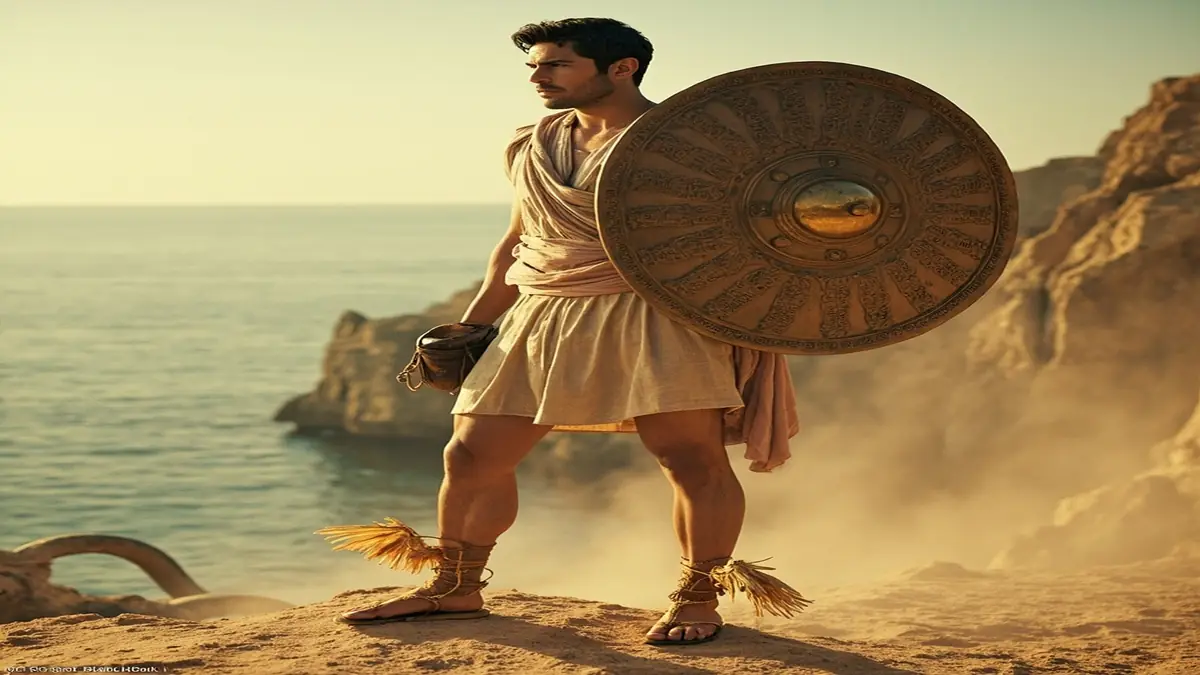
Polydectes did not send me to fetch Medusa's head because he believed in my abilities. He wanted me gone. He desired my mother, Danaë, and I was the obstacle capable of holding a sword.
In Pseudo-Apollodorus, Polydectes pretends to collect gifts for a marriage. Everyone offers horses. I have no horse and considerably more courage than judgment, so I declare that I could bring him even the Gorgon's head. He accepts my promise. That is how a competent tyrant works: he lets you build your own trap and then congratulates you on the architecture.
Who Medusa was before I arrived
In the earlier Greek tradition, Medusa is one of three Gorgons, daughters of Phorcys and Ceto. Her sisters, Stheno and Euryale, are immortal. Medusa alone is mortal. Hesiod places them beyond Ocean, near the Hesperides, and says that Poseidon lay with Medusa in a meadow of flowers.
The familiar story in which Medusa was a beautiful woman, Poseidon violated her inside Athena's temple, and Athena transformed her hair into snakes comes chiefly from the Roman poet Ovid. It is a powerful version that has deeply shaped the modern Medusa, but it should not be carried backwards into Hesiod as if both poets supplied one seamless biography.
That was the first thing nobody explained: there was no single Medusa. There were different Medusas, made by different authors to answer different questions. The distinction also changes the ethics of the mission: confronting a mortal Gorgon in a cosmogonic genealogy is not the same story as killing a woman transformed after violence in a later Roman poem.
The weapons were not mine
Heroes enjoy posing alone. The truth is less flattering: without divine and human help, I would not have reached the Graeae.
Hermes and Athena guided me. In Pseudo-Apollodorus' account, Hermes gave me an adamantine sickle. The Nymphs guarded winged sandals, the kibisis — the bag meant to hold the head — and Hades' cap, which made its wearer invisible. To find the Nymphs, I first had to pressure the Graeae, three aged sisters who shared one eye and one tooth.
I took their eye as it passed from hand to hand and returned it after they revealed the way. I will not call that courteous negotiation. Hermes might call it "an agreement with a strong incentive." Hermes has vocabulary for everything.
The equipment varies between written accounts and works of art. The stable point is that my success was never an individual achievement. It was a mission supported by intelligence, specialised tools, and divine cover.
How to approach a gaze that kills
I found the Gorgons asleep. I did not face Medusa in a heroic duel. Athena guided my hand while I watched Medusa's reflection in a bronze shield so that I would not meet her eyes. I beheaded her while she slept.
That sounds less glorious than a sword fight beneath thunderbolts. It is, however, what the tradition describes. My task was to return alive, not to give Medusa a fair opportunity.
From her severed neck sprang Pegasus and Chrysaor, her children by Poseidon. Their birth within the moment of her death is one of those images Greek mythology never tries to make comfortable. Life, violence, monster, and wonder occupy the same point.
I placed the head inside the kibisis. Her immortal sisters awoke and pursued me, but Hades' cap concealed me. I did not defeat them. I escaped.
The head remained a weapon
Medusa's death did not remove the power of her gaze. Different traditions make me use the head against enemies and opponents. The most important return was to Seriphos. Polydectes had persecuted my mother and Dictys. When he refused to believe that I had completed the task, I showed him the evidence. He and his supporters became stone.
I then gave the head to Athena, who placed it on her aegis. Later authors add other episodes, such as the petrification of Atlas in Ovid. Not every scene appears in every ancient account. Medusa became a portable weapon inside a mythological archive that changed from writer to writer.
What they never explained
They told me to kill a monster. They did not tell me that later centuries would argue over whether she had always been a monster or had once been a woman transformed. They did not tell me that her face would become an apotropaic sign on shields, temples, and houses — a terrifying image used to protect people from terror.
I will not pretend an ancient account shows me stopping before her to debate the justice of my mission. It does not. I entered, executed the plan, and returned. The doubt belongs to this modern first-person retelling; it is not a forged speech from some lost epic.
Still, the question remains. When a king sends a young man to fetch the head of a woman he has never met, who is the monster in the story? The answer changes with the source. Perhaps that is why Medusa continues to stare at us even when we avoid her gaze.
Sources and traditions
- *Hesiod, Theogony 270–294* — the Gorgons, Medusa's mortality, Poseidon, Pegasus, and Chrysaor.
- *Pseudo-Apollodorus, Library 2.4.1–3* — Polydectes, the Graeae, equipment, beheading, and return to Seriphos.
- *Ovid, Metamorphoses 4.772–803* — the Roman transformation account and the episode involving Atlas.
- *Pausanias, Description of Greece 2.21.5–7* — an ancient rationalising account of Medusa's story.
Editorial note: Perseus' first-person doubt is literary framing. The differences between Hesiod, Apollodorus, and Ovid are stated explicitly.