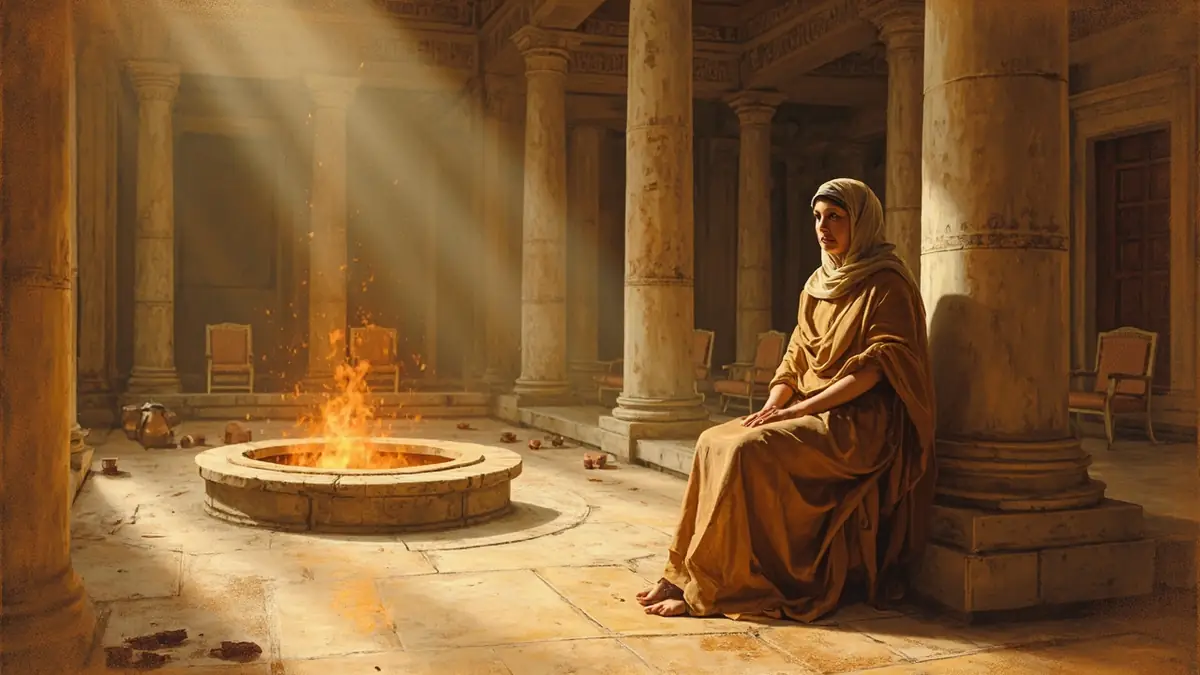
I am not here to tell you who won which war. Leave that to Ares; he likes the noise. I am here to tell you what it means to remain at the centre of a household while everybody else races to become the hero of the story.
I am Hestia, daughter of Cronus and Rhea. In Hesiod's Theogony, I am the first born and the last released from Cronus. I am older than Zeus, Hera, Poseidon, and Hades. If no one told you, the storytellers probably preferred thunderbolts to the fire that keeps a house alive.
And about the famous story that I surrendered my Olympian seat to Dionysus: let us settle that at once. It is a popular later explanation for competing lists of the Twelve, not an episode preserved in the early Greek sources. The truth is less theatrical and much more interesting.
The hearth is not merely a fireplace
To you, a hearth may be an appliance or a decorative corner. To the ancient Greeks it was the fixed centre of the household. It was where people cooked, offered, and gathered. Its fire was not decoration. It declared that the household lived and that its people belonged somewhere.
The hymns do not show me approving speakers by raising my flames or blocking Zeus's decisions with meaningful silence. They say something more precise: I am honoured in houses and temples, and I receive the first and last libation at the feast. There is no need to invent secret superpowers for me. Opening and closing a ritual act is already power.
That is the first secret of Olympus: the most important presence is not always the loudest. A thunderbolt is heard for a moment. A fire must remain alight through the night.
What the poets actually say
The Homeric Hymn to Aphrodite tells how Poseidon and Apollo both wished to marry me. I refused them. I touched the head of Zeus and swore to remain a maiden. Instead of punishing me for choosing no husband, Zeus granted me honour at the centre of the house and a share in sacrifices.
That choice is often made smaller in the retelling. I did not "end up alone" because no one chose me. I chose. In a world where divine marriages produce wars, jealousies, and family trees requiring professional diagrams, I decided not to become anyone's prize.
The short Homeric Hymn to Hestia associates me with Apollo at Delphi and asks us to grant favour and joy. It is not an epic crowded with monsters. It is a prayer for presence. Human beings did not always need a god to kill something. Sometimes they simply needed one to be there.
My presence reached beyond the private house. A city's common hearth expressed the continuity of its civic community, while its fire could accompany settlers when they founded a new community. I am not merely domestic warmth. I am the place where "I" becomes "we" without a war trumpet needing to sound.
And in Plato's Phaedrus, when the gods set out in celestial procession, I remain in the house. That is not a demotion. Someone must guard the place of return. If everyone leaves to admire the universe, who keeps the house open?
What the sources do not say
No surviving ancient episode places me beside Zeus as his secret adviser before the division of the cosmos. There is no preserved scene in which I serve bread to a blood-covered Ares. In the Odyssey, when Hephaestus traps Ares and Aphrodite, the poem never says that I watched or cleaned the floor afterwards.
I could present those scenes as "secrets the poets hid." They would make excellent gossip and terrible mythology. Gods Uncensored can use literary voice and humour, but it will not turn our own stage directions into ancient testimony.
So when you hear me commenting on the chaos of Olympus, remember the distinction: the voice is mine; the surviving events belong to the sources. Satire is permitted. Forgery is not.
The seat I may never have surrendered
You have probably read that I voluntarily gave my place among the Twelve Olympians to Dionysus. It is an elegant tale: the quiet goddess prevents conflict and chooses the hearth over a throne. It also solves a counting problem, because ancient lists of the Twelve are not always identical.
But no early Greek text gives us a formal resignation, negotiation, or exchange of chairs. The honest answer is simple: we do not know when or how that story developed. We may mention it as a later tradition, not as a confirmed event in my biography.
And, between us, I do not need it. The sources give me something stronger than a place on a list: the fixed centre of every household and honour in ritual. The other gods travel, fight, fall in love, and knock down walls. I am the point to which they return when the noise is over.
That is my actual secret. I am not the goddess who "has no stories." I am the goddess without whom no story has a home.
Sources and traditions
- Hesiod, Theogony 453–506 — the children of Cronus and Rhea; Hestia as firstborn and last released.
- Homeric Hymn 5, To Aphrodite, 21–32 — Hestia's vow of virginity and the honours Zeus grants her.
- Homeric Hymn 24, To Hestia — the first and last libation and Hestia's association with the household.
- Homer, Odyssey 8.266–366 — the net of Hephaestus; Hestia is not named in the episode.
- Plato, Phaedrus 246e — Hestia remains in the house while the other gods proceed.
- Walter Burkert, Greek Religion (1985) — modern scholarship on the household and civic hearth.
Editorial note: first-person comments are literary framing. Where an ancient source is silent, this article says so.