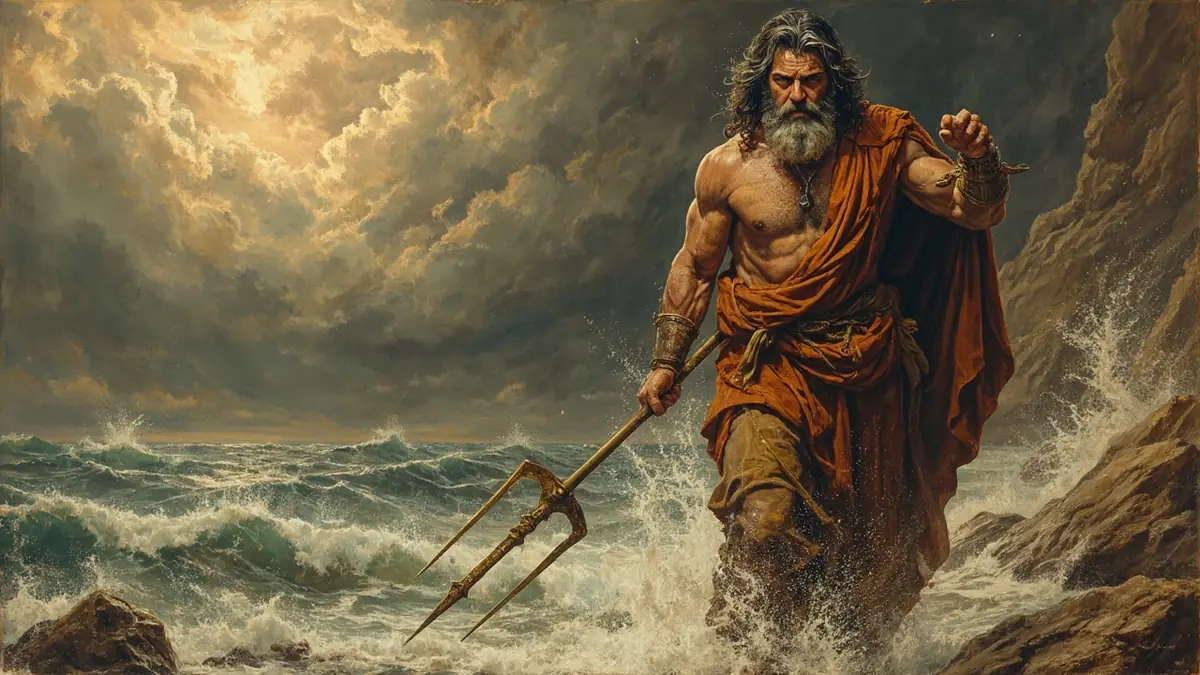
If you're reading this and assume I got the sea because I'm the god of the sea, sit down. That's not how it happened. None of us woke up one morning and decided to become the god of the sky, the sea, or the underworld. It was a lot draw. Yes, really. Like lottery balls — except there was no second chance, and no payout desk.
And here is how those balls fell.
The lot draw nobody remembers correctly
I say it plainly in the Iliad: we are three brothers, sons of Cronus and Rhea, and our powers were divided when the lots were shaken. The grey sea fell to me, the darkness below to Hades and the broad sky to Zeus. Earth and Olympus remained common to us all. People often forget that final clause when they present Zeus as the landlord of the entire universe.
Apollodorus also describes a division by lot after the Titans were overthrown. Neither source gives us symbolic objects to hold or records a divine ceremony. I will not sell you colourful details that no ancient text preserved. We know the outcome, not whether Zeus smiled before drawing his lot.
What each of us got
- Zeus got the sky. With all the trimmings: clouds, thunderbolts, eagles, and the general assumption that whenever someone says "God," they mean him. He settled in nicely.
- Hades got the Underworld. I won't say I envied him, but the Underworld is stable. No currents, no storms, no one telling you the waves aren't for swimming. Hades won the calm. If you enjoy calm with three million dead souls in the back office, that is.
- I got the sea. Along with everything that swims, sinks, trembles, or drowns in it. No resignation clause.
Now, every time some mortal stands on a beach and says "what a beautiful sea," I think: yes, beautiful. It's mine. It might drown you, but it's mine.
The bitter truth I don't tell at parties
If you think about it calmly, my job is the least thankless of the three. Wait — let me rephrase. It's the most thankless. Zeus sits on Olympus and throws thunderbolts. Pretty, dramatic, mortals fear him and worship him. Hades sits in his darkness and nobody bothers him — the dead don't complain much. Me? I hear the prayers of every sailor afraid of drowning and every fisherman about to lose his nets. Mortals invoked me as a protector of ships, but they also feared me as the Earth-Shaker.
Because the earth shakes, remember. That does not mean I own a portion of the land: in the Iliad, earth remains common. It means my power does not stop at the shoreline. If you are in a Cretan village and wonder which god ancient people feared when the ground moved, now you know.
When I told Zeus he was not my superior
The drawing of lots did not make Zeus our owner. In the same book of the Iliad, Iris delivers his order that I leave the battlefield. I am furious, and I remind her that we are brothers with equal shares. The sky fell to Zeus; it did not grant him the right to command me like a servant.
I eventually withdraw, not because I suddenly recognise him as my master, but because Iris warns me about the consequences of open conflict. That scene tells you more about our relationship than ten family trees. Zeus held greater political authority on Olympus. I never forgot what the lots had established: three brothers, three domains, and one earth held in common.
Athens, Athena, and me
Athens must be mentioned, and my rival there was Athena, not Zeus. I struck the rock of the Acropolis with my trident and, in the best-known Attic tradition, produced salt water. Athena offered the olive and won patronage of the city. Other traditions connect my gift with the horse, so I will not pretend there was only one ancient account.
Whenever I look at the Acropolis, I feel like a former candidate who lost the election but kept a strong opposition. The city took Athena's name, yet my cult did not disappear from Attica. Losing one contest in a myth does not erase a god from the religious life of a city.
What I keep from all of this
I won't say I regret it. The sea is boundless, contrary, and alive. No sky gives you what the sea gives you when you leave Chios harbor on an August night. No Underworld has the smell of salt in the Cyclades.
But if you ask whether I'd want us to redraw the lot — I'll be honest — yes. I'd love to see Zeus chase waves and Hades fight an Aegean gale at 8 Beaufort. I'd love to hear them shout "Poseidon, do something" while I sit on a dry rock and explain how "easy" the sea is.
Until then, I will keep raising and calming the waters. Myths make me quick-tempered, but sailors did not worship me because they wanted to drown. They asked for safe passage from a power that could mean rescue or destruction.
And don't tell me "the sea is calm today." I know. I made it that way.
Sources and traditions
- Homer, Iliad, Book 15, lines 187–193 — Poseidon explicitly describes the drawing of lots and says earth and Olympus remained common.
- Hesiod, Theogony — provides the genealogical background of each brother's authority after the Titanomachy.
- Apollodorus, Bibliotheca (1.2.1) — describes the distribution of power by lot after the Titans were overthrown.
- Pseudo-Apollodorus, Bibliotheca 3.14.1 — recounts the contest between Poseidon and Athena for Attica and the judgment in Athena's favour.
- Walter Burkert, Greek Religion (Harvard University Press, 1985) — modern scholarly treatment of the triadic structure of Greek divine rule.