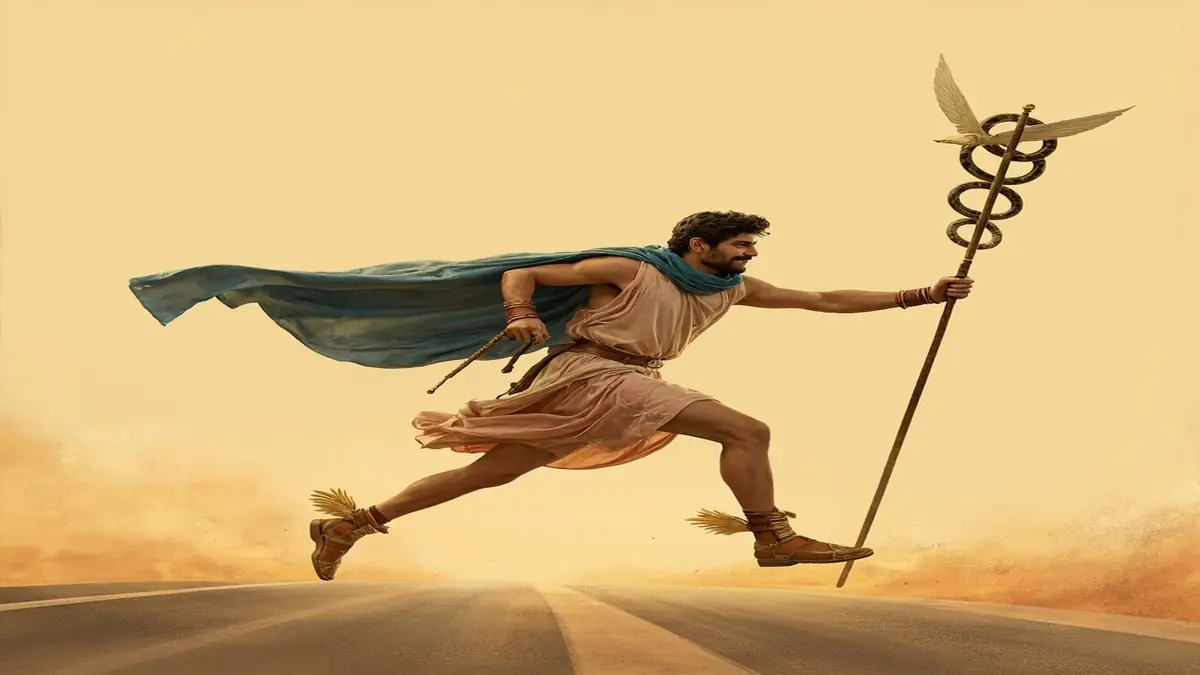
Let us clear up one thing immediately. I am not merely the young man in winged sandals who delivers Zeus's messages. If that were the entire job, I would have resigned before the first divine complaint form was filed. I am the god who moves across boundaries: Olympus and earth, city and wilderness, profit and deception, life and death. Yes, I also carry the occasional divine message, usually the one nobody else wants to deliver.
The official version calls me the messenger of the gods. The honest version is that I am Olympus's specialist in difficult errands. Whenever a job demands speed, negotiation, secrecy or a convincing excuse, someone remembers Hermes.
My first day was unusually productive
I was born in a cave on Mount Cyllene, the son of Zeus and Maia. My mother wanted a quiet child. According to the Homeric Hymn to Hermes, within the first day of my life I had already climbed out of my cradle, found a tortoise, invented the lyre and stolen Apollo's cattle.
That was not childhood mischief. It was a demonstration.
I drove the cattle in a way that confused their tracks, hid the herd and returned to the cave looking like a harmless infant. Apollo was not convinced. He dragged me before Zeus, where I defended myself with the solemn dignity normally reserved for people facing overwhelming evidence.
I did not win the case. I won something better: a deal. Apollo heard my lyre and wanted it; the lyre passed to him, the cattle were settled, and further gifts followed, including a golden staff. What began as theft became an alliance built on mutual recognition. It was not a neat exchange of divine "responsibilities" but a sequence of bargains that secured my place among the gods.
The story matters because it contains nearly everything people later associated with me. Cleverness can cross the line into deceit. Theft can turn into exchange. A quarrel can end in an agreement neither side expected. I do not smash obstacles when I can rearrange them.
The sandals are equipment, not a personality
Later artists often show me wearing winged sandals and a traveller's hat, carrying the caduceus. But the caduceus is not a magic wand that repairs every mythological disaster. It is primarily a symbol of heraldic office, negotiation, and protected passage.
My power is passage. I go where other gods hesitate. I never belong completely to one place. I stand at doors, roads, crossroads, exchanges and moments of change. The Greeks placed stone herms along routes and boundaries. They were not roadside decoration. They marked a passage and reminded travellers that every journey carries risk.
That is why different people called on me:
- travellers entering unfamiliar country,
- merchants bargaining over an uncertain price,
- heralds and diplomats crossing hostile ground,
- athletes relying on speed and skill,
- and thieves who valued intelligence more than force.
Do not look so shocked at the last group. Greek myth rarely divides the world into tidy teams of heroes and villains.
I guide the dead as well
The most serious part of my work receives no applause. As psychopomp, I guide souls toward the realm of Hades. I do not decide who dies, and I do not judge what happens to them after death. I make sure they reach the threshold they must cross.
That role explains me better than any pair of wings. Most gods rule a place or a force. I belong to transition itself. I am present when someone leaves the known and enters something else: a voyage, a bargain, a message that changes a household, the final journey of a soul.
There is little glory in that service, but there is trust. Some Olympians would not trust me alone with their livestock. They still trust me near the border of the underworld.
Contradictory? Of course. A boundary god who guides both merchants and ghosts was never going to fit neatly into one job description.
The assignments that never make the short biography
In the Iliad, I help the elderly Priam cross the Greek camp unseen. He is travelling to Achilles to beg for the body of his son Hector. There is no clever theft at the heart of that episode. It is protection. A father enters the camp of the men who killed his son, and I get him safely to the one warrior whose answer matters.
In the Odyssey, I give Odysseus moly, the herb that protects him from Circe's magic. Other traditions connect me with heroes such as Perseus, although the equipment and divine helpers vary between sources. That variation deserves respect. Greek mythology did not come with one authorized manual. Poets, cities and generations told overlapping versions, sometimes agreeing and sometimes refusing to cooperate.
Then there is Argus Panoptes, the many-eyed guard. That mission ended badly for Argus. Later tradition connected the deed with my title Argeiphontes, although the etymology of the already Homeric epithet is uncertain. I will not polish it into a charming adventure. Zeus's orders often carried a cost.
My reputation for charm makes people forget that a divine messenger can be sent into cruel stories. Moving between worlds means carrying more than good news.
How I see the Olympian family
Zeus has a remarkable talent for assigning urgent missions created by his own decisions. Apollo is brilliant, in both senses of the word, but occasionally needs someone to remind him that a bargain can solve what an arrow cannot. Athena plans ten moves ahead. I prefer to keep ten exits open. Ares enters through the main gate. I usually know who forgot to lock the window.
As for Hades, he is consistent. On Olympus, consistency is almost an exotic gift.
I do not claim to be nobler than the others. I am simply harder to place inside one box. Protector and trickster. Herald and inventor. Guide of travellers and guide of the dead. Friend to merchants, athletes and thieves. Those tensions are not errors in my mythology. They are its centre.
What the Romans changed, and what they kept
The Romans knew me as Mercury. They emphasized trade, profit and exchange, although many Greek stories and symbols travelled with me into Roman religion and art. Mercury is not a perfect copy of Hermes, just as no god remains unchanged when another culture adopts him.
That is another boundary worth noticing. My identity moved across languages and cities. The name changed. Some duties grew louder while others became quieter. The traveller survived the journey, but he did not arrive wearing exactly the same clothes.
My version of the truth
If you want to understand me, stop staring at the wings. Watch the moment of change instead. The first step beyond the doorway. The hand that gives and the hand that takes. The message before its seal is broken. The line on the ground just before someone crosses it.
That is where you will find me.
And if one of your cattle is missing after I leave, let us not rush to conclusions.
Sources and traditions
- Homeric Hymn 4, To Hermes — birth, lyre, cattle, and reconciliation with Apollo.
- Homer, Iliad 24.333–469, 677–694 — guiding and protecting Priam.
- Homer, Odyssey 10.275–307 and 24.1–14 — moly and the escort of souls.
- Hesiod, Theogony 938–939 — Hermes' birth to Zeus and Maia.
- Pseudo-Apollodorus, Library 2.1.3 and 2.4.2 — Argus Panoptes and assistance to Perseus.